

IRO alternatives for injured NSW workers: your guide
If the Independent Review Office hasn’t resolved your situation, you have real options. Legal Aid NSW provides free or low-cost legal advice for eligible claimants. Community Legal Centres (CLCs) offer free triage and advocacy, no means test required in many cases. LawAccess NSW is a free government phone and online service that can point you in the right direction fast. The Workers Compensation Commission (WCC) runs formal conciliation and arbitration for workers compensation disputes. Unions and union legal services can represent members in workplace injury matters at little or no cost. Service NSW connects injured workers to financial supports, rebates, and government assistance beyond the legal system. And private personal injury firms such as Carelawyers handle the full conduct of complex claims, typically on a no-win-no-fee basis.
Here is what each one actually delivers:
- Legal Aid NSW — free legal advice and, for eligible applicants, funded representation; means-tested for most services
- Community Legal Centres — free initial advice and advocacy; no means test for many services; useful for early triage
- LawAccess NSW — free government phone/online referral service; no means test; best for finding out where to go next
- Workers Compensation Commission — formal dispute resolution (conciliation and arbitration) for workers compensation claims; no cost to lodge
- Unions/union legal services — low or no cost for members; covers workplace injury disputes and insurer negotiations
- Service NSW — non-legal financial and government support; free; no means test for most tools
- Carelawyers — full legal representation for workers compensation, motor accidents, and related claims; no-win-no-fee or fixed fee; paid on settlement
The IRO funds independent legal advice for workers compensation through its ILARS scheme, but that funding does not extend to most motor vehicle accident legal claims. If your claim falls outside that scope, or if you need faster action than the IRO process allows, the alternatives above are where to turn.
Table of Contents
- Which IRO alternative is right for your situation?
- How do you pick the right alternative for your claim?
- When should you use the IRO, and when is an alternative better?
- What does hiring a specialist personal injury lawyer actually look like?
- Key takeaways
- Why comparing your options before you commit actually matters
- Carelawyers: direct help for injured NSW workers
- Useful contacts and official resources
Which IRO alternative is right for your situation?
| Service | What they help with | Eligibility | Cost to you | How to access | Best for | Typical timeline |
|---|---|---|---|---|---|---|
| Legal Aid NSW | Legal advice, funded representation | Means-tested; workers comp and some motor accident matters | Free (if eligible) | Phone 1300 888 529 or online | Low-income claimants needing representation | Weeks to months depending on matter |
| Community Legal Centres | Free advice, advocacy, referrals | Open to most; some CLCs specialise in workers comp | Free | Search lawhelp.org.au or call local CLC | Early triage, advocacy, referrals | Days to weeks |
| LawAccess NSW | Legal information and referrals | Open to all NSW residents | Free | Phone 1300 888 529 or lawaccess.nsw.gov.au | Finding the right service fast | Same day to a few days |
| Workers Compensation Commission | Conciliation and arbitration for workers comp disputes | Workers comp claimants in NSW | Free to lodge | wcc.nsw.gov.au or phone phone (contact details available on site) | Urgent or unresolved insurer disputes | Conciliation often within weeks |
| Unions/union legal services | Workplace injury disputes, insurer negotiations | Union members | Low or no cost | Contact your union directly | Workplace disputes, employer/insurer conduct | Varies by union |
| Service NSW | Financial supports, rebates, government assistance | Open to all NSW residents | Free | service.nsw.gov.au or phone (contact details available on site) | Broader financial help alongside legal action | Immediate to a few days |
| IRO | Insurer complaints; ILARS legal funding for workers comp | Workers comp claimants (ILARS); motor vehicle limited | Free | 139 476 or complaints@iro.nsw.gov.au | Insurer conduct complaints; workers comp legal funding | Weeks |
| Carelawyers | Full legal representation: workers comp, motor accidents, TPD, public liability | Injured NSW workers and claimants | No-win-no-fee or fixed fee (paid on settlement) | carelawyers.com.au or direct call | Complex or denied claims needing a lawyer | Varies by claim complexity |
Key limits to know:
- IRO’s ILARS funding covers workers compensation legal advice but motor vehicle legal funding is limited — if you were injured in a car accident, you will likely need Legal Aid, a CLC, or a private lawyer instead.
- Legal Aid NSW is means-tested. If your income or assets are above the threshold, you will not qualify for funded representation, though you can still get initial advice.
- WCC handles workers compensation disputes only. Motor accident disputes go through a separate pathway under SIRA and the Motor Accident Injuries Act.
- Union legal services are for members. If you are not a member, joining now may still give you access to some services, but check with your union first.
Pro Tip: LawAccess NSW (1300 888 529) is the fastest first call if you are unsure where to go. They triage your situation and direct you to the right service, whether that is Legal Aid, a CLC, the WCC, or a private lawyer. It costs nothing and takes minutes.

How do you pick the right alternative for your claim?
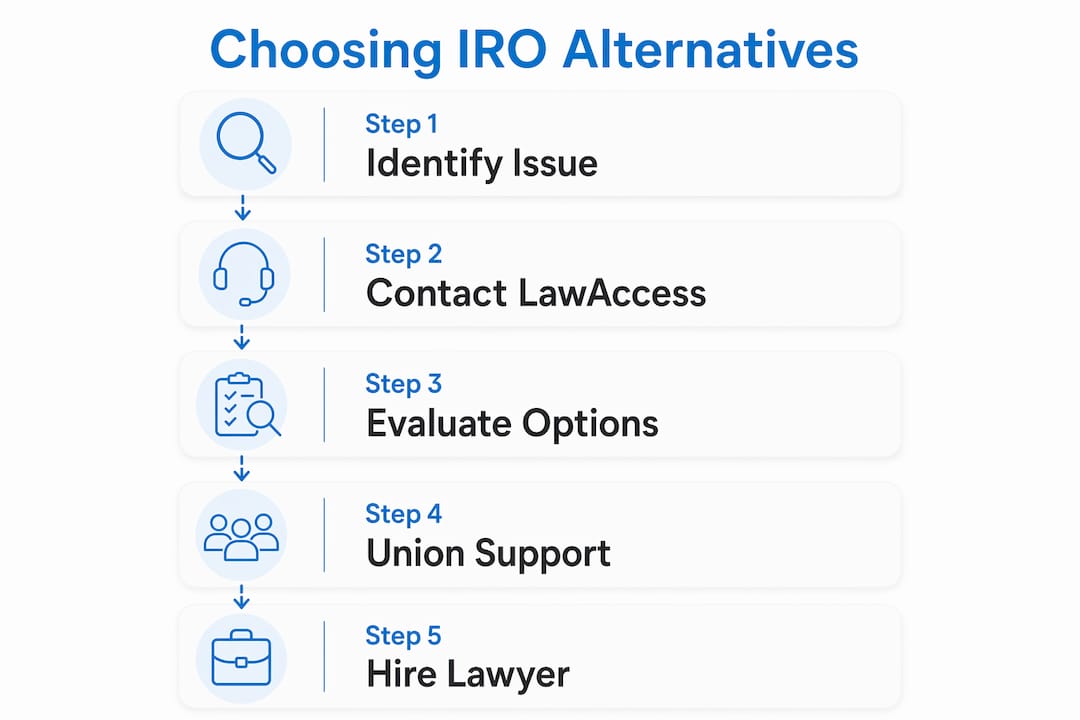
The right choice depends on four things: your claim type, how serious the injury is, what the insurer has done, and whether you can afford a private lawyer.
Work through this checklist:
- Claim type first. Workers compensation and motor accident claims run through different systems. Workers comp disputes go to the WCC; motor accident disputes go through SIRA and the CTP scheme. Getting this right from the start saves weeks.
- How serious is the injury? If you have been off work for more than a few weeks, have permanent impairment, or face a dispute about your whole person impairment rating, you need more than a phone referral. A specialist lawyer or funded representation is worth pursuing.
- What has the insurer done? If the insurer has denied liability, delayed payments, or refused to fund treatment, that is an active dispute. The WCC or a private lawyer can move faster than waiting for an IRO complaint to resolve.
- Cost sensitivity. If money is tight, start with LawAccess NSW, Legal Aid, or a CLC. All are free. If you are ineligible for Legal Aid and your claim is complex, a no-win-no-fee private lawyer costs nothing upfront.
- Time pressure. Limitation periods apply to personal injury claims in NSW. If you are close to a deadline, instruct a lawyer immediately rather than working through the free triage chain.
Questions to ask when you contact any service:
- Am I eligible for your help with this type of claim?
- What is the likely timeline from first contact to resolution?
- Are there any costs I need to know about, including disbursements?
- What is the scope of help you can provide — advice only, or full representation?
- What happens if my matter is too complex for your service?
Red flags to watch for: any service that cannot clearly explain its eligibility rules, promises a guaranteed outcome, or presents a fee agreement without explaining disbursements and after-the-event costs. A written conditional costs agreement is standard practice in NSW for no-win-no-fee arrangements — if you are not offered one, ask for it.
Pro Tip: If you are a union member, call your union before you do anything else. Union legal services can often get you into the right hands faster than going through the public triage chain, and the cost to you is minimal.
For a practical guide on choosing a workers comp lawyer, Carelawyers has published a detailed checklist worth reading before your first call.
When should you use the IRO, and when is an alternative better?
The IRO has two core functions: handling complaints about insurer conduct, and funding independent legal advice for workers compensation claimants through the ILARS scheme. It is a government body with statutory powers, and for the right situation it is genuinely useful. The problem is that its scope is narrower than many injured workers expect.
Use the IRO when:
- You have a workers compensation claim and want free independent legal advice funded through ILARS.
- Your insurer has acted improperly and you want to lodge a formal complaint.
- You need help understanding your rights before deciding whether to escalate.
Choose an alternative when:
- Your claim is a motor vehicle accident and you need legal representation, not just a complaint lodged. IRO’s legal funding does not cover most motor accident legal work. A motor accident lawyer or Legal Aid is the right route.
- The insurer has denied your claim or stopped payments and you need urgent conciliation. WCC conciliation can move faster than an IRO complaint process.
- Your income is low and you need funded representation, not just advice. Legal Aid NSW and CLCs are built for this.
- Your claim is complex — permanent impairment, work injury damages, TPD, or public liability — and you need a lawyer to run the whole matter. That is private representation territory.
A simple decision flow: insurer refusing entitlements → lodge an IRO complaint AND consider WCC conciliation or a private lawyer simultaneously. No funds for a lawyer and low income → Legal Aid NSW or a CLC first. Motor accident claim needing legal help → private lawyer or Legal Aid, not IRO. Workplace dispute with union membership → call your union.
What does hiring a specialist personal injury lawyer actually look like?
Most injured workers have never hired a lawyer before. The process is more straightforward than it sounds, and understanding the steps removes a lot of the uncertainty.
Typical steps from enquiry to resolution:
- Initial enquiry. You call or submit an online form. The lawyer reviews your situation, confirms the claim type, and advises whether you have a viable matter. No cost at this stage.
- Evidence review. The lawyer pulls together your medical records, employer correspondence, insurer letters, and any certificates of capacity. This is where the workplace injury evidence picture gets built.
- Letter of claim to the insurer. A formal letter setting out your entitlements and the basis for the claim. This often prompts the insurer to engage seriously for the first time.
- Negotiation. Most matters settle at this stage without going to a tribunal. The lawyer negotiates on your behalf.
- WCC conciliation or arbitration (if needed). If the insurer does not make a reasonable offer, the matter goes to the WCC. Conciliation is informal; arbitration is binding.
- Settlement or court. The vast majority of workers compensation and motor accident claims settle before a hearing. Court is rare.
Fee models in NSW practice:
- No-win-no-fee (contingency). You pay nothing upfront. If the claim succeeds, the legal fee is deducted from the settlement. NSW law requires a written conditional costs agreement that explains disbursements and how after-the-event costs are handled. Always read this before signing.
- Fixed fee. A set amount for a defined scope of work. Common for discrete tasks like reviewing an insurer’s decision or drafting a letter.
- Disbursements. Out-of-pocket costs (medical reports, expert fees, filing fees) are separate from the legal fee and are usually payable regardless of outcome. Ask about these upfront.
What to bring to your first meeting:
- All correspondence from your insurer and employer
- Medical reports, certificates of capacity, and treatment records
- Evidence of time off work and lost income
- Any photos, incident reports, or witness details
For a full picture of what you may be entitled to recover, the Carelawyers guide on work injury damages is a practical starting point.
Key takeaways
The most effective first step for an injured NSW worker is to match the service to the claim type — free options exist for almost every situation, and a private lawyer is the right call when the claim is complex or urgent.
| Point | Details |
|---|---|
| Free help is available for most claimants | LawAccess NSW, Legal Aid NSW, and CLCs are free; Legal Aid is means-tested for funded representation. |
| IRO scope is narrower than many expect | IRO funds ILARS for workers comp legal advice but does not cover most motor accident legal claims. |
| WCC is the fastest formal route for workers comp disputes | Conciliation at the WCC can move faster than an IRO complaint when an insurer has denied or delayed. |
| No-win-no-fee means no upfront cost | Private lawyers in NSW typically require a written conditional costs agreement disclosing all disbursements. |
| Carelawyers handles complex and denied claims | Carelawyers operates on no-win-no-fee or fixed-fee arrangements for workers comp, motor accidents, and related NSW claims. |
Why comparing your options before you commit actually matters
Most injured workers contact the first service they find and assume that is the right one. That is understandable — you are dealing with pain, lost income, and an insurer that may not be cooperating. But the IRO, the WCC, Legal Aid, and a private lawyer are not interchangeable. They solve different problems at different speeds.
The part that gets overlooked: free services are not always slower or less effective than paid ones. A CLC advocate who knows the WCC system can move a conciliation faster than a private lawyer who handles workers comp as a sideline. Conversely, a complex work injury damages claim — one involving permanent impairment, disputed liability, and a fight over weekly payments — genuinely needs a specialist lawyer running the full matter. Free triage services are not built for that.
The other thing worth saying plainly: the IRO is a complaints body, not a legal representative. It can fund advice and investigate insurer conduct, but it does not run your claim for you. If your insurer is actively denying entitlements and you need someone in your corner, a lawyer is the answer, not a complaint form.
Carelawyers: direct help for injured NSW workers
If you have read through the options and you want a lawyer who will actually run your claim, Carelawyers is a Sydney-based personal injury firm that handles workers compensation, motor accident, TPD, public liability, and related claims across NSW. The difference from a large firm is direct access to your lawyer throughout, no referrals to junior staff, and a no-win-no-fee arrangement that means you pay nothing unless your claim succeeds.

Carelawyers is reported to have a very high success rate for claims won. The first call is free, and the firm will tell you plainly whether your matter is one they can help with. For workers compensation and workplace injury matters, the workplace injury claim process guide sets out exactly what to expect at each stage. To speak with a lawyer now, visit carelawyers.com.au or call directly to book a free initial consultation.
This article is general information only, not legal advice. Confirm your specific entitlements and deadlines with a qualified legal professional or the relevant government body for your situation.
Useful contacts and official resources
| Service | Phone | Online access | Best for |
|---|---|---|---|
| IRO | 139 476 | iro.nsw.gov.au | Insurer complaints; ILARS workers comp legal funding |
| LawAccess NSW | 1300 888 529 | lawaccess.nsw.gov.au | Free legal information and referrals |
| Legal Aid NSW | 1300 888 529 | legalaid.nsw.gov.au | Free/funded representation (means-tested) |
| Community Legal Centres | Varies by centre | lawhelp.org.au | Free advice and advocacy |
| Workers Compensation Commission | phone (contact details available on site) | wcc.nsw.gov.au | Conciliation and arbitration for workers comp |
| SIRA | phone (contact details available on site) | sira.nsw.gov.au | Motor accident and workers comp regulation |
| Service NSW | phone (contact details available on site) | service.nsw.gov.au | Financial supports, rebates, government assistance |
| Carelawyers | See website | carelawyers.com.au | Private legal representation across NSW |
Quick reference for common situations:
- Low income, need free help → LawAccess NSW first, then Legal Aid or a CLC
- Insurer has denied or delayed your workers comp claim → WCC conciliation or Carelawyers
- Want to complain about insurer conduct → IRO (phone 139 476)
- Motor accident claim needing legal representation → Carelawyers or Legal Aid NSW
- Need financial support beyond legal help → Service NSW Cost of Living hub and payments and assistance
- Union member with a workplace dispute → contact your union directly before anything else


