

Workplace rights after serious injury: your 2026 guide
Workplace rights after serious injury guarantee you medical treatment, partial wage replacement, job protection, and legal recourse from your very first day of employment. These protections exist under workers’ compensation legislation, the Americans with Disabilities Act (ADA), and the Family and Medical Leave Act (FMLA), three overlapping frameworks that together cover most serious injury scenarios. Knowing which law applies to your situation, and acting within its deadlines, is the difference between a fully supported recovery and losing entitlements you cannot recover. This guide walks you through every critical step, from the moment of injury to your return to work.
1. What are your workplace rights after serious injury?
Workers’ compensation is a no-fault system providing medical care and partial wage replacement, typically around 66% of your pre-injury salary. Coverage begins from your first day of employment, with narrow exceptions for injuries caused by intoxication or intentional self-harm. This means you do not need to prove your employer was negligent to receive benefits. The system exists specifically to remove that burden from injured workers.
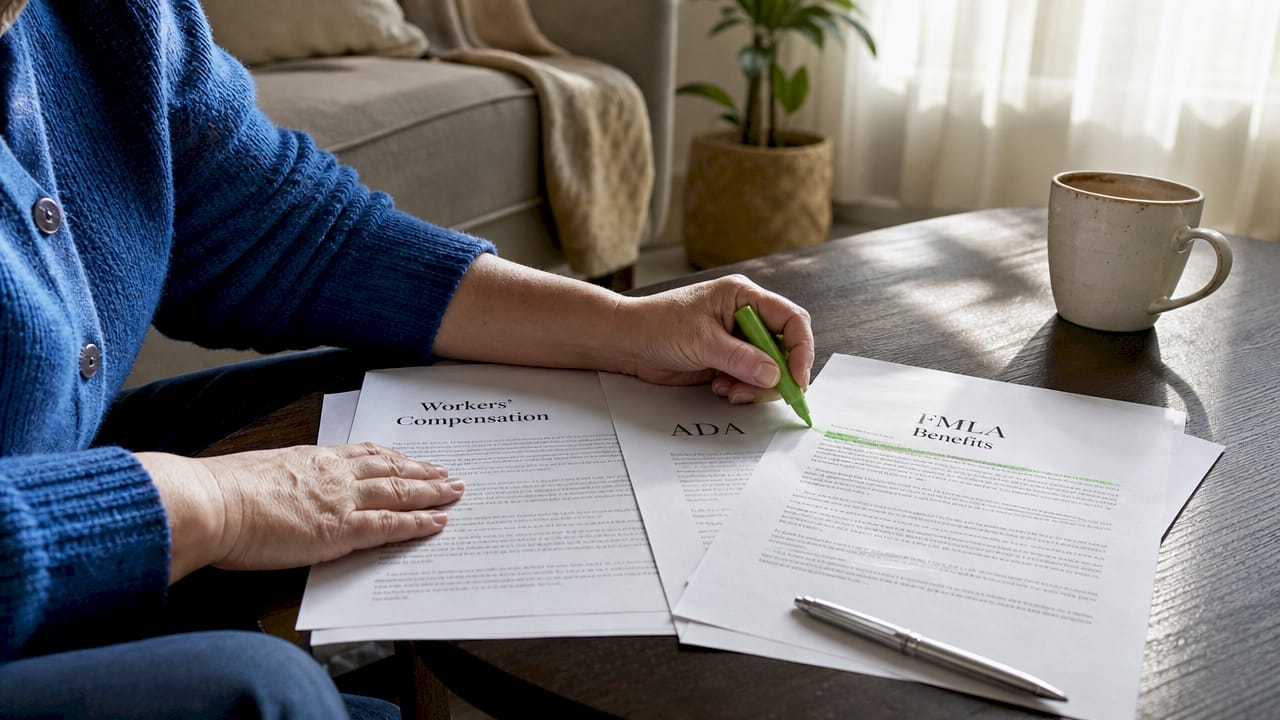
Beyond workers’ compensation, the ADA and FMLA provide separate but complementary protections. Understanding the distinctions between these three laws helps you make informed decisions about your claims and employment status. Each law has its own eligibility rules, timelines, and remedies. Treating them as one combined system is a common mistake that costs workers real money and job security.
2. Immediate steps to take after a workplace injury
Acting quickly after a serious workplace injury is not optional. The steps you take in the first 24 to 72 hours directly determine whether your claim succeeds or gets denied.
- Seek medical attention immediately. Tell the treating doctor or hospital that your injury is work-related. This creates a medical record linking your condition to the workplace, which is the foundation of your claim.
- Report the injury to your employer in writing. Missed reporting deadlines are a leading cause of claim denials. Most jurisdictions require notification within 30 days, and some require it within days. A written report protects you if your employer later disputes the timeline.
- Document everything. Write down exactly what happened, where it occurred, what equipment was involved, and who witnessed it. Photograph the scene if you can. This evidence becomes critical if your claim is disputed.
- File a formal workers’ compensation claim. Reporting to your employer is not the same as filing a claim. Formal filing deadlines range from one to three years depending on your state or territory, but waiting reduces your credibility and complicates the process.
- Keep copies of all paperwork. Every medical certificate, employer correspondence, and claim form should be stored somewhere safe and separate from your workplace records.
Pro Tip: Ask your treating doctor to specify in writing that the injury is work-related and to document your physical restrictions in detail. Vague medical certificates create gaps that insurers exploit during assessments.
3. Your core legal protections under workers’ compensation, ADA, and FMLA
These three legal frameworks operate in parallel, and each provides a distinct layer of protection for injured workers.
Workers’ compensation covers your medical treatment and replaces a portion of your lost wages. It is the primary financial safety net after a serious injury and applies regardless of fault.
The ADA requires employers with 15 or more employees to engage in an interactive process to provide reasonable accommodations for lasting impairments. Accommodations can include modified duties, ergonomic equipment, and adjusted schedules, provided they do not impose undue hardship on the employer. The key word is “reasonable.” Not every request must be granted, but every request must be genuinely considered.
FMLA grants up to 12 weeks of unpaid, job-protected leave for serious health conditions. When you return, you are entitled to the same position or an equivalent one. Your employer may require a fitness-for-duty certificate before you resume work, so have your doctor prepare this in advance.
The most important thing to understand is that these laws protect you from retaliation. Employers are prohibited from retaliating against workers for reporting injuries or filing workers’ compensation claims. If your hours are cut, your role is changed, or you face disciplinary action after reporting an injury, that is potential retaliation and it is illegal.
4. How to navigate the return-to-work process
Returning to work after a serious injury is rarely straightforward. Your medical restrictions, your employer’s obligations, and your legal rights all intersect in ways that require careful management.
Provide your employer with specific written restrictions from your treating doctor. Generic certificates saying “unfit for work” are less useful than documents that specify what you can and cannot do physically. Specificity gives your employer the information needed to identify suitable duties and protects you if a dispute arises later.
The ADA’s interactive process is an ongoing dialogue, not a one-time conversation. Failure to participate in this process can result in losing your right to accommodations. You do not need to use legal terminology to trigger your employer’s obligations. Providing enough information about your condition and its impact on your work is sufficient.
Be cautious about refusing light-duty work. Refusing suitable light-duty work within your documented medical restrictions can lead to suspension of your temporary disability benefits. If you believe the offered duties exceed your restrictions, verify this with your treating doctor in writing before declining.
Pro Tip: Always confirm light-duty offers in writing and have your doctor review the specific tasks before you accept or decline. A verbal description of duties from your employer is not sufficient documentation.
Your employer is also legally required to keep your medical records confidential and separate from your general personnel file. Access is limited to supervisors who need the information to arrange accommodations and relevant safety personnel. This privacy protection exists to prevent discrimination during your recovery.
5. Protecting yourself from retaliation and claim denials
Retaliation and claim denials are the two most common ways injured workers lose entitlements they are legally owed.
Retaliation takes many forms. Demotion, reduced hours, hostile treatment, or sudden performance management after you report an injury are all potential indicators. Retaliation protections are strongest when you keep detailed records and communicate within required deadlines. Document every conversation with your employer about your injury, your claim, or your return to work. Use email where possible so there is a written record.
Claim denials often result from procedural errors rather than the merits of the injury itself. The most common causes include:
- Missing the reporting deadline to your employer
- Failing to file the formal claim within the statutory period
- Insufficient medical documentation linking the injury to the workplace
- Gaps in treatment that insurers interpret as evidence the injury was not serious
- Accepting a settlement without understanding its scope
Workers’ compensation settlements do not waive your employer’s obligations to provide reasonable accommodations under the ADA if you return with ongoing impairments. Legal obligations under these frameworks run in parallel. Settling your compensation claim does not end your right to workplace adjustments.
If your claim is denied, you have the right to appeal. Seek legal advice before accepting any denial as final. Many denied claims are successfully overturned on appeal, particularly when proper documentation is provided.
6. Comparing your benefits and legal remedies
Understanding what each avenue of protection actually provides helps you identify gaps and pursue the right combination of remedies.
| Benefit type | What it covers | Key limitation |
|---|---|---|
| Workers’ compensation | Medical treatment, hospitalisation, and partial wage replacement at around 66% of pre-injury salary | Typically the exclusive remedy against your employer; cannot sue for pain and suffering |
| ADA accommodations | Modified duties, equipment, or schedules to support return to work | Applies only to employers with 15 or more employees; accommodations must be reasonable |
| FMLA leave | Up to 12 weeks of unpaid, job-protected leave with right to return | Unpaid; applies to employers with 50 or more employees within 75 miles |
| Vocational rehabilitation | Retraining and job placement support for workers unable to return to previous roles | Eligibility varies by jurisdiction and severity of impairment |
| Third-party lawsuits | Full damages including pain and suffering from negligent third parties | Only available when a party other than your employer caused or contributed to the injury |
Workers’ compensation is typically the exclusive remedy against your employer, but if a third party such as an equipment manufacturer or a contractor contributed to your injury, you may be able to pursue a separate negligence claim. Third-party lawsuits can recover damages for pain and suffering that workers’ compensation does not cover. This is a significant distinction that many injured workers are unaware of until it is too late to act.
Vocational rehabilitation is available in most Australian states for workers whose injuries prevent them from returning to their previous role. These programmes cover retraining, job placement assistance, and in some cases, workplace modifications. Eligibility is assessed by the relevant workers’ compensation authority and depends on the nature and permanence of your impairment.
Key takeaways
Workplace rights after serious injury are legally enforceable from day one, and protecting them requires prompt reporting, thorough documentation, and active engagement with your employer and insurer.
| Point | Details |
|---|---|
| Report immediately | Notify your employer in writing within the required deadline to preserve your right to benefits. |
| Three laws protect you | Workers’ compensation, the ADA, and FMLA each provide distinct and overlapping protections. |
| Document everything | Detailed records of your injury, treatment, and employer interactions are your strongest defence against retaliation and denials. |
| Settlements have limits | Accepting a workers’ compensation settlement does not end your right to ADA accommodations if impairments remain. |
| Third-party claims exist | If a contractor or manufacturer contributed to your injury, you may be able to pursue damages beyond workers’ compensation. |
What I have learned from watching injured workers navigate this process
After years of working closely with injured workers in Sydney and across NSW, the pattern I see most often is not malice from employers. It is confusion on both sides, and that confusion almost always costs the worker more than the employer.
The workers who protect their rights most effectively are not the ones who know the most law. They are the ones who write things down, respond to correspondence promptly, and ask their doctor specific questions rather than general ones. A medical certificate that says “restricted to light duties” is almost useless. One that says “no lifting above 5 kilograms, no standing for more than 20 minutes, no operation of vibrating equipment” gives your employer something concrete to work with and gives you something concrete to enforce.
The interactive accommodation process under the ADA is where I see the most unintentional self-sabotage. Most workers lose accommodation rights not because their employer acted in bad faith, but because they stopped engaging. They assumed silence from their employer meant the request was being handled. It rarely is. Follow up in writing. Set deadlines. Keep the dialogue moving.
One more thing that rarely gets said clearly: settling your workers’ compensation claim does not mean you are done. If you still have physical limitations when you return to work, your employer’s ADA obligations continue. Too many workers sign a settlement and assume all their rights have been resolved. They have not. Know what you are signing before you sign it.
— Daniel
How Carelawyers can protect your rights and maximise your claim

Carelawyers is a Sydney-based personal injury firm with over a decade of experience helping injured workers cut through the complexity of workers’ compensation claims and employment protections. Their no win, no fee approach means you face no financial risk when pursuing the entitlements you are owed. Unlike larger firms where your file moves between case managers, Carelawyers connects you directly with your lawyer from the first call to the final resolution. With a success rate above 99% of claims won, their team handles everything from initial claim lodgement to disputed appeals and third-party negligence actions. If you are unsure where you stand after a serious workplace injury, speaking with a personal injury lawyer at Carelawyers is the clearest next step you can take.
FAQ
What is the deadline for reporting a workplace injury?
Most jurisdictions require you to notify your employer within 30 days of the injury, and some require notification within days. Missing this deadline is one of the most common reasons workers’ compensation claims are denied.
Can my employer sack me for filing a workers’ compensation claim?
No. Terminating or otherwise penalising an employee for reporting an injury or filing a claim is illegal retaliation. Document all interactions with your employer after filing and seek legal advice immediately if you believe you are being targeted.
Does settling my workers’ comp claim end all my workplace rights?
No. A workers’ compensation settlement does not remove your employer’s obligation to provide reasonable accommodations under the ADA if you return to work with ongoing physical limitations.
What is vocational rehabilitation and who qualifies?
Vocational rehabilitation covers retraining, job placement support, and workplace modifications for workers who cannot return to their previous role due to injury. Eligibility is assessed by your state or territory workers’ compensation authority based on the nature and permanence of your impairment.
When can I sue someone other than my employer after a workplace injury?
If a third party such as a contractor, equipment manufacturer, or another driver contributed to your injury, you may be able to pursue a negligence claim for damages including pain and suffering. Workers’ compensation alone does not cover these losses.


