

Workplace injury timeline: what to expect in 2026
What does the full workplace injury timeline look like in Australia?
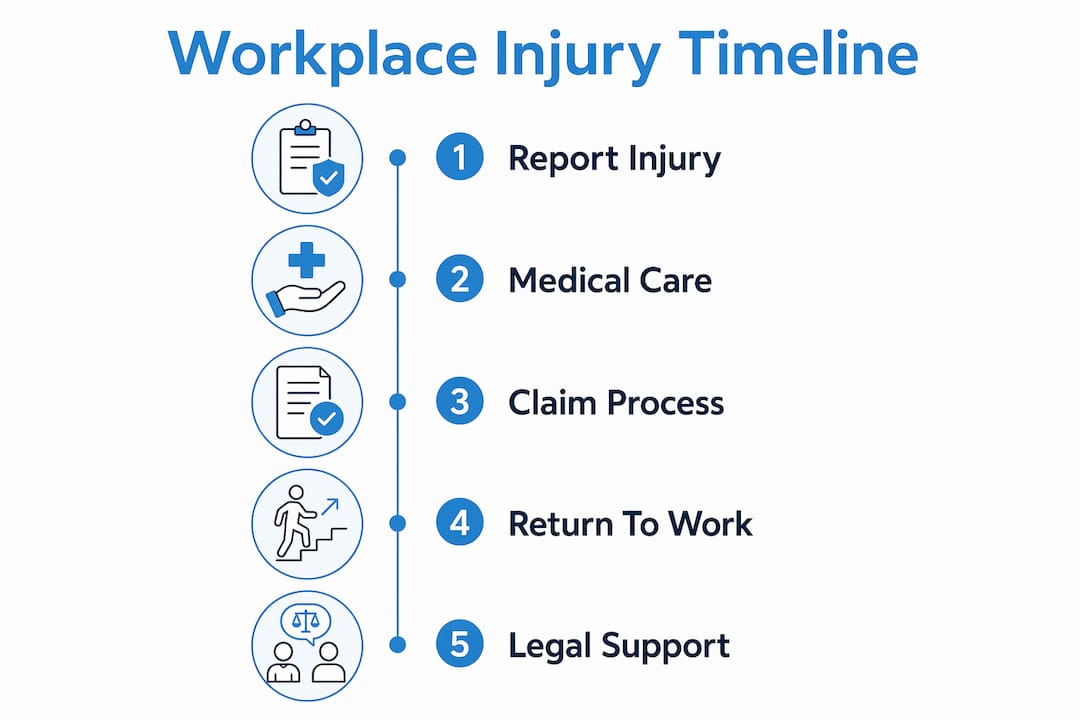
After a workplace injury, most workers face the same sequence: immediate medical care, written injury report, formal compensation claim, phased recovery, and a structured return to work. The entire process can span anywhere from a few weeks for minor injuries to two or more years for serious ones. Knowing the milestones upfront makes the waiting periods far less stressful.
Here is the core timeline at a glance:
- Day 1: Seek first aid or emergency treatment. Tell your employer verbally as soon as possible.
- Within 30 days: Submit written notification to your employer. Failing to report within 30 days may jeopardise your eligibility for workers’ compensation entirely.
- Within days of your report: Your employer forwards the claim to their insurer. Medical certificates begin documenting your work capacity.
- Within 10–60 days: The insurer investigates and decides to accept or deny the claim. Provisional payments may begin while the investigation runs.
- Weeks to months: Active treatment phase, including physiotherapy, specialist reviews, and ongoing medical certification.
- Several months to years: Tissue remodelling and full functional recovery for serious soft tissue or musculoskeletal injuries.
- At maximum medical improvement: Claim settlement or permanent impairment assessment, if applicable.
- Throughout: Return to work planning, starting with light or modified duties when your doctor approves.
Regulatory bodies WorkSafe (operating across Queensland, Victoria, and other states) and SIRA (the State Insurance Regulatory Authority in New South Wales) both emphasise that early reporting and consistent medical engagement are the two factors most within your control. Mental health injuries follow the same reporting pathway and attract provisional payments in most Australian jurisdictions while the claim is assessed.
## 1. How to report a workplace injury and start your compensation claim
Reporting promptly is the single most consequential step in the entire workers’ compensation process. A verbal report to your supervisor on the day of injury is the starting point, but it is not enough on its own.
What you need to do:
- Notify your employer verbally on the day of injury or as soon as your condition allows.
- Follow up in writing, by email or a signed incident report form, to establish a clear record of the date your employer became aware. A dated written paper trail protects against disputes about when the clock started on your claim.
- Ask your employer for the relevant claim form. In NSW, SIRA-regulated claims use specific insurer forms; in Queensland, WorkSafe QLD has its own documentation pathway.
- Complete your section of the form accurately and return it promptly.
- Keep a personal copy of every document you submit or receive.
- Attend a doctor and tell them the injury is work-related. Your treating doctor will certify whether the injury is work-related and document your capacity for work.
Your employer is legally required to forward your claim to their insurer, typically within a few days of receiving your notification. Delays on their end can slow the entire process, which is why your own written record of the notification date matters so much. For a detailed breakdown of what the claim process involves, the steps are well worth reviewing before you file.
Pro Tip: Send your written injury notification by email and keep the sent copy. An email creates an automatic timestamp that is far harder to dispute than a handwritten note with no date.
## 2. What medical care and recovery phases should you expect?
Biological healing does not follow a straight line, and understanding the phases helps you set realistic expectations rather than measuring yourself against a calendar.
The three healing phases:
- Inflammatory phase (days 1–7): Swelling, pain, and reduced movement are normal. This is your body’s first response, not a sign that something has gone wrong.
- Proliferative phase (weeks 1–6): New tissue forms. Physiotherapy typically begins here, with gentle progressive loading.
- Remodelling phase (weeks 6 through up to 2 years): Tissue remodelling requires progressive loading through rehabilitation. Pain reduction early in this phase does not mean full structural recovery.
Your treating doctor plays a central role beyond just prescribing medication. They certify your work capacity, refer you to specialists or physiotherapists, and issue the medical certificates your insurer requires to continue wage replacement payments. Missing appointments can suspend those payments, so attendance is not optional.
One of the most common mistakes injured workers make is equating the absence of pain with being fully healed. Returning to full duties before medical clearance increases the risk of re-injury and can turn a recoverable condition into a chronic one. Financial pressure is the most common driver of premature return, and it is worth discussing openly with your doctor rather than acting on it unilaterally.

Pro Tip: Ask your doctor to document specific functional milestones, not just pain levels, at each appointment. “Can lift 5kg without pain” is far more useful to your insurer and employer than “improving.”
## 3. How does the workers’ compensation claim process work, and how long does it take?
Once your claim is lodged, the insurer takes over the investigation. The timeline from here depends on the complexity of your injury and how complete your documentation is.
Key stages and timeframes:
- Employer notifies insurer: Usually required within a few days of receiving your report. Delays here can push back your first payment.
- Provisional payments: In NSW under SIRA, provisional liability allows weekly payments and medical expenses to begin within 7 days of the claim being made, before a final decision is reached, for most claims.
- Claim decision: Insurers generally aim to accept or deny a claim within a few weeks for straightforward cases. More complex claims, particularly those involving disputed causation or pre-existing conditions, can take longer up to about two months.
- Accepted claim: Medical expenses and wage replacement payments continue. A return to work plan is developed with your employer and insurer.
- Denied claim: You receive a written denial with reasons. You typically have 60 days to lodge an appeal, though this varies by state. Seeking legal advice immediately after a denial protects your appeal window.
Types of compensation available:
- Weekly wage replacement payments (usually a percentage of your pre-injury earnings)
- Medical and rehabilitation expenses
- Permanent impairment lump sum, if applicable
- Work injury damages for serious injuries in some jurisdictions
One point that catches many workers off guard: settling a claim too early can leave you without coverage for future medical needs that arise from the same injury. Experts consistently recommend waiting until you have reached maximum medical improvement before agreeing to any final settlement. For a clear picture of what you may be entitled to, the work injury damages guide for NSW covers the key categories in plain terms.
## 4. What should you expect when planning your return to work?
Returning to work after a workplace injury is rarely a single event. It is a staged process, and the pace is set by your medical team, not your employer or insurer.
What the return to work process typically involves:
- Your treating doctor issues an Activity Prescription specifying what tasks you can and cannot safely perform.
- Your employer is required to explore suitable duties within those restrictions before concluding that no work is available.
- Light or modified duties are offered where possible. Early return to work in a modified role helps prevent the ‘disability trap’, supports recovery, and maintains your connection to the workplace.
- A formal return to work plan is documented and agreed upon by you, your employer, and your treating doctor.
- Your capacity is reviewed regularly, with duties progressively increasing as your recovery advances.
Workers sometimes feel pressure from employers or insurers to return faster than their medical team recommends. You have the right to follow your doctor’s restrictions, and doing so is not obstruction. If you find after returning that you genuinely cannot perform the offered duties because of your injury, contact your doctor immediately and document the situation in writing to understand your rights better, especially if you suspect workplace retaliation as explained by Optimum Employment Lawyers.
Mental health is part of the picture too. Anxiety, depression, and adjustment difficulties are common after a workplace injury, particularly for serious or prolonged cases. Most Australian workers’ compensation schemes cover psychological injuries, and provisional payments are available while a mental health claim is assessed. Asking for a referral to a psychologist through your treating doctor is a legitimate and often underused step.

Pro Tip: Before your first day back, get your Activity Prescription in writing and share a copy with your direct supervisor. Verbal agreements about modified duties have a way of being forgotten when workloads get busy.
## 5. How Carelawyers supports you through every stage of your claim
Navigating the workers’ compensation process alone is possible, but the points where claims go wrong are almost always the same: late reporting, inadequate documentation, premature settlement, or missing an appeal deadline after a denial.
Carelawyers works with injured workers across NSW and beyond, providing direct access to experienced compensation lawyers without the layers of case managers and call centres that characterise larger firms. Every client speaks to their lawyer directly. That matters most at the moments when a decision has to be made quickly, such as when an insurer offers an early settlement or when a denial letter arrives with a 60-day appeal window.
The team at Carelawyers assists with:
- Reviewing your claim documentation to identify gaps before submission
- Advising on provisional payment entitlements and how to protect them
- Challenging denied claims through the formal dispute and appeal process
- Assessing whether a settlement offer reflects your full entitlements, including future medical needs
- Guiding you through permanent impairment assessments and lump sum claims
Carelawyers operates on a no win, no fee basis for eligible claims, which means the cost of getting expert advice is not a barrier when you are already dealing with lost income. For workers dealing with a serious injury claim timeline, having a lawyer who knows the system from day one can be the difference between a fair outcome and one that leaves gaps in your long-term coverage.

If your claim has been denied or you are unsure whether a settlement offer is fair, Carelawyers offers a free initial consultation. You can also explore the benefits of no win no fee representation before you decide whether to proceed.
Key takeaways
Navigating a workplace injury in Australia requires prompt written reporting, consistent medical engagement, and patience with a claim process that operates on its own timeline, separate from biological recovery.
| Point | Details |
|---|---|
| Report in writing promptly | Failing to notify your employer in writing within an appropriate timeframe can end your eligibility for workers’ compensation. |
| Tissue healing can span a prolonged period | The remodelling phase extends well beyond pain relief; premature return to full duties risks re-injury. |
| Claim decisions vary in duration | Simple claims resolve faster; disputed or complex cases can take a few weeks to a couple of months for a formal decision. |
| Never settle before maximum medical improvement | Early settlement can leave you without coverage for future medical costs from the same injury. |
| Light duties aid recovery | Early return in a modified role prevents the disability trap and supports both physical and psychological recovery. |


