

Workers compensation claim explained: 2026 guide
A workers’ compensation claim is a formal request for benefits under a no-fault, state-mandated insurance programme that covers medical expenses and lost wages when you are injured at work. You do not need to prove your employer was negligent to receive these benefits. According to 2026 data, the average medical cost per claim sits at approximately $24,700, with average indemnity payments of $22,600. Those figures show just how significant the financial stakes are. Understanding the workers compensation claim process from the start gives you the best chance of receiving every dollar you are entitled to.
What is the workers compensation claim process?
The workers compensation claim process follows a clear sequence, but missing any step can cost you your benefits entirely. Here is how it works from injury to approval.
- Report the injury to your employer in writing. Do this as soon as possible after the incident. Verbal reports are not enough. A written record creates a timestamp that protects you if the claim is disputed later.
- Seek medical treatment from an approved provider. Your employer or their insurer will direct you to a specific doctor or clinic. Attending an unapproved provider can complicate reimbursement.
- File the formal claim with the relevant state workers’ compensation board. This step is separate from reporting to your employer. Reporting an injury differs from filing a formal claim, and legal deadlines only begin once the formal claim is submitted.
- Cooperate with the insurance adjuster’s investigation. The insurer will review medical records, speak with your employer, and may request an independent medical examination.
- Receive a claim decision. The insurer accepts, disputes, or denies the claim. If denied, you have the right to appeal through the relevant tribunal or board.
Statutory deadlines vary significantly. Filing deadlines range from 200 days to three years after injury or disease discovery, depending on jurisdiction. Missing that window usually forfeits your right to benefits permanently.
Pro Tip: Keep a copy of every document you submit, including the date and method of delivery. If your employer disputes receiving your injury report, written proof is your strongest defence.

Temporary Total Disability benefits generally have a waiting period of 3–7 days before payments begin, though they are often paid retroactively once the claim is accepted. Medical bills are typically paid directly by the insurer, so you should not be out of pocket for approved treatment.
What benefits does a workers compensation claim provide?
Workers’ compensation benefits fall into four main categories. Knowing what you are entitled to helps you identify gaps and avoid accepting less than you deserve.
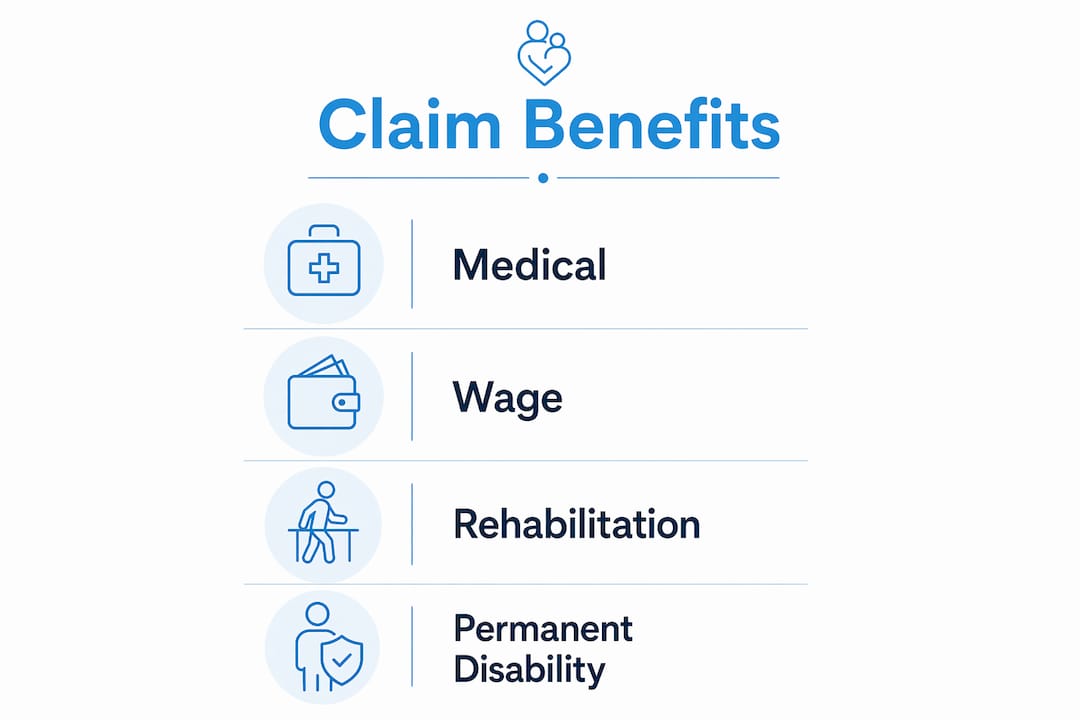
Medical benefits cover doctor visits, hospital stays, surgery, physiotherapy, prescription medication, and reasonable rehabilitation costs. The insurer pays the approved provider directly.
Wage replacement is the benefit most injured workers rely on during recovery. Wage replacement sits at approximately 66.67% of your average weekly wage, with state-specific caps ranging from roughly $390 to over $1,200 per week. That cap matters enormously for higher earners, who may receive a fraction of their normal income.
Permanent disability benefits apply when your injury leaves lasting impairment. These are split into two types:
- Permanent Partial Disability (PPD): You retain some work capacity but have a lasting functional limitation. Benefits are calculated using a disability rating percentage.
- Permanent Total Disability (PTD): You cannot return to any form of gainful employment. Benefits are typically paid for life or until retirement age.
Vocational rehabilitation covers retraining or job placement assistance if you cannot return to your previous role.
Workers’ compensation does not cover pain and suffering, emotional distress, or punitive damages. Those categories require a separate personal injury claim, which is only available when a third party, not your employer, contributed to the injury.
| Benefit Type | Typical Coverage |
|---|---|
| Medical treatment | All approved treatment paid directly by insurer |
| Temporary Total Disability | Approx. 66.67% of average weekly wage |
| Permanent Partial Disability | Percentage of wage based on disability rating |
| Permanent Total Disability | Ongoing wage replacement, often for life |
| Vocational rehabilitation | Retraining and job placement support |
How do settlement options compare in workers comp claims?
Two primary settlement structures exist in workers’ compensation: Compromise and Release, and Stipulated Award. Choosing the wrong one at the wrong time can leave you financially exposed for years.
Compromise and Release is a lump sum payment that closes the claim entirely. You receive a single payment and give up all future rights to medical treatment and wage benefits under that claim. A lump sum ends future medical coverage, which is the most significant risk. If your condition worsens or requires surgery years later, you bear that cost alone.
Stipulated Award is a structured arrangement where the insurer continues paying weekly benefits and medical costs according to an agreed schedule. You retain access to ongoing medical care, but the total payout may be lower over time if your recovery is faster than expected.
The critical timing factor is Maximum Medical Improvement, or MMI. Reaching MMI triggers eligibility for a permanent disability rating and opens formal settlement negotiations. Settling before MMI is confirmed almost always undervalues the claim because the full extent of your injury is not yet established.
| Settlement Type | Pros | Cons |
|---|---|---|
| Compromise and Release (lump sum) | Immediate cash, full control | Ends medical coverage, risk of undervaluing |
| Stipulated Award (structured) | Ongoing medical access, predictable income | Lower flexibility, longer process |
Pro Tip: Get independent legal advice before signing any settlement agreement. Once a Compromise and Release is signed, it is almost impossible to reopen the claim regardless of how your condition changes.
Settling too early often sacrifices future medical coverage that injured workers will genuinely need. The financial pressure to accept a quick payment is real, but the long-term cost of losing medical benefits frequently outweighs the short-term gain.
What common pitfalls should injured workers avoid?
The most preventable claim failures share a common cause: poor documentation in the first days after injury. Early, accurate documentation significantly affects claim decisions, and legal professionals consistently identify the initial post-injury period as the most critical window.
Here are the pitfalls that most frequently derail valid claims:
- Delaying injury notification. Waiting days or weeks to tell your employer creates a gap that adjusters interpret as evidence the injury was not serious or did not occur at work.
- Confusing injury reporting with formal claim filing. Many workers believe telling their employer is enough. It is not. The formal claim must be filed separately with the relevant authority, and legal timelines start only after formal submission.
- Vague or incomplete medical notes at the first appointment. Initial medical notes carry the most weight in any claim assessment. If you fail to mention a symptom at your first visit, the insurer will argue it was not caused by the workplace incident.
- Missing medical appointments. Gaps in treatment suggest to adjusters that your injury is not as serious as claimed.
- Inconsistent statements. Telling your doctor one thing and your employer another gives the insurer grounds to dispute your credibility.
- Ignoring third-party liability. If a contractor, equipment manufacturer, or another driver caused your injury, workers’ comp and personal injury claims can run simultaneously, giving you access to damages not covered by workers’ compensation.
Pro Tip: Start a daily injury log from the day of the incident. Record your symptoms, pain levels, treatment appointments, and any communications with your employer or insurer. This log becomes powerful evidence if your claim is disputed.
What practical steps support a successful claim?
Taking the right steps in the first 48 hours after a workplace injury shapes the entire outcome of your claim. The workplace injury claim process rewards workers who act quickly and document thoroughly.
Follow these steps to give your claim the strongest possible foundation:
- Notify your employer in writing the same day or the next business day. Include the time, location, and nature of the injury. Keep a copy.
- See an approved medical provider without delay. Describe every symptom fully, even those that seem minor. Do not minimise your condition.
- Keep personal records separate from official documents. Your own log of symptoms, treatment dates, and conversations with the insurer is independent evidence that supports your formal records.
- Understand your claim timeline. Ask your employer or insurer for the claim reference number and expected decision date. Follow up in writing if deadlines pass.
- Know your workplace rights after injury. You cannot be dismissed for making a legitimate workers’ compensation claim in Australia.
- Get legal advice before any settlement discussion. A workers’ compensation lawyer can identify whether your claim is being undervalued before you sign anything.
- Ask about modified duties or vocational rehabilitation. Returning to work in a reduced capacity, where medically appropriate, can support your recovery and maintain your income.
Key takeaways
A workers’ compensation claim provides no-fault medical and wage benefits, but the outcome depends almost entirely on how accurately and promptly you document and file from the first day of injury.
| Point | Details |
|---|---|
| File formally, not just verbally | Reporting to your employer is not the same as filing a formal claim with the relevant board. |
| Document from day one | Accurate, detailed medical notes at the first appointment carry the most weight in any claim assessment. |
| Know your benefit entitlements | Wage replacement sits at approximately 66.67% of average weekly wage, with jurisdiction-specific caps. |
| Time settlement decisions carefully | Settling before Maximum Medical Improvement is confirmed almost always undervalues your claim. |
| Seek legal advice early | Independent legal guidance before any settlement agreement protects your long-term medical and financial interests. |
What i have learned after years of watching claims go wrong
The single most common mistake I see injured workers make is assuming the system will look after them if they are honest. Honesty is necessary, but it is not sufficient. Workers’ compensation is an insurance process, and insurers are trained to look for gaps, inconsistencies, and missed steps.
The workers who get the best outcomes are not necessarily the most seriously injured. They are the ones who reported promptly, attended every appointment, described every symptom fully, and kept their own records. A worker with a moderate back injury who documents meticulously will often receive a better settlement than someone with a severe injury who delayed reporting by two weeks.
I also see workers accept lump sum settlements far too early, often because they are under financial pressure and the insurer moves quickly. That urgency is not accidental. Once you sign a Compromise and Release, the claim is closed. If you need surgery six months later, you pay for it yourself. The long-term cost of that decision is almost always greater than the short-term relief of the payment.
My honest advice: treat your claim like a job. Document everything, meet every deadline, and get independent legal advice before you sign anything. The process is manageable when you understand it. The workers who struggle are almost always the ones who did not know what they did not know.
— Daniel
How Carelawyers can help with your workers compensation claim
Dealing with a workers’ compensation claim while recovering from injury is genuinely difficult. Carelawyers specialises in workers’ compensation claims in Sydney and NSW, with a success rate of over 99% of claims won. Their team handles the paperwork, deadlines, and insurer negotiations so you can focus on recovery.

Carelawyers offers a no-obligation consultation, and their no win no fee model means you pay nothing unless your claim succeeds. Whether you are at the start of the process or facing a disputed claim, their personal injury lawyers provide direct, plain-language advice without the jargon or the runaround. Contact Carelawyers today to understand exactly where you stand.
FAQ
What is a workers compensation claim?
A workers’ compensation claim is a formal request for medical and wage benefits under a no-fault insurance programme after a workplace injury. You do not need to prove employer negligence to receive benefits.
How long do i have to file a workers compensation claim?
Filing deadlines vary by jurisdiction, ranging from 200 days to three years after the injury or disease discovery. Missing the deadline typically forfeits your right to benefits permanently.
What wage replacement will i receive?
Wage replacement is generally set at approximately 66.67% of your average weekly wage, subject to state-specific weekly caps that range from around $390 to over $1,200.
Should i accept a lump sum settlement?
You should not accept a lump sum settlement before reaching Maximum Medical Improvement. Settling early almost always undervalues the claim and ends your access to future medical coverage.
Can i sue my employer as well as claim workers compensation?
Workers’ compensation replaces the right to sue your employer for negligence. However, if a third party contributed to your injury, you can pursue a separate personal injury claim alongside your workers’ compensation benefits.


