

Workers comp weekly payments process: NSW guide for injured workers
In NSW, your weekly workers’ compensation payments start when your insurer accepts liability or when provisional payments begin. Two things trigger the process: notify your employer of the injury and submit a SIRA Certificate of Capacity from your treating doctor. Once notified, the insurer must start provisional weekly payments within seven calendar days unless a reasonable excuse applies. SIRA (State Insurance Regulatory Authority) and icare administer the NSW scheme, and Carelawyers is available for legal help if your payments are disputed or delayed.
Your immediate next steps:
- Notify your employer in writing as soon as possible after the injury
- See your treating doctor and obtain a SIRA Certificate of Capacity
- Submit the certificate to your employer and insurer promptly
- Ask your insurer about provisional payments if liability has not yet been decided
Pro Tip: Keep a dated copy of every notification you send. A text message, email, or signed letter all count as evidence that you gave notice.
Table of Contents
- How the workers comp weekly payments process works step by step
- What determines how much you receive each week
- Why your SIRA Certificate of Capacity is the most important document you hold
- Return-to-work obligations and what happens if you do not comply
- What to do immediately if your payments stop or are reduced
- How to challenge an insurer decision through formal dispute routes
- Documents to collect and keep for your claim
- Typical timelines: when to expect payments and when to escalate
- Key takeaways
- A lawyer’s view: the mistakes that cost injured workers their payments
- Carelawyers: direct legal help for weekly payment disputes in NSW
- Authoritative NSW sources and further reading
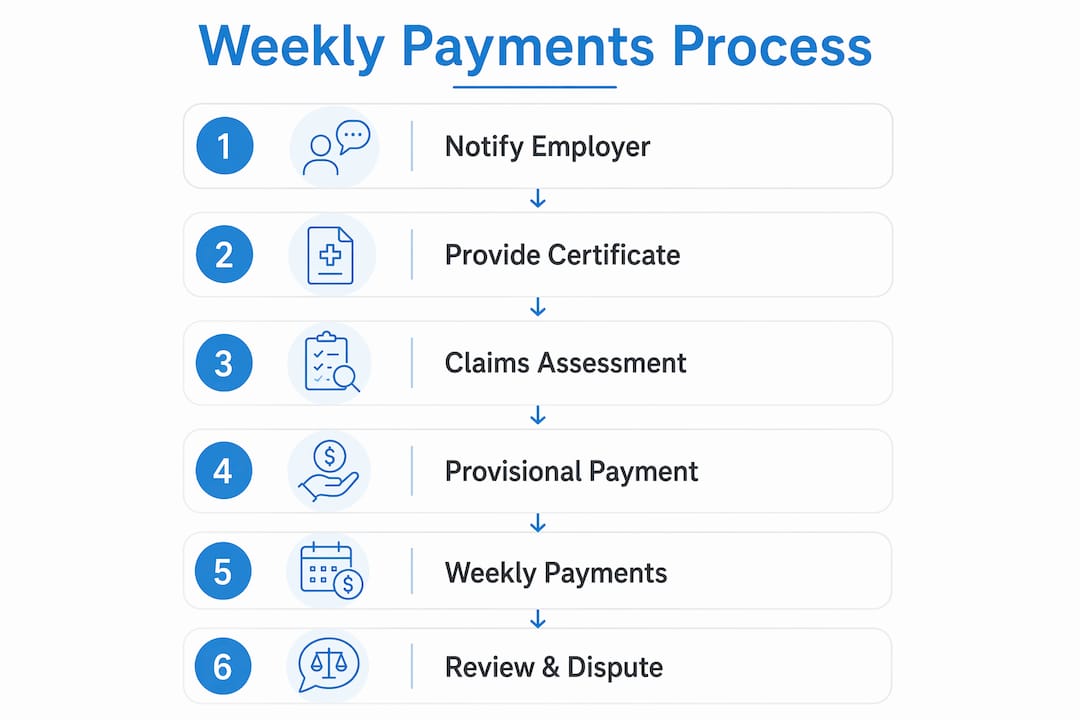
How the workers comp weekly payments process works step by step
The workers compensation payment process follows a clear sequence. Miss a step and payments can stall.
- Notify your employer. Tell your employer about the injury as soon as practicable. Include the date, nature of the injury, and how it occurred. Written notice is best.
- Get a SIRA Certificate of Capacity. Your treating doctor completes this form. It records your diagnosis, functional limitations, and recommended hours or duties.
- Insurer starts provisional payments. Once the insurer is notified, provisional weekly payments must begin within seven calendar days unless a reasonable excuse is issued. These can run for up to 12 weeks, covering weekly income and up to $10,000 in medical expenses while liability is assessed.
- Lodge a claim form. Complete the workers compensation claim form and submit it to your employer or insurer. Once received, the insurer has 21 days to accept or dispute liability.
- Liability accepted — ongoing payments begin. After acceptance, weekly payments continue on a regular schedule. The insurer pays directly into your bank account, typically aligned with your normal pay cycle.
- Ongoing certificate submissions. You must keep providing updated Certificates of Capacity at each review date your doctor specifies.
Key documents at each stage:
- Written injury notification (dated)
- SIRA Certificate of Capacity
- Completed claim form
- Payslips covering the 52 weeks before injury
Pro Tip: If your insurer has not started provisional payments within seven days and has given no written reasonable excuse, contact them in writing immediately and request the reason. Silence is not a valid excuse.

What determines how much you receive each week
Your weekly payment amount depends on several variables, not just your salary.
PIAWE (pre-injury average weekly earnings) is the base figure. It typically includes your ordinary pay, overtime, and allowances for the first 52 weeks of the claim. After 52 weeks, overtime and shift allowances are generally excluded from the calculation.
Your work capacity matters just as much. If you have no capacity for any work, you receive a higher percentage of PIAWE. If you have some capacity, your assessed earning capacity is deducted from the payment. The SIRA weekly payments guidance sets out percentage rates that apply at different stages of the claim, with 95% of PIAWE applying in the early period and 80% applying later, depending on injury date and circumstances.
Maximum weekly compensation caps are indexed periodically. Check the current cap on the SIRA Workers Compensation Benefits Guide, as the figure changes.
| Factor | What it affects | Documents to check |
|---|---|---|
| PIAWE | Base weekly payment amount | Payslips, employer wage statements |
| Work capacity assessment | Deductible earning amount | Certificate of Capacity, vocational reports |
| Overtime and allowances | Included for first 52 weeks only | Employment contract, payslips |
| Maximum weekly cap | Upper limit on payment | SIRA Benefits Guide (current indexed figure) |
| Hours worked | Reduces payment if earning capacity exists | Timesheets, payslips |
Your employment contract is worth checking too. It confirms your base rate, allowances, and any penalty rates that feed into the PIAWE calculation.
Pro Tip: Ask your employer for a written wage statement covering the 52 weeks before your injury. Insurers sometimes use a shorter period that underestimates your PIAWE.
Why your SIRA Certificate of Capacity is the most important document you hold
The SIRA Certificate of Capacity is the primary evidence your insurer uses to assess your work capacity. A vague or incomplete certificate can directly cause a payment reduction or suspension.
What to ask your treating doctor to record on every certificate:
- Your diagnosis and how the injury affects your function
- Specific physical limitations (lifting, sitting, standing, walking)
- Recommended hours per day and duties you can safely perform
- Clear dates of incapacity and the next review date
- Any restrictions on travel or workplace attendance
Checklist before submitting each certificate:
- Doctor has signed the declaration section
- You have completed the worker declaration (including any other employment)
- The certificate covers the period from your last certificate’s end date
- You have kept a copy before submitting
If you fail to provide a completed certificate, the insurer can stop weekly payments within seven days of advising you that the document is required. That is a hard deadline. Understanding what your work injury certificate means for your claim is worth reading before your next appointment.
Pro Tip: Never let a certificate lapse. Book your next doctor’s appointment before the current certificate expires, not after.
Return-to-work obligations and what happens if you do not comply
Participating in rehabilitation is not optional. Failing to meet return-to-work obligations is one of the most common reasons weekly payments are suspended.
Your obligations typically include:
- Attending return-to-work meetings with your employer and insurer
- Participating in a written rehabilitation or return-to-work plan
- Following your treating doctor’s medical advice
- Attending any insurer-arranged medical or vocational assessments
Under icare guidance, if you fail to comply with a formal return-to-work notice, payments can be suspended after 14 days. That notice must be in writing.
If you receive a compliance notice:
- Read it carefully and note the deadline
- Respond in writing within the timeframe stated
- If you cannot comply for medical reasons, attach a supporting letter from your treating doctor
- Request an adjustment to the plan in writing, citing your current certificate
Keep every piece of correspondence. If a dispute arises later, your written responses are evidence that you engaged in good faith.
Pro Tip: If the return-to-work duties proposed exceed what your certificate allows, write to the insurer immediately. Accepting unsuitable duties without objecting can be used against you later.
What to do immediately if your payments stop or are reduced
Act the same day you notice a missed payment or a reduced amount.
Immediate checklist:
- Check your bank account and confirm the shortfall in writing to your insurer
- Ask the insurer for the specific reason in writing
- Pull out your most recent SIRA Certificate of Capacity and confirm it has not lapsed
- Check whether a compliance notice was issued that you may have missed
To request a written explanation, write to your insurer and ask for:
- The exact reason for the reduction or suspension
- Any medical or vocational assessment reports they relied on
- Copies of any compliance notices issued
- The date the decision was made and who made it
Insurers must justify stop or reduction decisions against your current certificate. If their assessment contradicts your certificate, that justification must be clearly documented and disclosed to you. Expect a response within a reasonable timeframe; if none arrives within five business days, escalate to the Independent Review Office.
Pro Tip: Send your request by email so you have a time-stamped record. Follow up any phone call with a written summary of what was discussed.
How to challenge an insurer decision through formal dispute routes
If the insurer’s written reasons do not satisfy you, formal dispute routes are available.
- Internal review. Request a formal internal review from the insurer in writing. This is the first required step before escalating.
- Independent Review Office (IRO). If the internal review does not resolve the dispute, lodge a complaint with the IRO. The IRO is a free, independent service for NSW workers. Contact details are on the SIRA guidance pages.
- Workers Compensation Commission. For unresolved disputes, the Workers Compensation Commission hears formal applications. A lawyer is strongly advisable at this stage.
When to get a lawyer involved:
- The insurer disputes liability entirely
- Payments have been suspended for more than two weeks without a satisfactory explanation
- You are approaching the 130-week or 260-week limits under section 39 of the Workers Compensation Act 1987
- A vocational assessment has reduced your capacity rating and you disagree with it
Pro Tip: Write a brief note after every phone call with your insurer: date, time, name of the person you spoke with, and what was said. These contemporaneous notes carry real weight in a dispute.
Documents to collect and keep for your claim
Organised records protect your payments and strengthen any dispute.
| Document | Why it matters | How long to keep |
|---|---|---|
| SIRA Certificates of Capacity (all) | Primary evidence of incapacity and capacity limits | — |
| Payslips (52 weeks pre-injury) | Establishes PIAWE | — |
| Employer wage statement | Confirms allowances and overtime | — |
| Claim form (copy) | Proof of lodgement date | — |
| Medical reports | Supports capacity assessments | — |
| Rehabilitation or return-to-work plan | Confirms obligations agreed | — |
| Written insurer notices | Tracks compliance and suspension triggers | — |
Scan every document and store copies in a named folder with the date in the filename. For anything critical, use certified mail or email so delivery is provable. The workers compensation entitlements checklist from Carelawyers covers additional documents worth gathering early.
Pro Tip: Photograph physical documents with your phone as a backup. A lost paper certificate has caused more than one claim to stall.
Typical timelines: when to expect payments and when to escalate
Knowing the standard windows tells you exactly when something has gone wrong.
| Event | Typical timeframe | Action if overdue |
|---|---|---|
| Provisional payments start | Within seven calendar days of notification | Request written reason immediately |
| Insurer liability decision | Within 21 days of receiving claim form | Follow up in writing; escalate to IRO |
| Provisional payments maximum duration | Up to 12 weeks | Ensure liability decision is made before expiry |
| Formal internal review response | Varies; usually 2–4 weeks | Escalate to IRO if no response |
| IRO complaint resolution | Weeks to months depending on complexity | Seek legal advice for prolonged disputes |
| Maximum weekly payments duration | Generally up to 260 weeks (section 39, Workers Compensation Act 1987) | Seek legal advice if impairment exceeds 20% |
Weekly payments are generally available for up to 260 weeks under section 39 of the Workers Compensation Act 1987, with exceptions where impairment exceeds 20% or other statutory conditions apply. For a broader picture of what to expect at each stage, the workplace injury timeline guide covers the full claim arc.
A week without payment after the due date is a trigger to act, not to wait.
Key takeaways
Getting weekly workers’ compensation payments in NSW requires prompt notification, a current SIRA Certificate of Capacity, and active participation in rehabilitation from the outset.
| Point | Details |
|---|---|
| Notify immediately | Tell your employer in writing on the day of injury or as soon as possible. |
| Certificate of Capacity is critical | A missing or lapsed certificate can stop payments within seven days of insurer notice. |
| Provisional payments are a safety net | Up to 12 weeks of weekly income and up to $10,000 in medical costs while liability is assessed. |
| Non-compliance suspends payments | Failing to meet return-to-work obligations can trigger suspension after 14 days. |
| Carelawyers can help | Carelawyers offers free case assessments for NSW injured workers facing payment disputes or complex claims. |
A lawyer’s view: the mistakes that cost injured workers their payments
The most avoidable delays come down to three things: a lapsed certificate, an informal conversation treated as formal notice, and a missed appointment with no written explanation.
Insurers are not obliged to chase you for a new certificate. When the current one expires and no replacement arrives, the seven-day clock starts. By the time most workers realise payments have stopped, they are already behind. The fix is mechanical: book the next appointment before the current certificate runs out, every time.
Phone calls are the other trap. Workers often believe they have “told the insurer” about a change in their condition or a new medical opinion. Without a written record, that conversation does not exist in a dispute. Every meaningful update should be confirmed in writing, even a one-line email.
Where legal involvement makes the clearest difference is in vocational capacity disputes. When an insurer’s occupational assessor concludes you can perform work your treating doctor says you cannot, the gap between those two opinions is where claims are won or lost. A lawyer who understands how to challenge a vocational assessment, and what medical evidence is needed to counter it, can preserve payments that would otherwise be reduced or cut entirely. For workers approaching the 130-week or 260-week thresholds, early legal advice on long-term strategy is not a luxury.
Carelawyers: direct legal help for weekly payment disputes in NSW
When weekly payments stop without a clear explanation, or when an insurer’s vocational assessment contradicts your doctor’s certificate, having a lawyer who knows the NSW scheme is the fastest way to get payments reinstated.

Carelawyers handles workers compensation disputes, tribunal representation, and document collection for injured workers across Sydney and NSW. The fee model is straightforward: no win, no fee arrangements mean you pay nothing unless your claim succeeds. Fixed-fee options are also available for specific matters. From the first contact, you speak directly with your lawyer, not a case manager or a call centre.
If your payments have been reduced, suspended, or disputed, a free case assessment is the right first step. Carelawyers can review your certificate, your insurer’s reasons, and your claim history to tell you where you stand. For workers weighing weekly payments against lump-sum options, understanding what damages in an accident claim actually means is worth reading before making that decision.
Contact Carelawyers for a free case assessment at carelawyers.com.au/workers-compensation-lawyers.
Authoritative NSW sources and further reading
SIRA (State Insurance Regulatory Authority) publishes the definitive guidance on weekly payments in NSW, covering provisional payment rules, the Certificate of Capacity, calculation methods, and dispute rights. Start here for any question about entitlements or insurer obligations.
- SIRA weekly payments guidance — provisional payments, liability timelines, calculation rules, and suspension triggers
- icare weekly payments — insurer obligations, return-to-work compliance, and the 14-day suspension rule
- Independent Review Office (IRO) — free complaint and review service for disputed payments in NSW
- Carelawyers weekly workers comp benefits guide — legal framework, entitlement calculations, and NSW-specific claim support
- Workers compensation claim explained — full claim process overview for NSW injured workers
This article is general information about the NSW workers’ compensation system, not legal advice. Your specific entitlements depend on your individual circumstances. Confirm current rules with SIRA, icare, or a qualified workers compensation lawyer before acting.


