

Workers comp vs common law: what injured workers must know
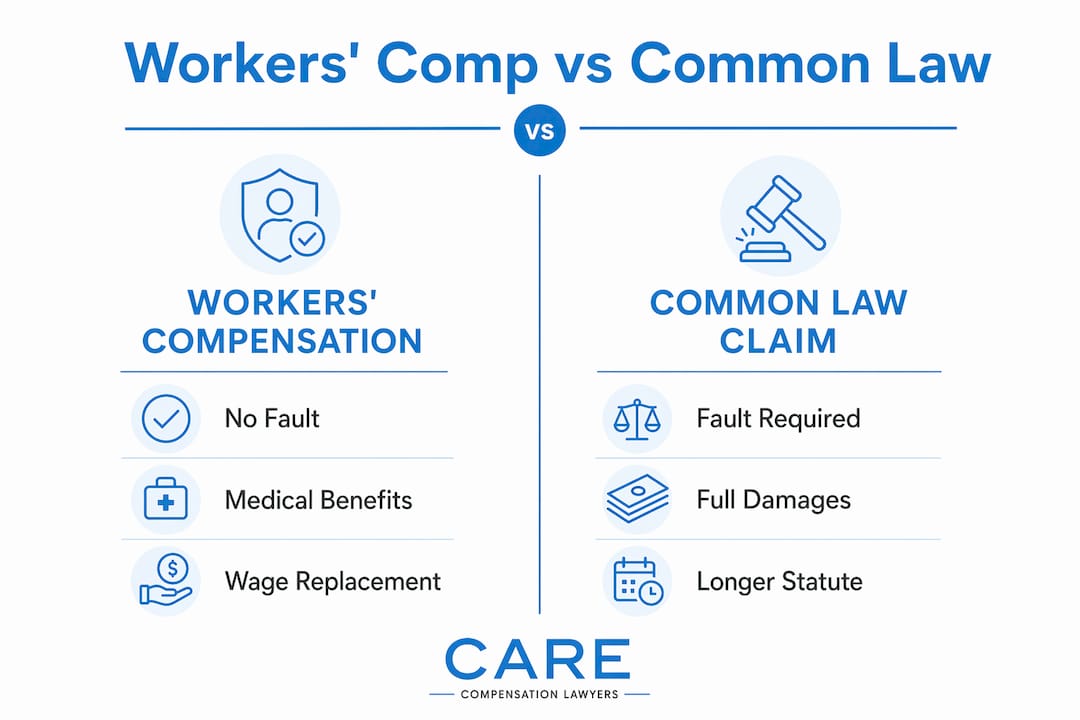
Workers’ compensation and common law claims are two distinct legal pathways for injured workers in Australia, each with fundamentally different rules, eligibility criteria, and financial outcomes. Workers’ comp is a no-fault insurance system replacing roughly 66–67% of lost wages and covering medical expenses, regardless of who caused the injury. Common law claims are fault-based lawsuits requiring proof of employer or third-party negligence, but they can deliver full economic and non-economic damages including pain and suffering. Choosing the wrong path, or settling too early, can permanently close off your right to the other. Understanding both frameworks before you act is not optional. It is the difference between partial recovery and full compensation.
What is the difference between workers comp and common law?
Workers’ compensation operates as a mandatory, no-fault insurance scheme. Most Australian employers are legally required to hold workers’ comp cover, and injured workers can claim benefits without proving anyone was at fault. Coverage includes medical treatment, rehabilitation costs, and weekly wage replacement at approximately 66–67% of pre-injury earnings.
Common law claims sit in a different category entirely. They are civil lawsuits where you, as the injured worker, must prove that your employer or a third party acted negligently and that negligence directly caused your injury. The workers compensation legal framework treats these two systems as separate tracks, and the rules governing each are not interchangeable.

The exclusive remedy doctrine is the most misunderstood element of this comparison. By accepting workers’ comp benefits, you generally surrender the right to sue your direct employer for negligence. This doctrine exists in every Australian jurisdiction and is a core feature of the workers’ comp bargain: employers fund the insurance scheme, and in return, workers cannot pursue them in court for most workplace injuries.
The financial gap between the two systems is significant. Workers’ comp replaces a portion of wages and covers medical costs. Common law claims can recover full lost wages, future economic loss, and damages for pain and suffering. For workers with serious, permanent injuries, that gap can represent hundreds of thousands of dollars.
How does workers’ compensation work in practice?
The workers’ comp process is designed to move quickly. You must report your injury to your employer, typically within 30 days, and lodge a formal claim with the relevant insurer. Reporting deadlines for workers’ comp are short, ranging from 30 to 90 days depending on the jurisdiction. Missing these deadlines can jeopardise your entire claim.
Once lodged, the insurer assesses liability and begins paying approved benefits. These cover your medical treatment, rehabilitation, and weekly wage replacement at the statutory rate. Disputes go through an administrative process rather than a court, which keeps costs lower and resolution faster than common law litigation.
Legal fees in workers’ comp matters are typically regulated by state legislation. Lawyers in this space generally charge between 10% and 20% of the settlement amount. That is a deliberate policy choice to keep the system accessible for injured workers who cannot afford large upfront legal costs.
The workers’ comp process is not adversarial in the same way litigation is, but insurers still act in their own financial interest. They will assess your claim to minimise payouts. Getting legal advice early, even before you lodge, protects your position from the start.
Pro Tip: Report your injury in writing and keep a copy. Verbal reports are frequently disputed by insurers, and a written record establishes the date and nature of the injury beyond argument.
How do common law claims differ from workers’ compensation?
Common law claims require you to clear several legal hurdles that workers’ comp does not. The first is fault. You must prove your employer or a third party was negligent and that their negligence caused your injury. This is a legal burden that takes time, evidence, and expert witnesses to satisfy.
The second hurdle is the permanent impairment threshold. Most Australian jurisdictions require you to reach a minimum permanent impairment rating before you can access common law damages. If your injury does not meet that threshold, you cannot file a common law claim regardless of how clear the employer’s negligence was. This is a hard legal gate, not a discretionary one.
The statute of limitations for common law claims is considerably longer than for workers’ comp. Personal injury statutes generally allow 2–3 years from the date of injury to file. That longer window reflects the complexity of building a negligence case compared to lodging an administrative claim.
The financial upside of common law is substantial. Common law damages can include full past and future lost wages, medical expenses, and pain and suffering. Workers’ comp covers none of the last category. For a worker with a serious spinal injury, for example, pain and suffering damages alone can dwarf the total workers’ comp payout.
Legal costs reflect that complexity. Common law lawyers typically charge contingency fees of 33–40% of the settlement. That is two to four times the regulated rate in workers’ comp matters. The higher cost is the price of accessing full damages.
| Factor | Workers’ compensation | Common law claim |
|---|---|---|
| Fault required | No | Yes, negligence must be proven |
| Wage replacement | ~66–67% of pre-injury wages | Full past and future lost wages |
| Pain and suffering | Not covered | Covered |
| Filing deadline | 30–90 days | 2–3 years |
| Legal fees | 10–20% (regulated) | 33–40% (contingency) |
| Process | Administrative | Court litigation |
Pro Tip: Get a permanent impairment assessment from an independent medical examiner, not just the insurer’s doctor. The rating directly determines whether you can access common law damages, and insurer-appointed assessors have a financial incentive to rate injuries lower.
Can you pursue both workers’ comp and a common law claim?
The exclusive remedy doctrine bars you from suing your direct employer, but it does not prevent you from suing third parties. This distinction is where dual-track claim strategies often yield the highest total recovery for injured workers.
Third-party claims apply in a wide range of real scenarios:
- A construction worker injured by a defective power tool can sue the tool manufacturer while receiving workers’ comp from their employer’s insurer.
- A delivery driver hit by another vehicle on the job can pursue a compulsory third-party motor accident claim alongside their workers’ comp benefits.
- A worker injured on a client’s premises due to that client’s negligence can sue the property owner as a third party.
- A subcontractor injured by the negligence of another subcontractor on the same site can pursue the responsible party directly.
The catch is the workers’ comp lien. When you settle a third-party lawsuit, your workers’ comp insurer has a legal right to recover the benefits they paid you from that settlement. Skilled lawyers negotiate these liens down, often significantly, to maximise what you actually take home. This negotiation is not automatic. It requires legal expertise and active management.
The timing of settlements matters enormously here. Settling workers’ comp prematurely can extinguish your right to pursue common law options later. A lump sum workers’ comp settlement accepted before you have explored all third-party avenues can permanently close those doors. Coordinate both claims before you sign anything.
Pro Tip: Never accept a lump sum workers’ comp settlement without first getting legal advice on whether a third-party or common law claim exists. Once you sign, those rights are typically gone.
What mistakes do injured workers commonly make?
The most costly mistake is delaying legal consultation. Many workers assume workers’ comp will cover everything and only seek legal advice after accepting an initial offer. By then, common law rights may already be compromised.
The second major mistake is misunderstanding the exclusive remedy rule. Workers often believe they cannot take any legal action against anyone once they are on workers’ comp. That misunderstanding causes them to ignore legitimate third-party claims that could have delivered full damages.
Other common errors include:
- Ignoring the impairment threshold. Workers with serious injuries sometimes settle workers’ comp without ever getting a formal permanent impairment assessment. Without that assessment, they never know whether they qualified for common law damages.
- Accepting the insurer’s impairment rating without challenge. Insurer-appointed doctors rate injuries conservatively. An independent assessment often produces a higher rating that unlocks common law access.
- Underestimating future losses. Workers’ comp replaces current wages. Common law claims can recover decades of future earning capacity. Workers who settle early often leave the largest component of their damages on the table.
- Missing the statutory time limits. The 30-to-90-day workers’ comp reporting window and the 2-to-3-year common law limitation period are hard deadlines. Missing either forfeits your rights entirely.
The workers comp vs personal injury decision is not a simple either/or choice. It is a strategic question that requires understanding both systems, your injury’s severity, the parties involved, and the timing of every step. Getting that wrong is expensive and often irreversible.
Key takeaways
Workers’ comp delivers immediate, no-fault benefits while common law claims require proving negligence but can recover full damages including pain and suffering, making early legal advice the single most important step after a workplace injury.
| Point | Details |
|---|---|
| Workers’ comp is no-fault | You receive medical and wage benefits without proving anyone caused your injury. |
| Common law requires negligence proof | You must prove employer or third-party fault to access full economic and non-economic damages. |
| Exclusive remedy limits employer lawsuits | Accepting workers’ comp generally bars suing your direct employer, but not third parties. |
| Impairment thresholds gate common law access | Most jurisdictions require a minimum permanent impairment rating before a common law claim is possible. |
| Early settlement can forfeit rights | Accepting a lump sum workers’ comp payout before exploring common law options can permanently close those avenues. |
What I have learned from watching workers navigate these two systems
The single biggest misconception I see is that common law is simply a better version of workers’ comp. Workers hear “full damages” and assume common law is the obvious choice. The reality is that common law claims are lengthier and riskier than workers’ comp, and many injured workers do not qualify because they cannot meet the permanent impairment threshold.
What I have also seen is how aggressively insurers work to minimise payouts from the moment a claim is lodged. They are not neutral administrators. They have financial incentives to close claims cheaply and quickly. Workers who engage a lawyer early consistently achieve better outcomes than those who try to manage the process themselves.
The third-party claim angle is the most underutilised opportunity in workplace injury law. Workers focus on their employer and miss the manufacturer, the subcontractor, or the property owner who may carry far greater liability. Those claims can be pursued alongside workers’ comp and can deliver the full damages that workers’ comp will never provide.
My practical advice is this: treat workers’ comp as your immediate safety net, not your final settlement. Get your medical treatment funded, get your wages replaced, and then get proper legal advice on whether a common law or third-party claim exists. Do not sign anything until you understand what you are giving up. The workplace rights of injured workers are broader than most people realise, and protecting them requires knowing the full picture before you act.
— Daniel
How Carelawyers can help you claim what you are owed
Carelawyers is a Sydney-based personal injury firm with over a decade of experience in workplace injury and compensation claims. The team specialises in both workers’ compensation and common law claims, and they offer free claim assessments so you can understand your options before committing to any legal path.

Carelawyers operates on a no-win-no-fee basis, which means you pay nothing unless your claim succeeds. Their personal injury lawyers handle the insurer negotiations, impairment assessments, and third-party claim coordination that determine how much you actually recover. If you have been injured at work and are unsure whether workers’ comp covers everything you are owed, their team can assess your position and explain your full legal options. For workers managing serious injuries, the serious injury claim timeline is a critical resource for protecting your rights at every stage.
FAQ
What is the main difference between workers’ comp and common law?
Workers’ compensation is a no-fault system covering medical costs and partial wage replacement. Common law claims are fault-based lawsuits that require proving negligence but can recover full damages including pain and suffering.
Can I make both a workers’ comp and a common law claim?
You can pursue workers’ comp and a third-party common law claim simultaneously. The exclusive remedy doctrine prevents suing your direct employer, but it does not bar claims against manufacturers, subcontractors, or other negligent third parties.
What is the permanent impairment threshold for common law claims?
Most Australian jurisdictions require you to reach a minimum permanent impairment rating before you can file a common law claim. The specific threshold varies by state, and failing to meet it bars the claim regardless of the employer’s negligence.
How long do I have to make a workers’ comp claim?
Workers’ comp reporting deadlines are typically 30–90 days from the date of injury. Common law personal injury claims generally allow 2–3 years. Missing either deadline forfeits your rights.
Will settling workers’ comp affect my common law rights?
Accepting a lump sum workers’ comp settlement can permanently extinguish your right to pursue common law or third-party claims. Always get legal advice before signing any settlement agreement.


