

Workers comp medical expenses covered: what to claim
Workers compensation in Australia pays for medical, hospital and rehabilitation expenses that are reasonably necessary to treat or relieve the effects of a work-related injury. That covers a lot: GP visits, specialist consultations, surgery, hospital stays, ambulance fees, physiotherapy, psychology, prostheses and workplace rehabilitation services. The legal foundation is section 60 of the Workers Compensation Act 1987 in NSW, with equivalent provisions administered by WorkSafe Victoria, ReturnToWorkSA and other state regulators.
Core expenses typically covered include:
- GP and specialist consultations related to the injury
- Surgery and hospital treatment (public and private)
- Ambulance services (emergency and approved non-emergency)
- Physiotherapy, chiropractic, osteopathy and other allied health
- Psychology and counselling
- Prescribed medications
- Prostheses, artificial aids and durable medical equipment
- Workplace rehabilitation services
- Reasonable travel to and from treatment
The single most important thing to know: workers compensation will pay for treatment that is reasonably necessary and connected to your work injury — but the insurer generally must approve it first. Starting non-urgent treatment without that approval can leave you personally liable for the bill.
Pro Tip: Before booking any elective procedure or extended allied health programme, contact your insurer or claims agent in writing and confirm approval. A two-minute email now can prevent a four-figure bill later.
Table of Contents
- What medical and treatment expenses does workers comp cover?
- What does ‘reasonably necessary’ actually mean for your claim?
- Which services need prior approval and which ones don’t?
- How do claiming and payments work in practice?
- What travel and ambulance costs can you claim?
- When do medical entitlements end?
- What to do before you start treatment
- What happens when a treatment is refused or you face a gap?
- Key takeaways
- The part most guides skip
- Refused a medical claim? Here is how Carelawyers can help
- Official sources and further reading
What medical and treatment expenses does workers comp cover?
Workers compensation medical benefits span a wide range of service categories. The SIRA medical expenses guidance sets out the NSW position clearly, and the framework is broadly consistent across Australian jurisdictions.
Medical and specialist consultations
- GP visits with your nominated treating doctor (NTD) for injury-related care
- Specialist referrals (orthopaedic surgeons, neurologists, pain specialists)
- Second opinions where clinically justified
Surgery and hospital services
- Inpatient and day surgery procedures connected to the injury
- Anaesthesia, theatre fees and post-operative care
- Public and private hospital accommodation up to approved limits (WorkSafe Queensland, for example, typically covers up to four days as an inpatient at a private hospital before further approval is needed)
Diagnostic tests and pharmaceuticals
- X-rays, MRI scans and CT imaging (common after back, shoulder or head injuries)
- Pathology and other diagnostic services
- Prescribed medications directly related to the injury
Allied health and rehabilitation
- Physiotherapy, chiropractic and osteopathic treatment
- Occupational therapy and exercise physiology
- Psychology and counselling for psychological injuries or adjustment disorders arising from a physical injury
- Speech pathology and other specialist allied health where clinically indicated
Dental treatment
- Covered when the injury directly caused or aggravated the dental condition (for example, a jaw injury from a workplace fall)
Prostheses, aids and home modifications
- Artificial limbs, orthotics and other durable aids
- Home or vehicle modifications where medically necessary (for example, after a spinal cord injury)
Workplace rehabilitation
SIRA-approved workplace rehabilitation providers can arrange vocational assessments, job analysis, suitable duties programmes and retraining. These services sit within workers compensation coverage and are coordinated through your insurer.

All of the above are subject to the ‘reasonably necessary’ test and must be connected to the work injury. An insurer will not fund treatment for a pre-existing condition that is unrelated to the workplace incident.
What does ‘reasonably necessary’ actually mean for your claim?
‘Reasonably necessary’ is the statutory test that determines whether an expense is payable. Under s60 of the Workers Compensation Act 1987, treatment must be necessary to treat or relieve the effects of the work injury. It is not enough that a doctor recommends it or that you would benefit from it generally.
SIRA’s guidance treats this as a clinical-standard test. Insurers look at whether the treatment:
- Has a clear clinical rationale tied to the work injury
- Aligns with an accepted treatment plan or clinical guideline
- Is provided by a suitably qualified practitioner
- Is proportionate to the nature and severity of the injury
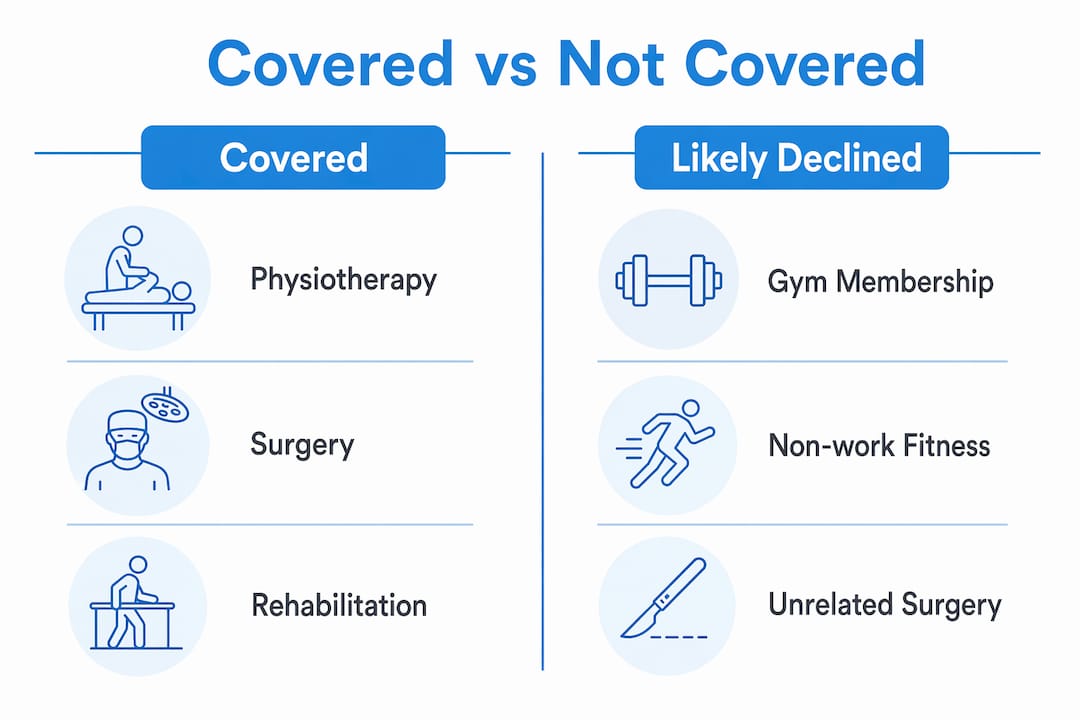
Accepted vs declined: quick examples
| Accepted | Likely declined |
|---|---|
| Physiotherapy for a work-related back strain | Gym membership for general fitness |
| Psychology for a diagnosed adjustment disorder after a workplace incident | Elective cosmetic surgery unrelated to the injury |
| MRI scan after a workplace shoulder injury | Treatment for a pre-existing condition not aggravated at work |
| Prescribed pain medication for the injury | Over-the-counter supplements not prescribed by a treating doctor |
Medical connection matters just as much as clinical necessity. The treatment must relate to the work injury, not a separate health issue. Your treating doctor’s notes, medical certificates and treatment plans are the documents that establish this link. If those records do not clearly connect the treatment to the workplace incident, the insurer has grounds to decline.
Pro Tip: Ask your treating doctor to include a specific note in every certificate and treatment plan stating that the treatment is required as a direct result of the work injury. That one sentence is often the difference between prompt payment and a dispute.
Which services need prior approval and which ones don’t?
Most workers compensation treatment coverage requires insurer pre-approval. The practical split matters because proceeding without approval for a non-exempt service can trigger s60(2A) of the Workers Compensation Act, which allows the insurer to decline the cost.
Services that usually require prior approval
| Service | Notes |
|---|---|
| Elective surgery | Written approval required before booking |
| Allied health beyond initial sessions | Treatment plan required for ongoing care |
| Durable aids and equipment | Prostheses, orthotics, home modifications |
| Long-term rehabilitation plans | Vocational retraining, extended physio programmes |
| Non-emergency ambulance transport | Pre-approval generally required |
| Private hospital beyond initial admission | Approval needed before extending a stay |
Services commonly exempt from prior approval
Under SIRA guidance, the following do not require pre-approval:
- Any treatment within 48 hours of the injury occurring
- Consultations with your nominated treating doctor related to the injury
- Treatment provided by your NTD within one month of the injury
- Services provided in the emergency department of a public hospital
- Initial sessions with certain allied health providers (physiotherapists, chiropractors, osteopaths, psychologists, counsellors, exercise physiologists) within guideline limits
SIRA requires insurers to determine requests for medical, hospital and rehabilitation services within 21 days. If you have submitted a request and heard nothing after three weeks, follow up in writing and keep a record of that contact.
Provisional payments for early mental health treatment
Provisional payments are a specific regulatory measure designed to fund early psychological treatment before full liability is accepted. Under Comcare’s framework and equivalent state provisions, an insurer can fund an initial number of psychology or counselling sessions (for example, five sessions under Comcare’s initial funding rules) while the claim is being assessed. This prevents a gap in mental health care during the critical early weeks after a workplace incident.
How do claiming and payments work in practice?
Getting treatment paid is straightforward when the steps are followed in order. Skipping a step, particularly the approval step, is where most out-of-pocket costs arise.
- Notify your employer of the injury as soon as possible and confirm they have lodged a workers compensation claim with their insurer.
- Obtain your claim number from the insurer or your employer’s HR team. You will need this for every provider interaction.
- Confirm approval before booking non-urgent treatment. Contact the insurer by phone or email and ask whether the specific service is approved. Get the response in writing.
- Ask your provider to invoice the insurer directly. Most treating doctors, hospitals and allied health providers experienced in workers compensation will bill the insurer rather than you. Give them the claim number and insurer contact details at your first appointment.
- Keep copies of all itemised invoices and receipts. If you pay out-of-pocket for any approved expense, you will need an itemised invoice (not just a receipt) to claim reimbursement.
- Submit out-of-pocket claims promptly. SIRA’s guidelines set time limits for lodging receipts — check your state’s specific rules, but treating the limit as six months from the date of service is a reasonable working guide. Waiting too long can forfeit the entitlement.
- Follow up on unpaid invoices. SIRA’s S15 standard emphasises prompt payment to support recovery. If a provider tells you their invoice is unpaid after 30 days, contact the insurer directly.
Invoices must be itemised and include the provider’s details, service codes, dates and fees aligned with the relevant fees order. Insurers can decline payment where invoices do not meet these requirements, so it is worth confirming with your provider that they are familiar with workers compensation billing.
Pro Tip: Keep a simple treatment log: date, provider, service, cost, and whether the insurer approved it. If a dispute arises months later, this log is the fastest way to reconstruct what happened and when.
What travel and ambulance costs can you claim?
Transport costs are a recoverable expense that many injured workers overlook. The SIRA medical expenses page confirms entitlement to travel reimbursement for attending approved medical, hospital and rehabilitation appointments.
Covered transport expenses typically include:
- Ambulance fees for emergency transport and approved non-emergency or inter-hospital transfers
- Private motor vehicle travel (kilometres recorded in a travel diary)
- Public transport fares (receipts required)
- Taxi or rideshare where public transport is not reasonably accessible due to the injury
- Escort travel costs where a medical certificate confirms an escort is necessary
Evidence you need to claim transport costs:
- Kilometre log or travel diary for private vehicle use
- Receipts for public transport, taxi or rideshare
- Medical certificate confirming the appointment was for the work injury
- Where an escort is required, a medical certificate stating that need specifically
For ambulance services in NSW, you are entitled to payment for reasonably necessary ambulance services including emergency, non-emergency and inter-hospital transfers provided by the Ambulance Service of NSW. Emergency ambulance transport does not require pre-approval. Non-emergency ambulance transport generally does, so contact your insurer before booking.
| Transport type | Pre-approval required? | Evidence needed |
|---|---|---|
| Emergency ambulance | No | Ambulance invoice |
| Non-emergency ambulance | Yes | Insurer approval + invoice |
| Private vehicle to appointments | No (claim after) | Kilometre log, appointment records |
| Public transport | No (claim after) | Receipts |
| Escort travel | Yes (medical cert required) | Medical certificate + receipts |
When do medical entitlements end?
Treatment coverage does not last indefinitely in most Australian schemes. Safe Work Australia’s national comparison shows that entitlement durations are commonly tied to the cessation of weekly payments and the degree of permanent impairment.
Under the NSW scheme, the rules are specific:
- Workers with 10% or less permanent impairment can claim medical expenses for two years after weekly payments stop (or two years from the date the claim was first made if no weekly payments were paid).
- Workers with 11–20% permanent impairment can claim for five years after weekly payments stop.
- Workers with greater than 20% permanent impairment are entitled to medical, hospital and rehabilitation expenses for life.
Exceptions apply for catastrophic injuries. Safe Work Australia notes that serious personal injury schemes in some states fund life-long treatment, attendant care and home modifications regardless of weekly payment status. For more on long-term entitlements after serious injury, the workplace rights after serious injury guide covers what ongoing supports may be available.
Watch for these red flags that can cut entitlements short:
- Insurer disputing liability for the injury or a specific treatment
- Running out of approved sessions without a new treatment plan in place
- Missing the time limit for lodging receipts or requesting review
- Weekly payments ceasing without a formal assessment of permanent impairment
The interaction between weekly payments and medical entitlements is one of the more complex parts of the scheme. If your weekly payments are about to stop, check your medical entitlement position at the same time.
What to do before you start treatment
Following these steps before treatment begins protects your entitlement and avoids personal liability for the bill.
- Notify your employer of the injury in writing as soon as possible after it occurs.
- Confirm the claim is open and obtain your claim number from the insurer or employer.
- Check whether the treatment needs prior approval. Ask your insurer directly. If you are unsure, assume approval is required.
- Get a medical certificate from your treating doctor that specifically links the proposed treatment to the work injury.
- Obtain a treatment plan for any ongoing allied health or rehabilitation services. This is the document the insurer uses to assess whether ongoing care is reasonably necessary.
- Ask the provider to bill the insurer directly using the claim number. Confirm they are familiar with workers compensation billing and the relevant fees order.
- Keep copies of everything: approval emails, medical certificates, treatment plans, invoices and receipts.
- Check the fee schedules that apply to your state. Providers who charge above the fees order rate may bill you for the gap.
Pro Tip: Get insurer approval in writing every time, even for services that seem straightforward. A phone call is not enough — ask the insurer to confirm approval by email or in the claim management system, and save that confirmation.
Emergency treatment is the one clear exception. If you need immediate care after a workplace injury, get it. You can seek retrospective approval for follow-up care, but document everything from the moment treatment begins.
For a broader view of the workplace injury claim process, including what happens at each stage of the claim, that guide walks through the full timeline.
What happens when a treatment is refused or you face a gap?
A refused treatment request or a large out-of-pocket bill is not necessarily the end of the road. There are formal review mechanisms in every Australian jurisdiction, and legal advisers can help you use them.
When to get legal help:
- The insurer has denied liability for a specific treatment or the claim overall
- You have received a substantial out-of-pocket bill for treatment you believed was approved
- A complex rehabilitation dispute is stalling your recovery
- The insurer has missed the 21-day decision deadline without explanation
- You are approaching an entitlement end point and need clarity on your options
How a lawyer can assist:
- Lodge an internal dispute or request a review of the insurer’s decision
- Request a review under s60 or the relevant state guideline
- Prepare and present expert medical evidence to support the treatment request
- Negotiate directly with the insurer or claims agent
- Advise on common-law options if the injury involved employer negligence
Pro Tip: If a treatment request is refused, ask the insurer for the refusal in writing with reasons. That document is the starting point for any review or dispute, and you cannot effectively challenge a decision you do not have in writing.
For an initial legal appointment, bring your claim number, all insurer correspondence, itemised invoices, medical certificates and any treatment plans. A workers compensation lawyer can assess the strength of a review application at that first meeting.
Key takeaways
Workers compensation in Australia pays for all reasonably necessary medical, hospital and rehabilitation expenses connected to a work injury, but insurer approval is required for most non-emergency treatment and entitlements are time-limited based on permanent impairment.
| Point | Details |
|---|---|
| Coverage scope | Doctor visits, surgery, allied health, ambulance, prostheses and rehab are all covered when reasonably necessary. |
| Approval is critical | Most non-emergency treatment needs written insurer approval before you start, or you risk personal liability under s60(2A). |
| Entitlement duration | In NSW, entitlements last two years (up to 10% impairment), five years (11–20%) or for life (above 20%). |
| Document everything | Itemised invoices, treatment plans, medical certificates and written approvals are the evidence that resolves disputes. |
| Carelawyers can help | If a treatment is refused or you face an unexpected bill, Carelawyers offers a free initial review and handles disputes with insurers. |
The part most guides skip
Most articles about workers comp medical expenses covered focus on the list of what is covered and stop there. The harder question is what happens when the insurer says no, or when a worker starts treatment assuming it will be covered and then receives a bill they cannot pay.
The ‘reasonably necessary’ test sounds objective, but in practice it is applied by an insurer whose financial interest runs in the opposite direction to yours. Treatment plans get rejected because a clinical goal is not measurable enough. Psychology sessions get capped because the insurer disputes whether the psychological injury is work-related. Physiotherapy is cut off because the insurer decides the worker has plateaued, even when the treating physio disagrees.
None of that means the system is broken. It means the system has levers, and most injured workers do not know where they are. A written approval request, a well-structured treatment plan, a medical certificate that explicitly connects the treatment to the injury: these are not bureaucratic formalities. They are the documents that determine whether you get paid or whether you pay.
The workers who fare best are not the ones with the most serious injuries. They are the ones who treat the paperwork as seriously as the treatment itself.
Refused a medical claim? Here is how Carelawyers can help
Dealing with a refused treatment request or an unexpected out-of-pocket bill is stressful enough without having to navigate the dispute process alone. Carelawyers works directly with injured workers in NSW and across Australia to challenge insurer decisions on medical and rehabilitation expenses, without the impersonal service of a large firm.

The practical difference: you speak directly to your lawyer, not a case manager or paralegal. Carelawyers reviews your insurer’s decision, identifies the grounds for challenge, prepares the supporting medical evidence and handles the dispute process on your behalf. For workers facing denied treatment, that means a clear answer on whether the decision can be reversed, and a lawyer who does the heavy lifting to reverse it.
To get started, bring your claim number, insurer correspondence, itemised invoices and any treatment plans to a free initial review. Carelawyers operates on a no-win no-fee basis for eligible matters, so cost is not a barrier to getting advice. Contact Carelawyers for a free initial review of your workers compensation medical claim.
This article provides general information only and is not legal advice. Workers compensation rules vary by state and territory. Confirm the current rules with the relevant regulator or a qualified legal professional for your specific situation.
Official sources and further reading
Rules differ meaningfully between Australian states and territories. The figures and processes in this article draw primarily on NSW (SIRA) and national Safe Work Australia comparisons. Always check the rules that apply in your state.
Key official sources:
- SIRA (NSW): Detailed guidance on medical, hospital and rehabilitation expenses, approval processes, fees orders and entitlement timeframes for NSW workers.
- WorkSafe Victoria: Treatment expense guidance for Victorian workers, including approval requirements and provider billing rules.
- ReturnToWorkSA: South Australian scheme guidance on medical and rehabilitation entitlements.
- Comcare: Federal scheme covering Commonwealth employees; includes treatment plan requirements and initial session funding for psychology.
- Safe Work Australia: National comparison of medical, hospital and other costs across all Australian jurisdictions, including entitlement duration tables.
- WorkSafe Queensland: Queensland-specific guidance on covered expenses and approval exemptions.
State variation is real and significant. Entitlement durations, approval processes, fees orders and dispute mechanisms all differ between NSW, Victoria, Queensland, South Australia, Western Australia and the federal Comcare scheme. The principles are consistent; the details are not. Contact the relevant regulator or your insurer for the process that applies to your claim.


