

Work injury certificate: what it means for your claim
A work injury certificate is a mandatory legal document issued by a medical practitioner that verifies your diagnosis, treatment, and functional capacity after a workplace injury. Known formally as a certificate of capacity or work capacity certificate, it sits at the centre of every workers compensation claim in Australia. Without it, insurers cannot approve weekly payments, medical treatment, or return-to-work plans. If you have been injured at work, this document is the single most important piece of work injury documentation you will obtain.
What is a work injury certificate and what does it contain?
A work injury certificate is the formal record that connects your medical condition to your legal entitlements. It is not simply a sick note. The certificate legally underpins all benefit payments, meaning inaccuracies can cause insurers to deny claims or reduce your entitlements entirely.
The certificate records the following key details:
- Worker’s personal details: your name, date of birth, and employer information
- Injury description: the nature and mechanism of the injury, including the body part affected
- Medical diagnosis: the treating practitioner’s clinical findings
- Treatment plan: recommended treatment, medications, and referrals
- Functional capacity status: whether you are classified as totally incapacitated, partially capable with restrictions, or fully capable of returning to work
- Specific restrictions: for example, no lifting over 5kg, limited standing, or reduced hours
- Review period: the date by which you must return for reassessment
- Medical practitioner details: name, provider number, and signature
The functional capacity section carries the most legal weight. Insurers and employers use this classification to determine your weekly workers comp benefits and to design suitable duties programmes. A vague entry like “light duties” gives your employer and insurer almost no guidance. A specific entry like “no lifting over 5kg, maximum four hours standing per day” protects you from being assigned tasks beyond your actual capacity.
Pro Tip: Ask your doctor to write specific, measurable restrictions rather than general phrases. Granular detail like “no lifting over 5kg” is far more protective than “light duties” when an insurer reviews your claim.

The certificate also carries privacy obligations. Your injury details are shared only on a need-to-know basis between your insurer and employer. Your employer receives enough information to arrange suitable duties, but not your full medical history.
How and when to get a work injury certificate
Speed matters more than most injured workers realise. Delaying your initial certificate creates evidence gaps that insurers can exploit to challenge your claim. The rule is straightforward: get your certificate as soon as possible after the injury occurs.
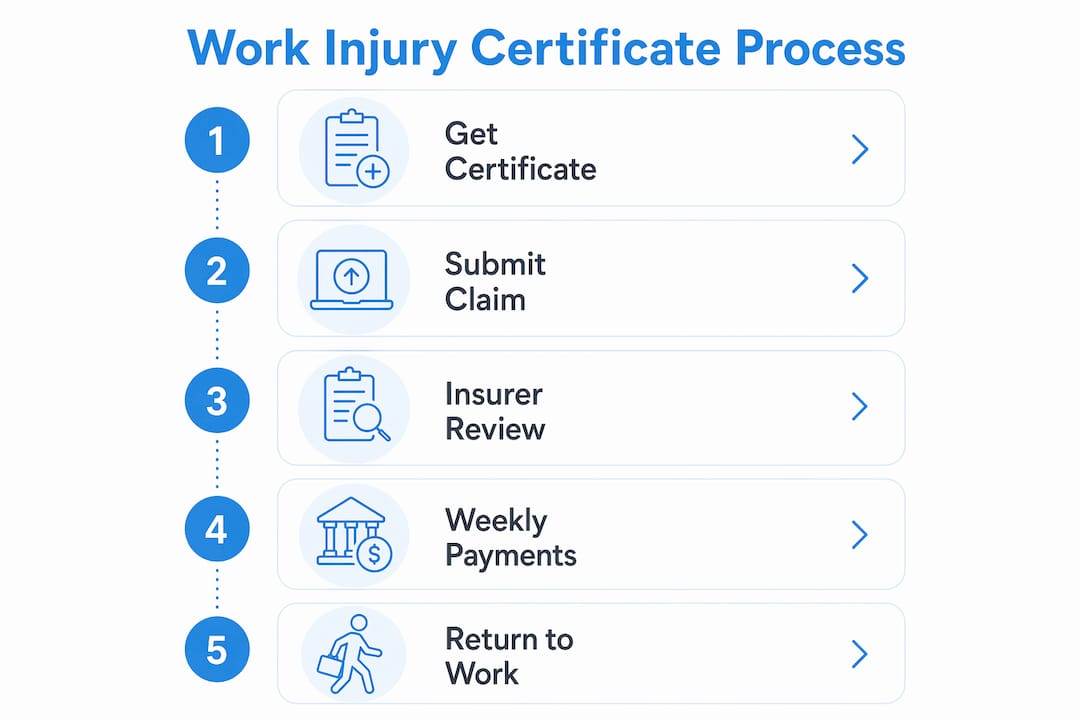
Follow these steps to obtain your certificate without delay:
- See a medical practitioner immediately. Your regular GP is the most common starting point. In an emergency, a nurse practitioner can issue a certificate valid for up to seven days per injury event.
- Describe your injury in full. Tell your doctor exactly how the injury happened, which body parts are affected, and what symptoms you are experiencing. Do not minimise your pain or limitations.
- Request specific functional restrictions. Ask your doctor to document precisely what you cannot do, not just a general capacity category. This detail directly shapes your return-to-work plan.
- Obtain your initial certificate before lodging your claim. The initial certificate is valid for up to 14 days. Ongoing certificates cover up to 28 days before reassessment is required.
- Submit the certificate to your employer and insurer promptly. Delays in submission can create gaps in your financial support.
- Book your follow-up appointment before the certificate expires. Never let a certificate lapse without a replacement in place.
Pro Tip: Do not wait until you have lodged your formal workers compensation claim to get your certificate. Early documentation creates contemporaneous evidence that is very difficult for an insurer to dispute later.
GPs issue the majority of certificates, but specialists such as orthopaedic surgeons or psychiatrists can also issue them when your condition requires specialist management. Understanding the full workplace injury claim process helps you see exactly where the certificate fits within the broader sequence of steps.
Common mistakes with work injury certificates and how to avoid them
The certificate looks straightforward, but injured workers make the same errors repeatedly. Each mistake carries real financial consequences.
- Letting certificates lapse. A gap between certificates gives insurers grounds to suspend weekly payments. Book your next appointment before the current certificate expires.
- Accepting vague capacity statements. If your doctor writes “unfit for work” without specifying restrictions, your return-to-work plan will be poorly designed. Push for measurable detail.
- Failing to update certificates as you recover. Stagnant certificates labelled total incapacity unnecessarily prolong claims and cause insurers to question whether ongoing treatment is genuinely necessary.
- Not reporting all symptoms. Workers sometimes understate pain or psychological symptoms at appointments. Every symptom you do not report is a symptom that will not appear in your certificate.
- Treating the certificate as a formality. The certificate is a legal document. Every word in it can be used by an insurer when assessing your claim or disputing your entitlements.
“A certificate’s functional capacity assessment is crucial. Specific, detailed restrictions help avoid rejected return-to-work plans and delays. Granular detail like ‘no lifting over 5kg’ is preferred over vague terms like ‘light duties’.” — Injury Management Doctors
The most underestimated mistake is not understanding the legal weight of the document. Workers who treat the certificate as routine paperwork often discover too late that an imprecise entry has cost them weeks of payments or forced them back to unsuitable duties. If your certificate does not accurately reflect your condition, speak to your doctor before submitting it.
What happens after you get a certificate?
Once your certificate is submitted, it triggers a chain of decisions across your insurer, employer, and treating practitioners. Understanding this chain helps you stay in control of your claim.
The certificate directly activates your weekly payments. Insurers use the capacity classification to calculate the correct payment rate under the relevant workers compensation scheme. A total incapacity classification typically attracts a higher weekly payment than a partial capacity classification. The workers compensation claim process depends on accurate certificates at every stage.
The certificate also guides your return-to-work plan. Your employer uses the specific restrictions to identify suitable duties. If the restrictions are vague, employers may assign tasks that exceed your actual capacity, which risks re-injury and complicates your claim further.
Ongoing reassessment is built into the system. Certificates are valid for defined periods, and each reassessment is an opportunity to update your capacity status as your condition changes. Workers who recover partially but remain on total incapacity certificates face insurer scrutiny. Workers who genuinely remain incapacitated must ensure each new certificate reflects that accurately.
The table below summarises how the certificate functions across the key stages of a claim:
| Stage | Certificate’s role |
|---|---|
| Initial claim lodgement | Provides medical evidence of injury and establishes capacity status |
| Weekly payment approval | Insurer uses capacity classification to calculate payment rate |
| Return-to-work planning | Employer uses specific restrictions to assign suitable duties |
| Ongoing claim management | Updated certificates reflect recovery progress and adjust entitlements |
| Dispute resolution | Certificate serves as contemporaneous medical evidence in disputes |
Electronic certificates, known as eWCC in some jurisdictions, have changed how quickly claims move. Doctors submitting electronically enable faster insurer approvals, which means less waiting time for injured workers to receive financial support. If your GP offers electronic submission, request it.
Workers compensation schemes differ across Australian states and territories. New South Wales operates under the State Insurance Regulatory Authority (SIRA) framework. South Australia uses ReturnToWorkSA. Victoria operates under WorkSafe. Each scheme uses slightly different certificate formats, but the core requirements, diagnosis, capacity status, and specific restrictions, remain consistent. Your rights after serious injury are protected under whichever scheme applies to your state.
Key takeaways
A work injury certificate is the legal foundation of every workers compensation claim, and its accuracy directly determines your weekly payments, treatment approvals, and return-to-work outcomes.
| Point | Details |
|---|---|
| Certificate is a legal document | Every entry can affect your payment rate, treatment approval, and return-to-work plan. |
| Get it immediately after injury | Early documentation prevents evidence gaps that insurers use to dispute claims. |
| Specific restrictions protect you | Request measurable limits like “no lifting over 5kg” rather than vague terms like “light duties.” |
| Update certificates as you recover | Stagnant total incapacity certificates invite insurer scrutiny and can delay your claim. |
| Electronic submission speeds up claims | Ask your GP to submit electronically to reduce approval delays and access support faster. |
Why I think most injured workers underestimate this document
Most injured workers I speak with treat the certificate as a box to tick on the way to lodging their claim. That is the wrong approach, and it costs people real money.
The certificate is not a formality. It is the document an insurer reads first when deciding whether to pay you and how much. I have seen claims delayed by weeks because a GP wrote “unfit for work” without specifying a single restriction. The insurer had no basis to approve suitable duties, the employer had no guidance, and the worker sat in limbo waiting for a resolution that should have been straightforward.
The most practical thing you can do is prepare for your medical appointment. Write down every symptom, every limitation, and every task you cannot perform before you walk in. Hand that list to your doctor. Ask them to include it in the certificate. That two-minute conversation can prevent months of disputes.
Workers also underestimate how much the certificate matters in a dispute. If your claim is ever challenged, the certificate issued on day one becomes the anchor point for every argument. A certificate that accurately reflects your condition from the start is your strongest protection. If you are unsure whether your certificate is working for you, get legal advice before the situation escalates.
— Daniel
How Carelawyers can help with your injury certificate and claim
Navigating a workers compensation claim while recovering from injury is genuinely difficult. The certificate process alone involves medical appointments, insurer communications, and strict deadlines that can affect your financial support if missed.

Carelawyers specialises in personal injury and workers compensation claims across Sydney and NSW. With a success rate of over 99% of claims won, the team helps injured workers ensure their certificates are accurate, their claims are properly lodged, and their entitlements are fully protected. You speak directly to your lawyer, not a case manager or receptionist. If your certificate has been questioned by an insurer or your claim has stalled, Carelawyers offers clear, practical advice on your next steps. Understanding your work injury damages in NSW starts with getting the documentation right.
FAQ
What is a work injury certificate?
A work injury certificate is a mandatory legal document issued by a medical practitioner that verifies your workplace injury, treatment plan, and functional capacity. It is also called a certificate of capacity or work capacity certificate depending on your state.
Who can issue a work injury certificate in Australia?
A GP or specialist medical practitioner issues most certificates. In an emergency, a nurse practitioner can issue a certificate valid for up to seven days per injury event.
How long is a work injury certificate valid?
An initial certificate covers up to 14 days. Ongoing certificates are valid for up to 28 days before a reassessment appointment is required.
What happens if my certificate has vague restrictions?
Vague entries like “light duties” give insurers and employers little guidance, which can lead to unsuitable duties being assigned or payment disputes. Specific, measurable restrictions protect your entitlements and reduce the risk of claim delays.
Can an insurer reject my claim based on my certificate?
Yes. Inaccurate or incomplete certificates risk claim denial or reduced benefits. If your certificate does not accurately reflect your condition, speak to your doctor and seek legal advice before submitting it.


