

Injury management plan: guide for workers, employers and insurers
An injury management plan (IMP) is a written, collaborative plan that sets agreed treatment, rehabilitation and return-to-work actions for an injured worker. Its job is to coordinate care, establish measurable return-to-work (RTW) goals, and assign clear responsibilities with timeframes so nothing falls through the cracks. In NSW, the plan is developed by the insurer in consultation with the worker, employer and treating doctor, and is required once a worker’s injury is identified as significant. The two authoritative bodies governing this process are SIRA (State Insurance Regulatory Authority) and icare.
A significant injury in NSW means incapacity for more than seven continuous days. Once that threshold is reached, the insurer’s clock starts. Understanding what an IMP must contain, who is accountable, and what to do when the plan breaks down is the difference between a smooth recovery and a drawn-out dispute.
Table of Contents
- What should an injury management plan include?
- Who prepares, signs and implements the IMP?
- How is an IMP developed and implemented?
- How does an IMP differ from a return-to-work plan and other documents?
- What is the legal framework, and what happens when parties disagree?
- What should workers and employers do when presented with an IMP?
- When should you get legal help about an IMP?
- Key takeaways
- Why worker involvement in an IMP changes everything
- Carelawyers can help when your IMP is not working
- Useful sources for further reading
What should an injury management plan include?
Good practice guidance from SIRA is clear: an IMP developed in consultation with the injured worker, employer, nominated treating doctor and other providers sets agreed goals, actions, timeframes and responsibilities. That consultation is not optional — it is what makes the plan enforceable.
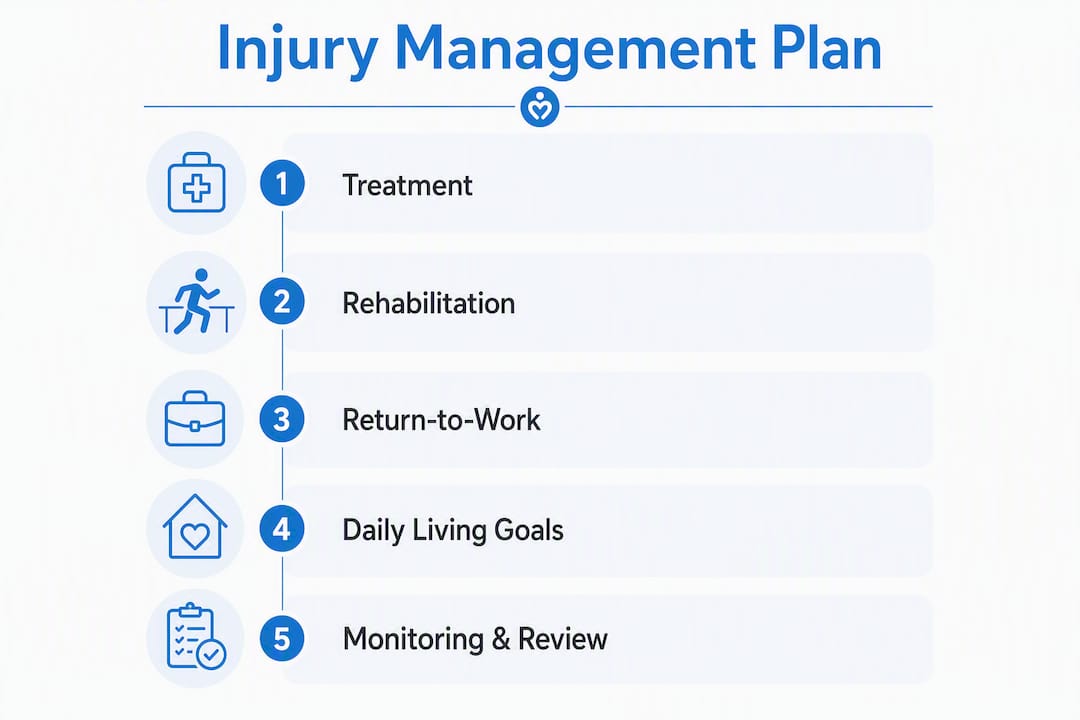
A complete IMP typically covers:
- Treatment details — type, frequency and provider (physiotherapy, psychology, specialist review)
- Rehabilitation activities — graded exercise programmes, vocational rehabilitation, functional capacity assessments
- Specific RTW goal — the target role, hours and duties the worker is aiming toward
- Suitable duties and hours — what the worker can do now, with any restrictions clearly stated
- Timeframes for review — scheduled dates to reassess progress and update the plan
- Roles and responsibilities — who does what and by when (insurer, employer, worker, treating doctor)
- Approved services — which treatments and providers the insurer has approved
- Communication plan — how updates are shared between parties
- Documented consent — the worker’s agreement to the plan and its goals
According to icare’s fact sheet, a typical IMP also includes activities of daily living goals alongside the clinical and vocational elements, which matters most for workers with serious or complex injuries.
Sample IMP checklist
Use this to check whether a plan you have received is complete:
- [ ] Worker’s name, claim number and injury date
- [ ] Named treating doctor and other providers
- [ ] Current capacity and medical restrictions documented
- [ ] Specific RTW goal stated (role, hours, target date)
- [ ] Suitable duties listed with realistic hours
- [ ] Treatment type and frequency approved
- [ ] Rehabilitation activities included
- [ ] Review dates set
- [ ] Responsibilities assigned by name or role
- [ ] Worker’s signature or written agreement recorded
Pro Tip: Read the suitable duties section carefully. Vague entries like “light duties as available” are red flags. A well-written duties section names specific tasks, states hour limits, and includes an escalation trigger — what happens if those duties are not available or the worker’s capacity changes.
Who prepares, signs and implements the IMP?
Each stakeholder has a defined role, and knowing who to contact for what saves time when things stall.

SIRA’s good practice guidance identifies the insurer’s case manager as the person who coordinates all aspects of a claim and is normally the primary contact for developing the IMP. That coordination role carries real weight: the case manager is responsible for pulling together input from the employer, treating doctor and rehabilitation provider, then drafting a plan that all parties can agree to.
| Stakeholder | Core responsibilities | Typical timeframe |
|---|---|---|
| Insurer / case manager | Develop and coordinate the IMP; approve services; review and vary the plan | Within 20 working days of significant injury identification |
| Injured worker | Attend appointments; follow agreed actions; notify insurer of changes | Ongoing from plan commencement |
| Employer | Offer suitable duties; communicate capacity changes; keep records | From plan commencement |
| Nominated treating doctor | Provide medical certificates; advise on capacity; contribute to goal-setting | At each consultation |
| Rehabilitation provider | Deliver rehabilitation services; report progress to case manager | Per approved service schedule |
| Union / worker representative | Advocate for worker; attend meetings if requested | As needed |
Written agreement matters because it creates accountability. When a worker signs an IMP, they are not simply acknowledging receipt — they are agreeing to the goals and actions set out in it. That mutual commitment is what allows either party to point to the plan if obligations are not met. Understanding your workplace rights after serious injury is worth doing before you sign anything you are unsure about.
How is an IMP developed and implemented?
The process follows a clear sequence, and knowing the milestones helps you spot when something is running late.
- Early notification and triage (Day 1–2). The worker notifies the employer of the injury. The employer notifies the insurer. The insurer opens a claim and begins initial assessment.
- Significant injury identification (by Day 7). If the worker has been incapacitated for more than seven continuous days, the injury is classified as significant. icare confirms the insurer must then develop an IMP within 20 working days of that identification.
- Stakeholder consultation (Weeks 1–3). The case manager contacts the treating doctor, employer and worker to gather information on capacity, available duties and treatment needs.
- Draft IMP (Weeks 2–4). The case manager prepares a draft incorporating medical advice, employer capacity and the worker’s RTW goal.
- Agreement and sign-off (Weeks 3–4). All parties review the draft. The worker and employer confirm suitable duties are realistic. The plan is signed or formally agreed.
- Implementation (from Week 4 onward). The worker commences suitable duties. Approved treatment begins. The case manager monitors progress.
- Review and variation (ongoing). The plan is reviewed at scheduled intervals and updated as the worker’s capacity changes. icare guidance notes that goals should be bite-sized and made more detailed as the claim progresses.
One practical note on record-keeping: keep a dated copy of every version of the IMP, every capacity certificate, and every email about duties or appointments. If a dispute arises later, contemporaneous records are far more persuasive than memory. The workplace injury timeline gives a broader picture of what to expect at each stage of a claim.
How does an IMP differ from a return-to-work plan and other documents?
Workers and employers often receive several documents during a claim and mix them up. Here is what each one actually is.

Injury management plan (IMP): A formal, insurer-led document covering treatment, rehabilitation and RTW goals. It is a regulatory requirement for significant injuries in NSW and carries legal weight. Prepared by the insurer’s case manager.
Return-to-work (RTW) plan: A shorter, employer-led document that sets out the specific duties, hours and conditions for the worker’s return. It sits within the broader IMP framework and is usually prepared by the employer with input from the treating doctor.
Rehabilitation plan: A provider-specific document prepared by a rehabilitation consultant. It details the clinical and vocational rehabilitation programme and feeds into the IMP.
Case management notes: Internal insurer records. Not a plan — not shared with the worker as a matter of course, though workers can request access to information held about them.
Two acronyms that cause regular confusion:
- IMC (injury management coordinator or committee): The person or group within the insurer or employer responsible for coordinating injury management activities. An IMC may be involved in developing or reviewing the IMP and is a point of contact for escalating concerns.
- IME (independent medical examination): A medical assessment arranged by the insurer, using a doctor who is not the worker’s treating practitioner. An IMP will often reference an IME when there is a dispute about capacity or treatment needs. The IME report can influence what the IMP says about suitable duties or approved treatment.
In practice, an IMP might note that an IME has been requested to clarify the worker’s functional capacity, with the plan to be updated once the report is received. That is normal. What is not normal is an insurer using an IME result to unilaterally change agreed duties without consulting the worker.
What is the legal framework, and what happens when parties disagree?
In NSW, the regulatory framework for IMPs sits under the workers compensation legislation administered by SIRA. The SIRA standards of practice set out insurer obligations, and icare oversees the claims service providers (CSPs) that manage most NSW workers compensation claims. Employers also carry obligations under the employer liability framework to support return-to-work.
When an IMP is not followed, the steps below give you a clear path forward:
- Escalate to SIRA or icare — If the insurer does not respond or the issue is not resolved, lodge a complaint with SIRA or contact icare’s dispute resolution team. Workers can also access conciliation through the Personal Injury Commission.
Pro Tip: Time limits apply to workers compensation disputes in NSW. Keep every email and letter dated. A contemporaneous note written the same day an event occurs is far stronger evidence than a reconstruction written weeks later. If you are unsure whether a deadline applies to your situation, get legal advice before the window closes.
What should workers and employers do when presented with an IMP?
Acting promptly and keeping records from the start protects both parties if the plan is later disputed.
| Worker: immediate steps | Employer: immediate steps |
|---|---|
| Read the IMP in full before signing | Review the suitable duties section against actual available work |
| Ask the case manager to clarify anything unclear | Confirm in writing that the listed duties are available |
| Keep a signed copy and note the date received | Keep a copy of the signed IMP and all subsequent versions |
| Attend all scheduled appointments | Communicate any changes to available duties to the case manager promptly |
| Notify the insurer if your capacity changes | Keep timesheets and attendance records for the worker on suitable duties |
| Do not agree to duties your doctor has not approved | Do not alter duties without consulting the case manager and treating doctor |
Red flags that should prompt follow-up or legal advice:
- Suitable duties are described vaguely or do not match the treating doctor’s restrictions
- No review dates are set
- The treating doctor’s input is absent or contradicted
- The insurer has changed the plan without consulting you
- Timeframes have passed with no action taken
For evidence to collect and retain: keep all medical reports and capacity certificates, dated emails with the insurer and employer, copies of every IMP version, timesheets, and any written communications about duties or appointments. The workplace injury evidence guide covers what supporting material carries the most weight in a dispute.
Sample email a worker can send to request clarification:
When should you get legal help about an IMP?
Most IMP issues can be resolved through direct communication with the case manager. Some cannot.
Seek legal advice when:
- The insurer has not developed an IMP within the required timeframe after a significant injury is identified
- The plan contains duties that contradict the treating doctor’s restrictions
- The insurer or employer is ignoring agreed duties or failing to provide approved treatment
- The insurer has made unilateral changes to the plan without consultation
- Repeated non-compliance is affecting your recovery or income
- You are approaching a dispute resolution deadline and do not know your rights
A workers compensation lawyer can review your IMP and supporting documents, advise on what obligations have been breached, negotiate with the insurer directly, prepare a formal letter of demand, and represent you at conciliation or tribunal hearings. Understanding why insurers deny serious injury claims can also help you anticipate and counter common insurer positions before they become formal disputes.
Bring to a first legal meeting: the IMP (all versions), capacity certificates, medical reports, all written communications with the insurer and employer, and any timesheets or duty records. A lawyer will typically assess the documents, identify the breach or gap, and advise on the fastest path to resolution — whether that is a letter to the insurer, a conciliation application, or a variation request. Outcomes lawyers commonly pursue include plan variation, insurer compliance, reinstatement of approved treatment, and in some cases compensation adjustments where non-compliance has caused financial loss.
Key takeaways
An injury management plan is a legally required, insurer-led document in NSW that must be developed within 20 working days of a significant injury and must include agreed treatment, rehabilitation goals, suitable duties, timeframes and assigned responsibilities.
| Point | Details |
|---|---|
| What an IMP is | A written, collaborative plan coordinating treatment, rehabilitation and RTW actions for an injured worker. |
| NSW trigger and timing | Significant injury means incapacity exceeding seven continuous days; the insurer must develop the IMP within 20 working days. |
| Who must be involved | Insurer, injured worker, employer and nominated treating doctor must all contribute to the plan. |
| Key components to check | Specific RTW goal, suitable duties with restrictions, approved treatment, review dates and assigned responsibilities. |
| If the plan is not followed | Document the issue, notify in writing, request a variation, and escalate to SIRA or seek legal advice if unresolved. |
| Carelawyers | Carelawyers assists NSW workers with IMP disputes, from document review and insurer negotiation to conciliation representation. |
Why worker involvement in an IMP changes everything
The conventional view of an IMP is that it is an administrative document the insurer produces and the worker signs. That framing misses the point entirely.
When a worker is genuinely consulted during the drafting stage, the goals in the plan reflect what is actually achievable given their medical restrictions, their workplace, and their life. Plans built that way tend to hold. Plans handed to a worker as a fait accompli tend to fall apart at the first review, because the duties are unrealistic, the timeframes are arbitrary, or the worker never agreed with the RTW goal in the first place.
SIRA’s good practice guidance makes the point directly: an effective IMP builds mutual accountability and enables timely review to avoid delays and optimise recovery. That accountability only exists when all parties have genuinely contributed. A worker who helped set the goals is far more likely to work toward them. An employer who confirmed the duties are available is far less likely to claim later that they were not.
The legal value of documented agreement is also underestimated. A clearly written IMP with measurable, staged goals is much easier to enforce at conciliation because the obligations and timeframes are on paper. Vague plans protect no one. If your IMP does not have specific duties, specific dates and specific responsibilities, ask for it to be rewritten before you sign it. That request is not obstructive — it is exactly what the good practice framework anticipates.
Carelawyers can help when your IMP is not working
When an injury management plan is not being followed, or was never properly developed in the first place, the gap between what the insurer is obliged to do and what is actually happening can cost you treatment, income and recovery time. Carelawyers works with injured workers across NSW to close that gap.

The team reviews your IMP and supporting documents, identifies what obligations have been missed, and negotiates directly with the insurer to get the plan back on track. Where negotiation is not enough, Carelawyers represents workers at conciliation and tribunal hearings. The firm operates on a no-win-no-fee basis for eligible claims, so cost is not a reason to delay getting advice.
If you are unsure whether your IMP is legally adequate, or if the insurer or employer is not meeting their obligations, the right time to get advice is before a deadline passes. Start with the workplace injury claim process guide to understand where your claim sits, then contact Carelawyers for an initial assessment of your IMP and your options.
This article provides general information about injury management plans in NSW. It is not legal advice. Confirm current rules and your specific entitlements with SIRA, icare or a qualified workers compensation lawyer.
Useful sources for further reading
The sources below are the primary references used in this article. Check them directly for the most current guidance, as workers compensation rules can change.
- Injury management plans — SIRA: SIRA’s main page on IMPs, including the insurer’s obligations and the worker’s rights during the injury management process.
- Good practice injury management plan — SIRA: Detailed guidance on what a well-developed IMP should contain, including stakeholder roles and goal-setting principles.
- Injury management plan (IMP) — SIRA glossary: The regulatory definition of an IMP and its role in the NSW workers compensation system.
- Injury management planning — icare: icare’s guidance on the 7-day trigger, the 20-working-day development requirement and goal-setting practice.
- What is an injury management plan — icare fact sheet: A concise summary of IMP components and the insurer’s development obligations.
- Standards of practice S12 — SIRA: The regulatory standards insurers must meet when developing and maintaining IMPs in NSW.
| Source | Best used for |
|---|---|
| SIRA IMP main page | Understanding insurer obligations and worker rights |
| SIRA good practice guide | Checking whether your IMP meets the expected standard |
| icare injury management planning | Confirming timing rules and goal-setting requirements |
| icare fact sheet | Quick reference on IMP components |
| SIRA standards of practice S12 | Regulatory basis for complaints or disputes |
| Carelawyers | Legal advice and representation for IMP disputes in NSW |
For workers outside NSW, check your state’s workers compensation authority for equivalent rules — the IMP framework varies by jurisdiction. For complex disputes or where the insurer is not meeting its obligations, contact a qualified workers compensation lawyer before time limits expire.


