

What is damages in an accident claim?
Damages in an accident claim are the monetary compensation awarded to an injured person for losses caused by another party’s wrongful conduct. The legal term “damages” covers two distinct categories: special and general damages, which compensate financial losses and intangible suffering respectively. In New South Wales, legislation such as the Motor Accident Injuries Act and bodies like the Medical Assessment Service govern how these amounts are assessed. Understanding what you can claim, and how each category is calculated, is the first step toward recovering what you are genuinely owed.
What is damages in an accident claim, and why does it matter?
Damages exist to restore you, as closely as money can, to the position you were in before the accident. The goal is not a windfall. It is financial and personal restoration to your pre-accident state.
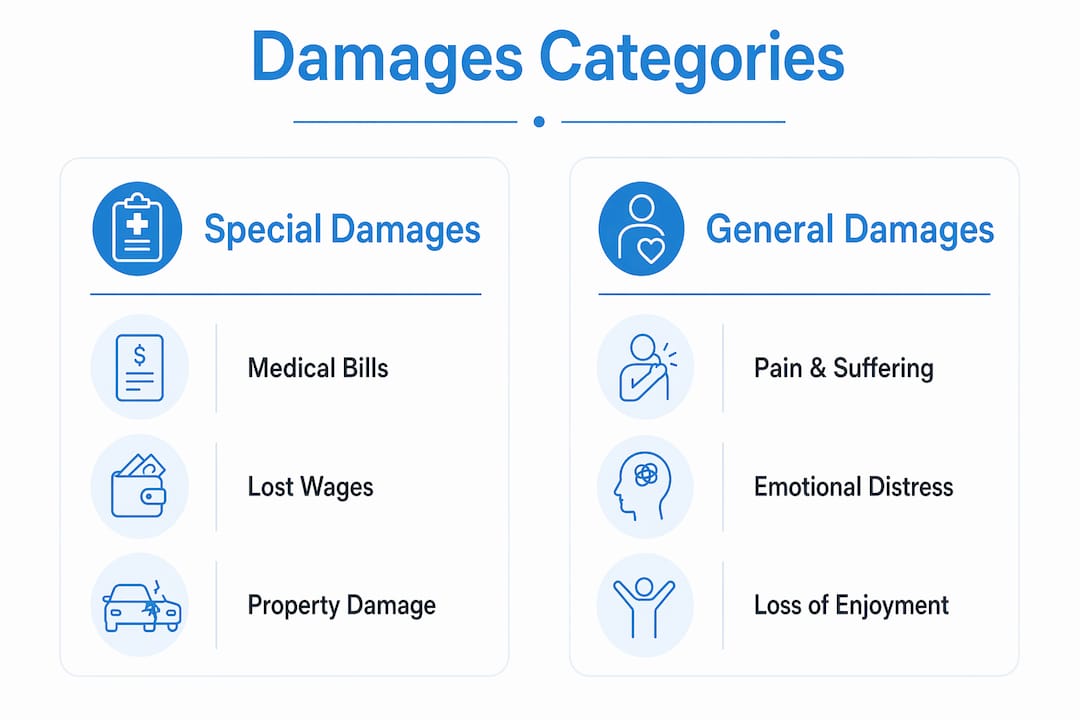
Personal injury damages split into two broad categories. Special damages cover measurable financial losses: medical bills, lost wages, and property repair costs. General damages cover losses that cannot be tallied on a receipt, such as pain, suffering, and loss of enjoyment of life. Both categories form part of your total accident claim compensation, and both require evidence to support them.

Negligence and damages are directly linked. To claim damages, you must show that another party’s negligence caused your injury. Without establishing fault, neither category of compensation is available to you.
What are special damages in a personal injury claim?
Special damages cover every quantifiable financial loss you have suffered because of the accident. Courts and insurers call these “economic damages” because each item carries a dollar figure you can prove with documents.
Common heads of special damages include:
- Medical expenses: Hospital bills, surgery costs, physiotherapy, medication, and ongoing rehabilitation.
- Lost income: Wages you missed while recovering from your injuries.
- Future loss of earning capacity: Reduced income if your injuries permanently limit your ability to work.
- Property damage: Repair or replacement costs for your vehicle or other damaged property.
- Out-of-pocket expenses: Travel to medical appointments, home modifications, and care costs.
Lost wages cover both past income missed during recovery and future career impacts if your injuries reduce your earning capacity long term. A tradesperson who can no longer perform physical work faces a very different future loss calculation than an office worker with a minor soft tissue injury.
Documentation is everything for special damages. Every receipt, invoice, payslip, and employment record strengthens your claim. Gaps in documentation give insurers grounds to reduce or reject individual items.
Pro Tip: Keep a dedicated folder, physical or digital, for every expense related to your injury from day one. Receipts for petrol to medical appointments count. So do invoices for home help you needed during recovery.
What are general damages and how are pain and suffering assessed?
General damages compensate for losses that have no price tag. Non-economic damages include pain and suffering, loss of enjoyment of life, emotional distress, disfigurement, and loss of consortium. Because these losses are subjective, assessing them is more complex than adding up receipts.
Courts rely on medical evidence and personal impact statements to assess general damages. A treating specialist’s report describing your ongoing pain, a psychologist’s assessment of your emotional distress, and your own account of how your daily life has changed all carry weight. The more specific and consistent this evidence is, the stronger your claim.
In NSW, a critical legal threshold applies to motor accident claims. Claiming non-economic loss requires your injury to exceed a 10% Whole Person Impairment (WPI) rating, assessed by the Medical Assessment Service. This threshold exists because impairment evidence is central to the system’s integrity. Without meeting it, you can still recover economic losses, but pain and suffering compensation is not available to you.
The WPI threshold shapes legal strategy from the outset. If your injuries are borderline, early and thorough medical assessment becomes critical. For more detail on how pain and suffering compensation is calculated in car accident claims, Carelawyers has a dedicated guide.
Pro Tip: Do not downplay your symptoms to your doctor. Accurate, detailed medical records are the foundation of any general damages claim. Underreporting pain or functional limitations at early appointments can undermine your WPI assessment later.
The types of losses covered under general damages include:
- Pain and suffering: Physical pain and mental anguish caused by the injury.
- Loss of enjoyment of life: Inability to participate in hobbies, sport, or social activities you previously enjoyed.
- Emotional distress: Anxiety, depression, and psychological trauma resulting from the accident or injury.
- Disfigurement: Permanent scarring or physical changes affecting your appearance.
- Loss of consortium: Impact on your relationship with a spouse or partner due to your injuries.
How to calculate damages in a personal injury accident claim
Calculating damages combines hard numbers with medico-legal assessments. Medical and legal assessments, including impairment ratings, are central to determining the final value of a claim, particularly for general damages.
The table below shows how the two categories differ in calculation approach:
| Damage type | Basis for calculation | Evidence required |
|---|---|---|
| Medical expenses | Actual costs incurred | Invoices, receipts, treatment records |
| Lost income (past) | Wages missed during recovery | Payslips, employer confirmation |
| Future earning capacity | Projected income loss over career | Expert economic evidence, medical prognosis |
| Pain and suffering | WPI rating and personal impact | Medical reports, impact statements |
| Loss of enjoyment | Severity and permanence of injury | Specialist reports, personal evidence |
For special damages, the calculation is additive. You total your documented expenses and losses. For general damages, the process is more involved. A medico-legal specialist assesses your WPI, and that rating, combined with descriptions of your life impact, informs the compensation figure. In NSW motor accident claims, the Medical Assessment Service conducts this assessment independently.
Caps and thresholds apply in Australia. NSW motor accident legislation sets limits on non-economic loss for lower-severity injuries. Workplace injury claims under NSW workers compensation law follow separate rules, which Carelawyers covers in detail for work injury damages.
Pro Tip: Ask your lawyer to obtain a medico-legal report early. Waiting until just before settlement can leave you with insufficient time to challenge an unfavourable WPI rating.
What practical steps should you take when making a damages claim?
Acting quickly and methodically after an accident directly affects the strength of your claim. The car accident compensation process has specific steps, and missing any of them can reduce your recovery.
- Seek medical attention immediately. Your health comes first, and early medical records establish the link between the accident and your injuries. Delayed treatment gives insurers grounds to argue your injuries were not caused by the accident.
- Document everything from day one. Photograph the accident scene, your injuries, and any property damage. Collect witness details. Keep every medical receipt and invoice.
- Report the accident. Notify police where required and report to the relevant insurer promptly. In NSW, motor accident claims must be reported to the at-fault driver’s CTP insurer.
- Obtain a formal medical assessment. Your treating doctor’s records are a starting point. A medico-legal specialist’s report is often needed to support a WPI assessment and general damages claim.
- Mitigate your losses. You have a legal obligation to take reasonable steps to reduce your losses. Refusing appropriate treatment or failing to return to suitable work when medically cleared can reduce your compensation.
- Engage a personal injury lawyer early. Legal advice before you accept any insurer offer protects you from settling for less than your claim is worth. Carelawyers offers direct access to lawyers without intermediaries.
- Avoid common pitfalls. Do not give recorded statements to insurers without legal advice. Do not post about your accident or injuries on social media. Both can be used to undermine your claim.
If you were involved in an accident and lack a police report, that does not automatically end your claim. Carelawyers has specific guidance on claiming without a police report for exactly this situation.
Key takeaways
Damages in an accident claim divide into special (economic) and general (non-economic) categories, and the strength of your evidence determines how much of each you recover.
| Point | Details |
|---|---|
| Two categories of damages | Special damages cover financial losses; general damages cover pain, suffering, and life impact. |
| Documentation drives special damages | Every receipt, invoice, and payslip strengthens your economic loss claim. |
| NSW WPI threshold applies | You must exceed 10% Whole Person Impairment to claim non-economic loss in NSW motor accident claims. |
| Medico-legal evidence is critical | Independent medical assessments determine WPI ratings and support general damages claims. |
| Act early and mitigate losses | Prompt medical treatment and reasonable steps to reduce losses protect your full entitlement. |
What I have learned about damages claims that most guides skip
After working closely with personal injury claimants in NSW, the single biggest mistake I see is treating the WPI threshold as an afterthought. Claimants focus on their medical bills and lost wages, which are important, but they underestimate how much the 10% WPI threshold shapes the entire claim strategy. If your injuries sit near that threshold, the difference between a thorough early assessment and a rushed one can be the difference between recovering pain and suffering compensation or walking away with only economic losses.
The second thing most guides miss is the obligation to mitigate. Claimants sometimes believe that the worse their situation appears, the more they will receive. That is not how it works. Insurers and courts expect you to take reasonable steps to recover and return to work where possible. Failing to do so can reduce your award, even when your injuries are genuine.
My honest view is that the claims process rewards preparation, not persistence. The claimants who recover the most are not necessarily the most seriously injured. They are the ones who documented everything early, obtained proper medical assessments, and had legal advice before accepting any offer. Carelawyers’ approach of connecting clients directly with their lawyer, without a chain of intermediaries, makes that preparation far more effective in practice.
— Daniel
Carelawyers can help you assess and pursue your damages claim
Knowing what damages you are entitled to is one thing. Building the evidence to support each head of loss, meeting the NSW WPI threshold, and negotiating with an insurer is another matter entirely.

Carelawyers specialises in personal injury claims across Sydney and NSW, with a success rate of over 99% of claims won. Their personal injury lawyers work directly with you, without middlemen, so your questions get answered by the person handling your claim. For serious injuries, their claim timeline management guide explains exactly what to expect at each stage. Contact Carelawyers for a no-win-no-fee consultation and get a clear picture of what your claim is worth.
FAQ
What does “damages” mean in a personal injury claim?
Damages are the monetary compensation awarded to an injured person for losses caused by another party’s negligence. They cover both financial losses (special damages) and non-financial suffering (general damages).
What is the difference between special and general damages?
Special damages are verifiable financial losses such as medical bills and lost wages. General damages cover subjective harm like pain, suffering, and loss of enjoyment of life.
Do I need to meet a threshold to claim pain and suffering in NSW?
Yes. NSW motor accident claims require your injury to exceed a 10% Whole Person Impairment rating, assessed by the Medical Assessment Service, before non-economic loss compensation is available.
How are general damages calculated?
General damages are assessed using medico-legal reports, WPI ratings, and personal impact statements describing how the injury has affected your daily life, relationships, and activities.
Can I claim for emotional distress after an accident?
Claiming for emotional distress falls under general damages and is available where your psychological injury is supported by medical evidence and, in NSW motor accident claims, where you meet the WPI threshold.


