

Weekly workers comp benefits: your 2026 guide
Weekly workers comp benefits are weekly payments that replace part of your lost wages after a work-related injury, calculated as a percentage of your pre-injury earnings and subject to state-set maximum and minimum amounts. The formal industry term is weekly indemnity benefits or weekly income benefits, though most injured workers simply call them workers comp weekly payments. Getting this right matters. Underpayments happen more often than insurers admit, and knowing how your benefit is calculated is the first step toward making sure you receive every dollar you are entitled to.
How are weekly workers comp benefits calculated?
Weekly workers comp benefits are based on your Average Weekly Wage (AWW), which is the foundation of every payment calculation across Australian state schemes. The AWW represents the average of your earnings over a set period before your injury date. In many jurisdictions, this lookback period is 13 weeks, and differences in lookback periods directly affect the AWW used as the benefit base, which in turn influences your final weekly payment.
Once your AWW is established, a percentage rate is applied to produce your weekly benefit amount. The percentage varies by state and by benefit type, but typical rates sit between 80% and 95% of your pre-injury earnings. Some jurisdictions use a “spendable weekly wage” rather than gross AWW, which accounts for tax deductions and produces a slightly different base figure.
Several factors feed into your AWW calculation:
- Regular wages and salary from your primary employer
- Overtime pay earned consistently before the injury
- Bonuses and allowances that form part of your ordinary pay
- Second job income in some states, where dual employment is recognised
- Commission payments averaged over the lookback period
Each of these inclusions can shift your AWW materially. A worker who regularly earns overtime may have a significantly higher AWW than their base salary alone would suggest.
Pro Tip: Check which wage calculation method your state uses before accepting any payment figure. Some states use gross wages; others use spendable or net wages. The difference can be hundreds of dollars per week.

What are the common types of weekly compensation benefits?
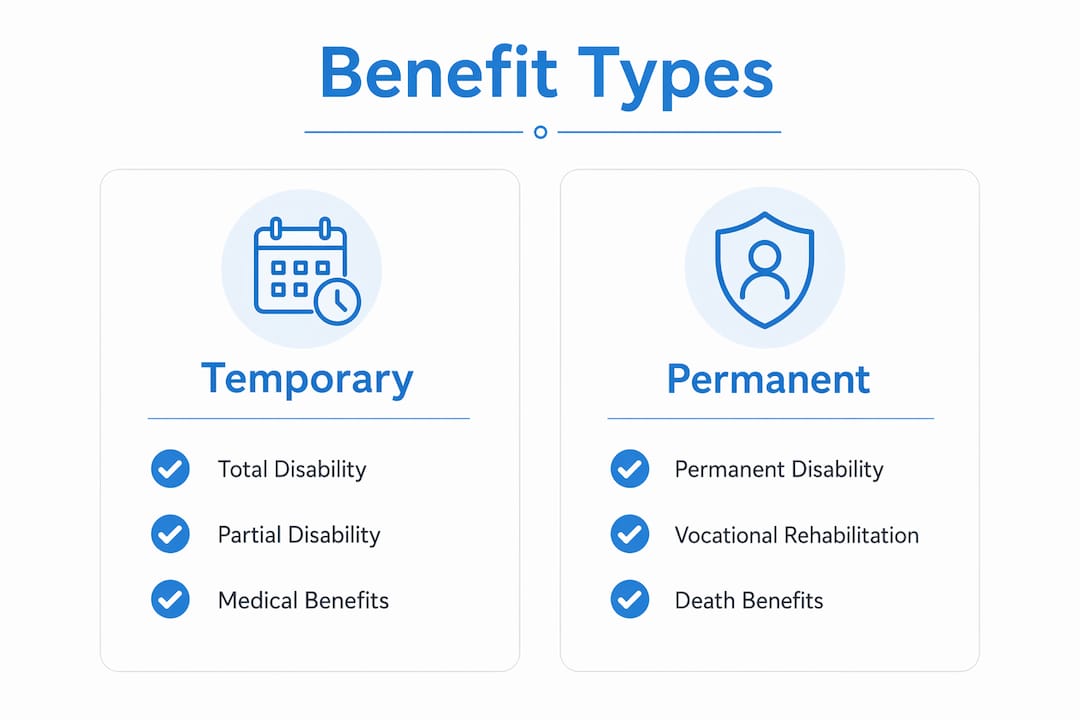
Benefit type classification determines both how much you receive and for how long. Misunderstanding your classification between Temporary Total Disability (TTD), Temporary Partial Disability (TPD), and impairment benefits is one of the most common sources of confusion for injured workers.
The three main types work as follows:
- Temporary Total Disability (TTD): Paid when you cannot work at all due to your injury. In Alaska, for example, TTD is set at 80% of spendable weekly wage, subject to statutory limits. Australian states apply similar logic, with NSW paying 95% of pre-injury earnings for the first 13 weeks.
- Temporary Partial Disability (TPD): Paid when you return to work in a reduced capacity. The benefit is calculated on the wage gap caused by your injury. In Alaska, TPD equals 80% of the wage difference between pre-injury and post-injury earnings. If your post-injury earnings increase, your TPD payment decreases accordingly.
- Impairment Income Benefits: Paid for permanent impairment after maximum medical improvement is reached. These are calculated differently, often as a lump sum or long-term weekly amount tied to your impairment rating percentage.
Payment duration also differs by type. TTD payments typically continue until you return to work, reach maximum medical improvement, or hit a statutory time limit. TPD payments adjust as your work capacity changes. Injury recovery progress and medical certification significantly influence whether temporary disability benefits continue or are adjusted at each review point.
Pro Tip: Ask your claims manager to confirm in writing which benefit type you are receiving. Your classification affects your payment rate, duration, and review schedule. Knowing this upfront prevents surprises later.
How do maximum and minimum benefit caps affect your payments?
Statutory caps and floors set the upper and lower limits on what you can receive each week, regardless of what the percentage calculation produces. Weekly benefit caps limit payments to a percentage of the state average weekly wage (SAWW), while minimum floors guarantee a base amount even for low-income earners.
The practical effect is significant. A high-earning worker whose calculated benefit exceeds the cap will receive less than their percentage rate implies. A lower-income worker whose calculated benefit falls below the floor will receive more than the raw percentage would suggest. Benefit caps can cause differing payments even for workers with similar incomes and injuries, which is why knowing the cap amount for your state and benefit type is not optional.
Caps are also indexed periodically. Caps adjusted annually mean your benefit can step up or down over time even if your wages and injury status remain unchanged. The timing of your injury relative to the indexation date can affect your payment for the entire duration of your claim.
Key points to understand about caps and floors:
- The cap applies at the benefit type level, not just the overall claim level
- A high earner on TTD may be capped even when the 95% calculation suggests a higher figure
- Minimum floors protect low-income workers from receiving negligible weekly amounts
- Indexation dates vary by state and are tied to published average weekly earnings data
- You can use a free compensation calculator to estimate how caps affect your specific payment
How do workers compensation weekly payments vary across australian states?
Australian state workers compensation schemes vary considerably in their weekly payment rates, duration rules, and caps. Two workers with identical injuries and wages can receive materially different weekly amounts depending solely on which state they work in.
Here is a summary of key state differences:
| State | Initial Weekly Rate | Duration Before Reduction | Notes |
|---|---|---|---|
| NSW | 95% of pre-injury earnings | First 13 weeks | Reduces to 80% after 13 weeks |
| Victoria | 95% of pre-injury earnings | First 13 weeks | Reduces to 80% after 13 weeks |
| Queensland | 85% of ordinary earnings | Up to 26 weeks | Cessation rules apply at set points |
| Western Australia | 100% of ordinary earnings | First week | Reduces to set rates thereafter |
| South Australia | 100% for first 52 weeks | First 52 weeks | Reduces to 80% after 52 weeks |
State-specific features that affect your payments include:
- NSW and Victoria both start at 95% but reduce to 80% after the initial period, which can represent a significant weekly drop for higher earners
- Queensland applies an 85% rate from the outset, with benefit cessation rules that can stop payments entirely at certain milestones
- Western Australia pays 100% initially but transitions quickly to a lower rate
- South Australia offers one of the more generous initial periods at 100% for the first year
Understanding your state’s rules is not just useful background knowledge. It is the difference between accepting an underpayment and disputing it successfully.
What practical steps can you take to ensure fair payments?
Receiving fair workers comp wage replacement requires active management of your claim, not passive acceptance of whatever figure appears in your bank account. Disputing your benefits payment requires understanding your state’s wage calculation method, lookback period, and how partial return to work affects your benefit amount.
Follow these steps to protect your entitlements:
- Review every payment statement against your calculated AWW and the applicable percentage rate for your benefit type
- Keep copies of all payslips from the 13 weeks before your injury, including any overtime, bonuses, or allowances
- Maintain consistent medical treatment and obtain regular medical certificates, since medical documentation directly affects whether payments continue
- Track any changes to your work capacity and report them promptly, as partial wage-earning capacity post-injury directly adjusts your TPD benefit
- Communicate in writing with your claims manager so you have a record of every decision and instruction
- Seek legal advice early if payments are delayed, reduced without explanation, or stopped before you have returned to full capacity
The workplace injury claim process involves multiple review points where insurers reassess your entitlements. Being prepared at each stage is the most reliable way to avoid underpayment.
Pro Tip: Contact a specialised workers compensation lawyer before your first review meeting with the insurer. Early advice costs nothing with a No Win No Fee firm, and it can prevent payment reductions that are difficult to reverse later.
Key takeaways
Weekly workers comp benefits are calculated as a percentage of your AWW, subject to statutory caps and floors that vary by state and benefit type, making it critical to verify your classification and payment figures at every stage of your claim.
| Point | Details |
|---|---|
| AWW is the payment foundation | Your Average Weekly Wage from the 13 weeks before injury sets your benefit base. |
| Benefit type determines your rate | TTD, TPD, and impairment benefits each carry different percentage rates and durations. |
| Caps can reduce high earners’ payments | A calculated benefit above the state cap is paid at the cap, not the percentage rate. |
| State rules differ significantly | NSW, Victoria, Queensland, and WA each apply different rates, durations, and cessation rules. |
| Active claim management protects you | Keeping wage records, medical certificates, and written communications prevents underpayment. |
What i have learned about workers comp payments after years in this field
Most injured workers assume their weekly payment is a straightforward calculation. It rarely is. The combination of AWW lookback periods, benefit type classifications, state-specific caps, and indexation cycles means that two workers sitting in the same hospital ward with the same diagnosis can receive very different weekly amounts. That is not a flaw in the system. It is the system working exactly as designed, and it rewards the workers who understand it.
The most common mistake I see is workers accepting their initial payment without checking the AWW calculation. Insurers sometimes use a lookback period that excludes a high-earning week, or they omit overtime that was genuinely part of ordinary earnings. These are not always deliberate errors, but they consistently favour the insurer. A worker who does not check will never know.
The second mistake is waiting too long to get advice. By the time a worker contacts a lawyer, they may have already accepted a benefit type classification that limits their entitlements, or signed documents that affect their ability to dispute past payments. The workers compensation lawyers who handle these claims every day know exactly where the calculation errors occur and how to correct them.
My honest view is this: the system is not designed to be simple for injured workers. It is designed to be administratively manageable for insurers. That means you need to be your own advocate, or find someone who will advocate for you.
— Daniel
How Carelawyers can help you claim what you are owed

Carelawyers specialises in workers compensation claims across Sydney and NSW, with a success rate of over 99% of claims won. If your weekly payments feel wrong, have been reduced without explanation, or have stopped before you have fully recovered, Carelawyers can review your entitlements and tell you exactly where you stand. The firm operates on a No Win No Fee basis, which means you pay nothing unless your claim succeeds. You speak directly to your lawyer, not a case manager or paralegal. For injured workers who want clarity on their workers compensation entitlements without the stress of navigating it alone, a free consultation with Carelawyers is the most practical next step you can take.
FAQ
What is the average weekly workers comp benefit in australia?
Weekly benefit amounts vary by state and individual earnings, but most Australian schemes pay between 80% and 95% of pre-injury earnings for the initial period. The exact amount depends on your AWW, benefit type, and applicable state caps.
How long do weekly workers compensation payments last?
Payment duration depends on your state scheme and benefit type. In NSW and Victoria, full-rate payments typically apply for the first 13 weeks, after which the rate reduces. Payments can continue for years in serious cases, subject to ongoing medical certification and work capacity assessments.
Can my weekly benefit be reduced if i return to work part-time?
Yes. Under Temporary Partial Disability rules, your weekly benefit is recalculated based on the wage gap between your pre-injury earnings and your current post-injury earnings. As your post-injury income increases, your weekly benefit decreases accordingly.
What should i do if my weekly payments are stopped or reduced?
Request a written explanation from your insurer immediately and compare the stated reason against your medical certificates and work capacity status. If the reduction appears incorrect, contact a workers compensation lawyer before signing any documents or agreeing to any changes.
Does overtime count toward my workers comp weekly payment calculation?
Overtime is included in your AWW calculation in most Australian states, provided it was a regular and consistent part of your earnings before the injury. Occasional or one-off overtime may be excluded depending on your state’s rules and the lookback period applied.


