

Uninsured driver claim explained: your 2026 guide
An uninsured driver claim is the process where your own insurance policy steps in to cover your losses when the at-fault driver carries no insurance. This is formally known as an uninsured motorist (UM) claim, and understanding how it works is the first step toward recovering what you are owed. Roughly 1 in 8 drivers carries no liability insurance at all. That figure means the risk of being hit by an uninsured driver is far from remote. This guide covers the uninsured driver claim explained in plain terms: what cover applies, what steps to take, and how to protect your right to compensation.
What cover applies when hit by an uninsured driver?
Two main types of cover protect you when the at-fault driver has no insurance: uninsured motorist bodily injury (UMBI) and uninsured motorist property damage (UMPD). These sit within your own policy, not the other driver’s.
Uninsured motorist bodily injury (UMBI) pays for:
- Medical expenses and hospital bills
- Rehabilitation and ongoing treatment costs
- Lost wages while you recover
- Pain and suffering compensation
Uninsured motorist property damage (UMPD) covers:
- Repairs to your vehicle
- Replacement costs if your car is written off
- Damage to personal property inside the vehicle
UMBI also covers hit-and-run incidents, which is a detail many people miss. That means you do not need to identify the other driver to trigger this benefit.
Underinsured motorist cover (UIM) is a related but separate protection. It applies when the at-fault driver has some insurance, but not enough to cover your full losses. Knowing the difference matters because you may need to claim under both at different stages of recovery.

One lesser-known feature is coverage stacking. Stacking UM coverages can increase the total compensation available to you, but many insurers remove this option automatically unless you specifically request it. Check your policy documents or ask your insurer directly.
The role of your insurer after an accident with an uninsured driver is to act as the paying party in place of the at-fault driver. Your insurer steps into that role, but they still investigate the claim and can dispute liability.
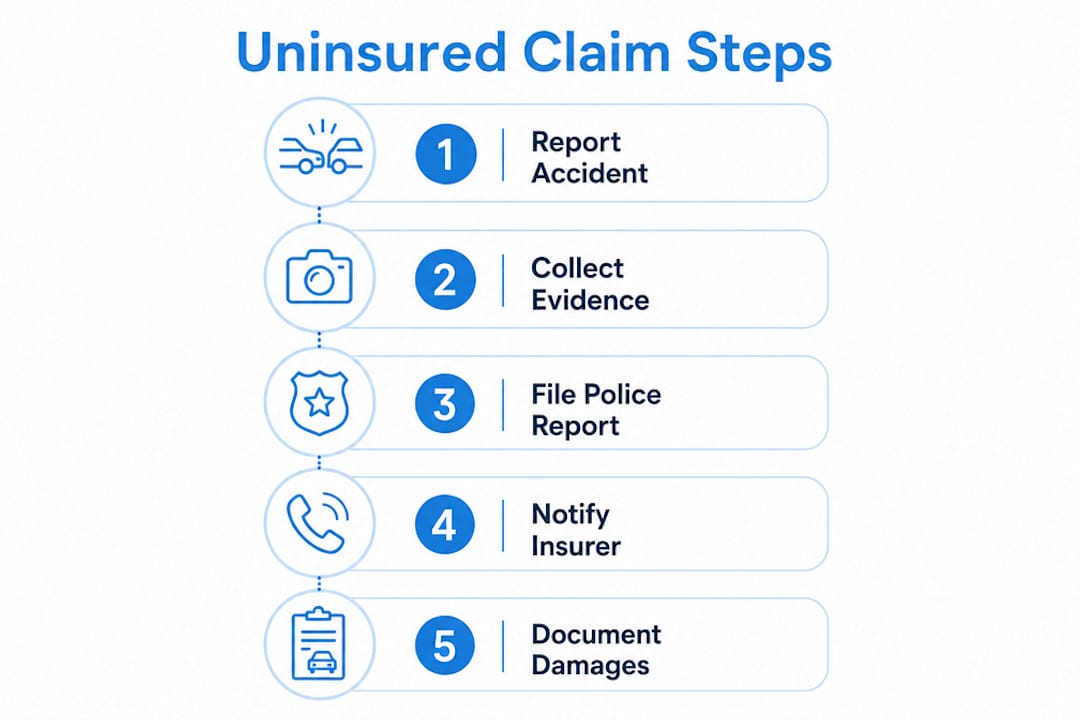
What to do immediately after an accident with an uninsured driver
The actions you take in the first hours after a crash directly affect whether your claim succeeds or fails. Speed and accuracy both matter.
- Call emergency services. Report the accident to police immediately. An official police report is your primary evidence that the incident occurred and that the other driver was uninsured.
- Gather evidence at the scene. Photograph vehicle positions, damage, road conditions, and any visible injuries. Collect names and contact details from witnesses before they leave.
- Record the other driver’s details. Note their name, licence plate, and any insurance information they offer, even if they claim to have no cover.
- Notify your insurer promptly. Most policies require accident reporting within 24–48 hours. Hit-and-run incidents often require a police report within 72 hours. Missing these windows can void your claim entirely.
- Seek medical attention. Even if you feel fine, see a doctor the same day. Delayed treatment gives insurers grounds to argue your injuries were not caused by the accident.
- Do not admit fault. Anything you say at the scene can be used against you during the claims process.
Pro Tip: Take a short video at the scene, not just photos. Video captures context, such as skid marks, traffic signals, and the overall scene layout, that still images often miss.
Official police reports within 24–72 hours are among the most critical documents in any uninsured motorist claim. A delayed or missing police report is one of the top reasons claims are denied outright.
If you are ever unsure whether a police report is strictly required, read the Carelawyers guide on filing without a police report before assuming you can skip it.
How to prove the other driver had no insurance
Your insurer will not pay out on a UM claim until you provide official proof that the other driver was uninsured. This is a firm requirement, not a formality.
The most reliable forms of proof include:
- A police report confirming the other driver produced no valid insurance certificate
- A written statement from the other driver admitting they carry no cover
- A letter from the other driver’s insurer confirming the policy did not exist or was cancelled
- Traffic authority or licensing records showing no registered insurance against the vehicle
Proving uninsured status requires official documentation before an insurer is obligated to trigger UM benefits. Verbal confirmation from the other driver is not enough on its own.
Witness statements and dashcam footage strengthen your position considerably. Footage from nearby businesses or traffic cameras can also fill gaps if your own dashcam was not running.
Pro Tip: Request a copy of the police report as soon as it is available, usually within a few days of filing. Do not wait for your insurer to obtain it. Having your own copy keeps the process moving.
Disputes over fault and uninsured status often end in arbitration rather than court. Most UM disputes resolve via arbitration, which means the quality of your evidence determines the outcome. Weak documentation rarely produces a fair result.
What damages can you claim and how to document them?
A UM claim can cover a broader range of losses than most people expect. Understanding what is recoverable prevents you from leaving money on the table.
Recoverable damages typically include:
- Medical expenses: hospital stays, surgery, physiotherapy, medication, and future treatment costs
- Lost income: wages lost during recovery, supported by an employer letter and payslips
- Pain and suffering: compensation for physical pain and psychological distress
- Vehicle repair or replacement costs
- Out-of-pocket expenses: transport to medical appointments, home care, and mobility aids
UMBI covers medical bills, lost wages, rehabilitation, and pain and suffering, though the exact scope varies by policy. Read your policy schedule carefully to confirm which categories apply.
The table below outlines the key document types needed to support each damage category:
| Damage type | Supporting documents |
|---|---|
| Medical expenses | Hospital invoices, receipts, treatment plans, specialist reports |
| Lost wages | Employer letter, payslips, tax returns for self-employed claimants |
| Pain and suffering | Medical records, psychological assessments, personal journal entries |
| Vehicle damage | Repair quotes, written-off vehicle valuation, photos of damage |
| Out-of-pocket costs | Receipts, bank statements, transport records |
A personal journal is one of the most underused tools in a claim. Recording daily pain levels, sleep disruption, and activity limitations creates a contemporaneous record that is hard for insurers to dismiss. Start it the day of the accident.
For a full breakdown of which recovery expenses are covered after a vehicle accident, Carelawyers provides a detailed 2026 guide that covers both insured and uninsured driver scenarios.
Common pitfalls that cause delays or denials
The claim process for uninsured drivers has several pressure points where things go wrong. Knowing them in advance is the most practical form of protection.
- Late reporting. Missing your insurer’s notification window is the single fastest way to lose your claim. Report within 24 hours wherever possible.
- Inconsistent statements. Late reporting, inconsistent statements, and delayed treatment are the top causes of UM claim denials. Every account you give, to police, your insurer, and medical staff, must align.
- Giving a recorded statement without legal advice. Insurers use recorded statements to find inconsistencies that justify reducing or denying your payout. Decline to provide one until you have spoken with a lawyer.
- Skipping or delaying medical treatment. A gap in treatment signals to insurers that your injuries were not serious. Attend every appointment and follow your treatment plan.
- Settling without consent-to-settle approval. Request consent-to-settle in writing before agreeing to any settlement figure. Some policies require insurer approval before you can settle with any third party.
- Suing the uninsured driver personally. Suing an uninsured driver personally is rarely effective. Most uninsured drivers lack the assets to pay a judgment. Your UM policy is the primary compensation avenue.
Early legal advice changes outcomes. A lawyer who specialises in accident claims can manage insurer communications, preserve evidence, and prevent the missteps that cost claimants thousands. The benefits of no win no fee representation are particularly relevant here, since upfront cost should never be the reason you face an insurer alone.
Key takeaways
An uninsured driver claim succeeds when you act fast, document everything, and understand exactly what your own policy covers before the insurer sets the terms.
| Point | Details |
|---|---|
| Report within 24–48 hours | Late notification is the most common reason UM claims are denied outright. |
| Prove uninsured status officially | Police reports and licensing records are required before UM benefits are triggered. |
| Document all damage categories | Medical records, employer letters, and a personal journal all support a stronger payout. |
| Decline recorded statements alone | Speak with a lawyer before giving any recorded statement to your insurer. |
| UM claims rarely raise premiums | Claims where you are not at fault typically do not result in premium surcharges. |
What I have learned from uninsured driver claims
After years of working alongside accident victims, the pattern I see most often is this: people underestimate their own insurer. There is a common assumption that because you pay premiums, your insurer is on your side. They are not adversaries, but they are not advocates either. Their job is to assess liability and minimise payouts. Yours is to give them no reason to do so.
The claimants who recover the most are not necessarily those with the worst injuries. They are the ones who documented everything from day one, got medical attention immediately, and called a lawyer before giving any statement. Early and accurate documentation dramatically improves claim success. That is not legal theory. That is what I see play out in real claims, repeatedly.
The other thing most articles do not say clearly enough: UM claims often go to arbitration, not court. Arbitration sounds less formal, but the evidence standards are just as demanding. A poorly documented claim does not get a sympathetic hearing in arbitration. It gets a low offer.
My honest advice is to treat your claim like a legal case from the moment the crash happens, because it is one. Photograph everything, keep every receipt, write in a journal daily, and do not speak to your insurer’s adjuster without knowing your rights first. The claim timeline and stages can stretch for months. The groundwork you lay in the first 72 hours determines how that time ends.
— Daniel
How Carelawyers can help with your uninsured driver claim
Facing an insurer alone after an accident with an uninsured driver is stressful and genuinely risky. Carelawyers specialises in car accident and personal injury claims across Sydney, with a success rate of over 99% of claims won.

The team at Carelawyers works on a no win no fee basis, which means you pay nothing unless your claim succeeds. Every client speaks directly with their lawyer, not a case manager or call centre. If you are unsure what damages you can claim or how to handle insurer pressure, Carelawyers offers a straightforward case evaluation to help you understand your position and your options. Contact Carelawyers today to get started.
FAQ
What is an uninsured motorist claim?
An uninsured motorist claim is a request made under your own insurance policy to cover losses caused by a driver who carries no liability insurance. It covers medical costs, lost wages, and pain and suffering when the at-fault driver cannot pay.
Will filing a UM claim raise my premiums?
UM claims where you are not at fault typically do not result in premium surcharges. Check your policy terms to confirm, as conditions vary between insurers.
How long do I have to report an accident to my insurer?
Most policies require reporting within 24–48 hours of the accident. Hit-and-run incidents often require a police report within 72 hours. Missing these deadlines can result in claim denial.
Can I sue the uninsured driver directly?
You can, but it is rarely worth pursuing. Most uninsured drivers lack the assets to satisfy a court judgment, making your own UM policy the practical path to compensation.
Do I need a lawyer to file an uninsured motorist claim?
You are not legally required to have one, but legal advice significantly improves outcomes. Insurers use recorded statements and documentation gaps to reduce payouts, and a lawyer prevents those errors before they happen.


