

TAC compensation NSW: what injured people must do now
If you were hurt in a motor vehicle accident in NSW, you can claim transport accident compensation through the Compulsory Third Party (CTP) scheme or a common-law damages claim. In this article, “TAC compensation” means exactly that: NSW-based injury compensation for road users, not payments from Victoria’s separate Transport Accident Commission.
Act immediately. The 28-day rule is the one deadline that catches people off guard: if you do not lodge your personal injury benefits application with the CTP insurer within 28 days of the crash, you lose the right to back-pay for lost earnings. Miss it and you only receive payments from the date you eventually lodge.
Right now, do these things:
- Get medical attention and ask your GP for a Certificate of Fitness
- Obtain a police event number (or report the crash to NSW Police if you haven’t)
- Photograph the scene, vehicles, injuries, and collect witness contact details
- Identify the at-fault vehicle’s CTP insurer via CTP Assist (phone 1300 656 919) or Service NSW
- Lodge your personal injury benefits application within 28 days to protect back-pay
- Contact Carelawyers for urgent legal advice before deadlines pass
The State Insurance Regulatory Authority (SIRA) oversees the entire NSW CTP scheme and is your primary reference for official forms and insurer obligations.
Table of Contents
- Who is eligible to claim CTP compensation in NSW?
- What types of compensation can you receive?
- What evidence and documents do you need?
- What does the claim timeline look like?
- Why do CTP claims get denied, and what can you do?
- How do statutory benefits and common-law claims interact?
- What are your options if the insurer denies your claim?
- Key takeaways
- Why the 28-day rule matters more than most lawyers admit
- How Carelawyers can help with your NSW transport accident claim
- Useful NSW sources and official forms
Who is eligible to claim CTP compensation in NSW?
Every road user injured in an NSW motor crash can claim under the CTP scheme: drivers, passengers, riders, pillion passengers, pedestrians, and cyclists. Fault does not bar most people from statutory benefits. Even an at-fault driver receives 52 weeks of defined statutory benefits covering treatment, care, and return-to-work support under the 2017 scheme.
If the vehicle that hit you was unregistered or fled the scene, you are not left without options. The Nominal Defendant steps in for hit-and-run and uninsured vehicle claims. CTP Assist can confirm which insurer to approach or whether the Nominal Defendant applies to your situation.
What types of compensation can you receive?
NSW transport accident compensation splits into two streams.

Statutory benefits are available to almost everyone regardless of fault and cover treatment and care costs, weekly loss-of-earnings payments, and return-to-work support for up to 52 weeks. Ambulance costs and most public hospital treatment are covered by the CTP Fund levy; private medical bills go to the insurer for assessment. Up to $5,000 for immediate treatment and lost earnings can be accessed quickly through the early payment process without lodging a full claim.
Common-law damages are available when your injury was caused by someone else’s negligence and your injuries meet a threshold of severity. These include general damages (pain and suffering), economic loss past and future, out-of-pocket expenses, and care costs. A lump-sum settlement or court judgment replaces ongoing statutory payments. Understanding what damages mean for your claim before you negotiate is critical.
What evidence and documents do you need?
Strong claims are built on paperwork gathered early. The core documents are:
- Medical records and reports from every treating practitioner, including the initial Certificate of Fitness
- Police event number and, where available, the crash report
- Proof of income: recent payslips, tax returns, or an employer’s letter confirming your pre-accident earnings
- Receipts and invoices for all treatment, medication, travel to appointments, and vehicle recovery expenses
- Witness statements with full names and contact details
- Photographs of the scene, damage, and visible injuries taken as close to the accident time as possible
If you did not get a police report at the scene, that is not necessarily fatal to your claim, but you should address it promptly.
What does the claim timeline look like?
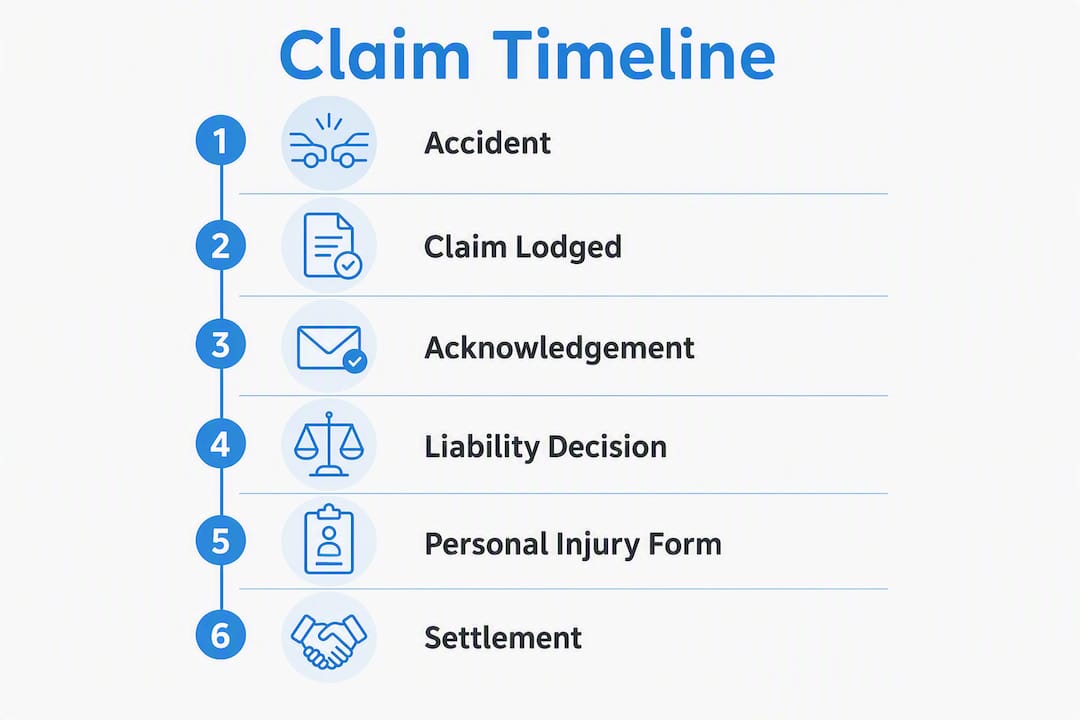
The process moves through predictable stages, though the pace depends on injury complexity.
After lodgement, the insurer must acknowledge receipt and contact you within three days, then deliver a liability decision within four weeks. Weekly payments, if approved, typically start within 10 working days of that decision.
The formal personal injury claim form must reach the insurer no later than six months from the accident. Common-law damages claims carry a three-year limitation period from the date of the crash, but waiting that long rarely helps your position. See the car accident claim timeline for a detailed stage-by-stage breakdown.
Why do CTP claims get denied, and what can you do?
The most common reasons for a denial or reduced benefit are late lodgement, gaps in medical evidence, inconsistencies between your account and the insurer’s investigation, and disputes over whether the vehicle or driver was at fault. Insurers also scrutinise pre-existing conditions closely.
Address these proactively: lodge on time, attend all medical appointments, keep every receipt, and never give a recorded statement to the insurer without legal advice. Underpaid or wrongly denied claims are more common than most people realise.
How do statutory benefits and common-law claims interact?
The two pathways are not mutually exclusive, but they do interact. Statutory benefits run for up to 52 weeks and are available regardless of fault. A common-law claim for lump-sum damages requires proving the other party’s negligence and that your injuries meet the statutory threshold.
Accepting a common-law settlement usually ends your entitlement to ongoing statutory benefits, so timing matters. A lawyer can advise whether to pursue both in sequence, negotiate a combined resolution, or prioritise one over the other based on your injury severity and financial position.
What are your options if the insurer denies your claim?
You have 28 days from the insurer’s decision to request an internal review. Submit that request in writing and include any additional medical or factual evidence that addresses the reason for denial.
If the internal review does not resolve the dispute, the Personal Injury Commission provides independent review and can make binding determinations. Beyond that, court proceedings are available for common-law damages disputes. Getting legal representation before the internal review stage significantly improves your chances of a successful outcome.
Key takeaways
In NSW, transport accident compensation through the CTP scheme requires lodging within strict deadlines, with the 28-day back-pay rule being the most urgent action any injured road user must take.
| Point | Details |
|---|---|
| 28-day back-pay rule | Lodge your personal injury benefits application within 28 days of the crash to preserve lost-earnings back-pay. |
| Three-month claim window | Apply for personal injury benefits within three months; some early treatment benefits are accessible within 28 days. |
| Six-month claim form deadline | Return the formal personal injury claim form to the CTP insurer no later than six months from the accident. |
| Dispute rights | You have 28 days after an insurer’s decision to request an internal review; the Personal Injury Commission handles independent disputes. |
| Carelawyers | Carelawyers provides direct lawyer access, no win-no fee arrangements, and has won over 99% of claims for NSW injury clients. |
Why the 28-day rule matters more than most lawyers admit
Most articles about NSW motor accident claims bury the 28-day back-pay rule in a deadlines table. That is the wrong place for it. It is the single most consequential deadline for injured workers, because it is the one that cannot be recovered once missed. You can sometimes negotiate late lodgement of a full claim. You cannot recover lost-earnings back-pay if you missed the 28-day window.
The other thing people underestimate is how early the insurer starts building its file. The moment you lodge, they begin gathering information. That is why getting legal advice before you give any statement, not after the insurer has already formed a view, is where the real advantage lies. A lawyer who is across your file from day one shapes the narrative; one who joins at the dispute stage is playing catch-up.
The common-law versus statutory benefits question also trips people up. Many injured people accept a statutory settlement without realising they may have had a viable common-law claim worth substantially more. The two pathways require different evidence, different thresholds, and different timing. Knowing which to pursue, or how to sequence both, is where experienced legal advice pays for itself many times over.
How Carelawyers can help with your NSW transport accident claim

Carelawyers handles NSW CTP and common-law motor accident claims from first contact through to settlement or court, with direct access to your lawyer at every stage. No call centres, no case managers passing messages. When you call, you speak to the person working your file.
The firm operates on a no win, no fee basis for most personal injury matters, meaning you pay nothing unless your claim succeeds. Fixed-fee options are available for specific matters. SIRA’s CTP Legal Advisory Service also provides funded legal advice for eligible claimants who need independent guidance on their rights.
At first contact, your lawyer will confirm which deadlines apply to your situation, advise on the Certificate of Fitness, identify the correct CTP insurer, and begin preserving evidence. If your injuries are serious, the firm can advise on catastrophic injury compensation and lifetime care entitlements. With a reported success rate above 99% of claims won, Carelawyers brings both the experience and the direct-access model that complex injury claims demand.
Contact Carelawyers now at carelawyers.com.au to protect your rights before any deadline passes.
Useful NSW sources and official forms
Official information, claim forms, and dispute contacts for NSW transport accident compensation:
| Resource | What it covers |
|---|---|
| SIRA motor crash compensation | Central hub for the NSW CTP scheme: insurer obligations, claim guides, and scheme performance data |
| SIRA guide for injured people | Step-by-step guide to making a CTP claim, including forms, deadlines, and early payment options |
| Service NSW: apply for personal injury benefits | Online application for personal injury benefits and the 28-day back-pay lodgement |
| SIRA benefits for injured people | Overview of the 2017 scheme’s 52-week statutory benefits and what they cover |
| CTP Assist: 1300 656 919 | Identifies the correct CTP insurer, advises on Nominal Defendant eligibility for hit-and-run claims |
| Personal Injury Commission | Independent review body for disputed CTP decisions after internal review is exhausted |
This article provides general information about NSW transport accident compensation and is not legal advice. Confirm current rules, deadlines, and your eligibility with SIRA or a qualified personal injury lawyer before acting.


