

Serious injury claim timeline management: 2026 guide
Serious injury claim timeline management is the process of coordinating multiple critical deadlines, medical milestones, and legal obligations to protect your right to full compensation. Most people recovering from serious injuries focus on getting better. The legal clock, however, starts ticking from day one. Miss a single deadline and you can permanently lose your right to claim. Understanding the personal injury claim process, the Serious Injury Guide framework used in Australia, and the three concurrent timelines you must track is the difference between a successful claim and a costly mistake.
What are the key timelines and deadlines in a serious injury claim?
Three separate clocks run simultaneously in every serious injury claim: the statute of limitations, insurer documentation deadlines, and medical lien or subrogation timelines. Failing to track any one of them independently risks losing the claim or its full value. This is the core challenge of serious injury claim timeline management.
Statute of limitations
Most jurisdictions impose a 2-year statute of limitations for standard personal injury claims. Claims against government entities often carry shorter windows. Missing this filing deadline results in permanent loss of the right to claim compensation. In New South Wales, specific limitation periods apply depending on the type of injury and the party at fault, so confirming your exact deadline with a solicitor early is non-negotiable.
Insurer notification and response deadlines
The Serious Injury Guide sets clear procedural expectations for high-value claims. Notification letters must be sent within 7 days of instructing a solicitor to trigger insurer response timelines. Insurers must acknowledge the claim within 14 days and begin liability discussions within 28 days of notification. Rehabilitation requests must receive a response within 21 days. Liability itself should be agreed within six months of initial notification.
Maximum Medical Improvement and medical lien timelines
Maximum Medical Improvement (MMI) is the point at which your medical condition has stabilised and is unlikely to improve further. Settling before MMI is established risks losing compensation for long-term care and specialised treatment needs. Medical lien and subrogation timelines must also be negotiated and cleared before final settlement to avoid unexpected deductions from your payout.
| Deadline | Timeframe | Consequence of missing |
|---|---|---|
| Solicitor notification to insurer | Within 7 days of instruction | Insurer response timelines not triggered |
| Insurer acknowledgement | Within 14 days of notification | Procedural breach under Serious Injury Guide |
| Liability discussion | Within 28 days of notification | Delays in establishing fault |
| Rehab request response | Within 21 days | Medical progress stalls, claim weakens |
| Liability agreement | Within 6 months | Extended dispute, delayed settlement |
| Statute of limitations | Typically 2 years | Permanent loss of right to claim |
Pro Tip: Get your solicitor to send the notification letter to the insurer on the same day you formally instruct them. That single action starts the insurer’s response clock immediately.
How to organise and track your injury claim timeline
Claimants consistently underestimate the complexity of juggling multiple timelines at once. A structured approach to managing injury claims prevents missed deadlines and keeps your case moving forward.
Build a master timeline calendar. List every known deadline from day one. Include the statute of limitations date, insurer notification deadlines, rehab request windows, and any court dates. Use Google Calendar or a similar digital tool and set reminders at least two weeks before each deadline.
Document every communication. Send all correspondence with insurers and medical providers in writing. Keep copies of every letter, email, and report. Your solicitor needs a clear paper trail to negotiate effectively and to respond to any disputes about what was said or agreed.
Schedule medical assessments early. Independent medical expert assessments take time to book and complete. Waiting until late in the process delays your evidence base and can push back settlement negotiations by months. Book assessments as soon as your treating specialists confirm your diagnosis.
Separate negotiation and litigation timelines. Negotiation with an insurer and formal litigation follow different rules and different timeframes. Know which phase your claim is in at all times. If negotiations stall, filing a lawsuit typically adds 6 to 12 months to the overall claim duration for discovery and preparation.
Follow up on every insurer response. If an insurer misses the 21-day rehabilitation response window, document the delay and notify your solicitor immediately. Delayed or inadequate management of rehabilitation requests extends claim timelines unnecessarily. Proactive follow-up is not optional.
Pro Tip: Ask your solicitor to provide a written case plan at the start of your claim. It should list every key milestone, who is responsible for each action, and the target date. Review it together every month.
What are the common phases in the personal injury claim process?

Serious injury claims in Australia typically take between 2 to 5 years to resolve depending on injury complexity and liability disputes. Complex cases can extend to 6 years, while straightforward soft-tissue injuries may settle in 6 to 18 months. Understanding which phase your claim is in helps you set realistic expectations and make informed decisions.
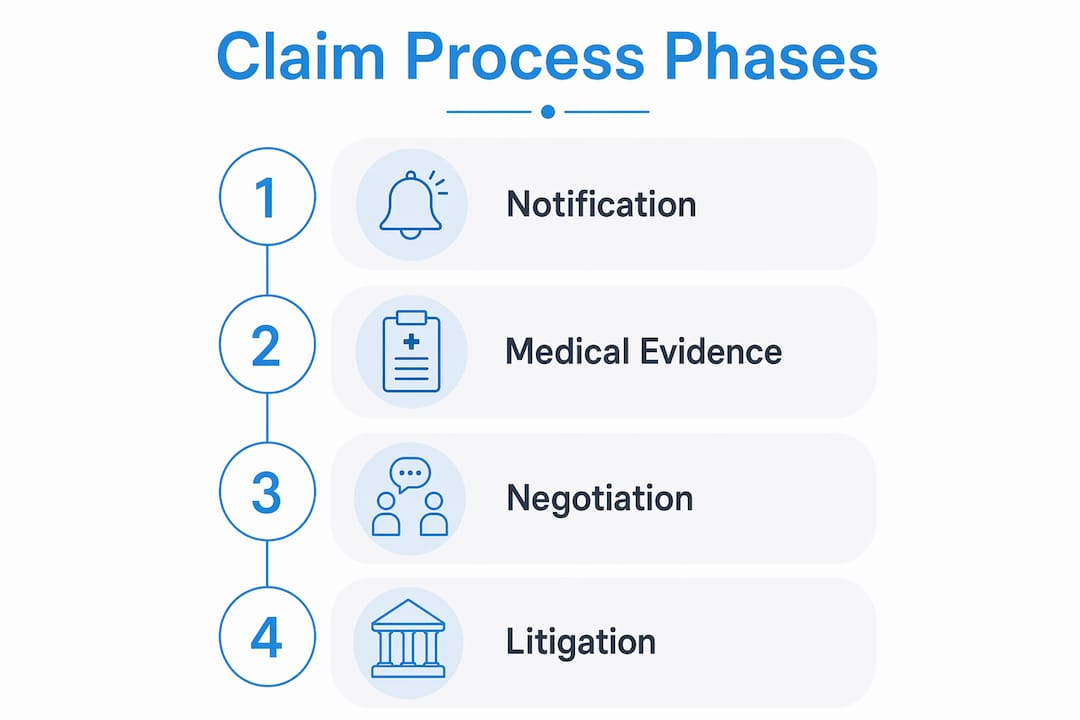
Phase 1: Initial notification and liability (weeks 1 to 8)
Your solicitor notifies the insurer, triggers the response deadlines, and begins gathering initial evidence. Liability discussions start within 28 days. This phase moves quickly and sets the tone for the entire claim. Early solicitor involvement and prompt insurer notification preserves your claim rights and speeds resolution.
Phase 2: Medical evidence and rehabilitation (months 2 to 18)
This is the longest and most variable phase. Your treating team documents your injuries, you undergo independent medical assessments, and rehabilitation is arranged and funded. Interim payments can often be obtained within 3 to 6 months of claim commencement once liability is established. These payments prevent financial hardship during long recovery periods. For rehabilitation support during this phase, having a solicitor who actively manages insurer responses makes a measurable difference.
Phase 3: Negotiation and settlement (months 12 to 36+)
Once MMI is reached, your solicitor compiles a full schedule of loss and presents a settlement demand. Negotiations can take weeks or months. The insurer may counter-offer multiple times. Most serious injury claims settle at this stage without going to court.
Phase 4: Litigation (adds 6 to 12 months or more)
When negotiations fail, litigation begins. Legal discovery during litigation enables uncovering evidence that can substantially alter claim value but adds considerable time. Mediation often occurs before trial and resolves many disputes. Trial itself is rare but possible.
| Injury complexity | Typical claim duration | Key variable |
|---|---|---|
| Soft tissue, clear liability | 6–18 months | Speed of medical recovery |
| Moderate injury, disputed liability | 18–36 months | Liability resolution |
| Serious or catastrophic injury | 2–5 years | MMI timing and care needs |
| Complex multi-party or litigation | 4–6 years | Court scheduling and discovery |
How to handle challenges and avoid pitfalls in your claim
The biggest risks in managing an injury compensation timeline are not legal technicalities. They are practical mistakes that claimants make under financial and emotional pressure.
- Accepting early settlement offers. Early settlement offers often undervalue lifelong costs because your full medical prognosis is not yet known. Once you sign a settlement, you cannot reopen the claim. Wait for MMI before agreeing to any final figure.
- Missing notification deadlines. Failing to notify the insurer within the required window can void your procedural rights under the Serious Injury Guide. Your solicitor must act on day one.
- Ignoring interim payment options. Many claimants do not know they can apply for interim payments once liability is clear. Interim payments act as a critical tool to reduce financial pressure during long claims. Ask your solicitor about eligibility from the outset.
- Letting rehabilitation stall. If an insurer delays approving rehabilitation, your recovery suffers and your claim weakens. Follow up in writing every time a deadline passes without a response.
- Underestimating litigation timelines. If your claim proceeds to court, discovery and preparation add significant time. Budget for this possibility from the start, both financially and emotionally.
“Settling too early is the single most common and most costly mistake in serious injury claims. The pressure of financial hardship is real, but a premature settlement can leave you without the funds to cover care you will need for decades.”
Pro Tip: If you are under financial pressure, apply for interim payments rather than accepting a low settlement offer. Interim payments keep you financially stable without closing your claim.
Key takeaways
Effective serious injury claim timeline management requires tracking three concurrent deadlines, reaching Maximum Medical Improvement before settling, and engaging a solicitor from day one to protect your rights.
| Point | Details |
|---|---|
| Three concurrent timelines | Track the statute of limitations, insurer deadlines, and medical lien timelines independently. |
| Notify early | Send the insurer notification letter within 7 days of instructing your solicitor. |
| Wait for MMI | Never accept a final settlement before your medical condition has fully stabilised. |
| Use interim payments | Apply for interim payments once liability is clear to avoid financial pressure during long claims. |
| Litigation adds time | If negotiations fail, expect 6 to 12 months or more added to your claim duration. |
What I have learned from watching clients manage these timelines
The most consistent pattern I see is claimants treating their injury claim as a single timeline when it is actually three or four running at once. The statute of limitations is the one everyone knows about. The insurer notification windows and rehabilitation response deadlines catch people off guard, often because they are focused on recovery and assume their solicitor is handling everything automatically.
Early solicitor engagement is not just helpful. It is the single biggest factor in whether a claim stays on track. I have seen claims where delayed notification cost the claimant months of procedural momentum, and others where prompt action in the first week set up a smooth resolution two years later.
Interim payments are underused. Clients who apply for them early feel far less pressure to accept a low settlement offer. That financial breathing room is what allows them to wait for MMI and negotiate from a position of strength rather than desperation.
The other thing I counsel clients on is patience versus prompt action. These are not opposites. You act promptly on every procedural deadline. You are patient about the overall timeline, because rushing toward settlement before your prognosis is clear is where the real money is lost. For workplace injury claims in NSW, the stakes are especially high because the compensation categories are broader and the timelines more complex.
Document everything. Every phone call, every letter, every medical appointment. The claimants who keep thorough records give their solicitors the tools to negotiate effectively and, if necessary, to win in court.
— Daniel
How Carelawyers can manage your claim timeline from day one
Recovering from a serious injury is hard enough without trying to track multiple legal deadlines on your own. Carelawyers specialises in serious injury legal advice for clients across Sydney and NSW, with a track record of over 99% of claims won. The team manages every procedural deadline, insurer communication, and medical milestone on your behalf so nothing falls through the cracks.

Carelawyers operates on a no win, no fee basis, meaning you pay nothing unless your claim succeeds. Every client speaks directly to their lawyer, not a case manager or paralegal. If you are unsure where your claim stands or whether you have missed a deadline, contact Carelawyers for a free consultation to assess your options.
FAQ
How long does a serious injury claim take in Australia?
Serious injury claims typically take between 2 to 5 years to resolve, depending on injury complexity and liability disputes. Simpler soft-tissue cases can settle in 6 to 18 months, while complex or catastrophic injury claims may extend to 6 years.
What is the statute of limitations for a personal injury claim?
Most jurisdictions set a 2-year statute of limitations for personal injury claims. Missing this deadline permanently removes your right to seek compensation, so confirming your exact window with a solicitor immediately after injury is critical.
When can I apply for interim payments?
Interim payments can be obtained within 3 to 6 months of commencing a claim once liability is established. They provide financial support during the recovery and negotiation phases without closing your claim.
Why should I wait for Maximum Medical Improvement before settling?
Settling before MMI means your full long-term care and treatment costs are unknown. Accepting an early offer risks leaving you without funds to cover future medical needs that were not yet apparent at the time of settlement.
What happens if negotiations fail and my claim goes to litigation?
Filing a lawsuit when negotiations stall typically adds 6 to 12 months to the claim timeline for formal discovery and court preparation. Mediation often resolves disputes before trial, but claimants should plan for the extended timeframe from the outset.


