

S66 calculator NSW: your guide to injury compensation
The s66 calculator NSW is a tool used to estimate compensation amounts for workplace injuries under New South Wales workers compensation law. Specifically, it applies the concept of Whole Person Impairment (WPI) to calculate potential lump sum payouts and weekly payment entitlements. The formal industry term for this process is “permanent impairment assessment,” and the s66 calculator is the practical instrument claimants use to model their entitlements before lodging or negotiating a claim. Understanding how it works gives you a realistic picture of what you may be owed, and where your claim stands before you speak to an insurer.
One critical point upfront: the s66 calculator is an estimate tool that provides indicative figures, not guaranteed settlement amounts. Calculator outputs depend heavily on the accuracy of your inputs and the insurer’s own assessments. Two claimants with similar injuries can receive very different results based on medical evidence quality and how their impairment is rated. Getting the inputs right is the entire game.
What data do you need to use the s66 calculator effectively?
Accurate inputs produce accurate estimates. Before you open any online compensation tool, gather the following documents and figures.
Medical and clinical records
- A completed SIRA Certificate of Capacity, which verifies your work capacity status. Insurers can cease payments if this certificate is not provided within 7 days of request. That is a hard deadline, not a suggestion.
- An impairment assessment report from an approved medical specialist, showing your WPI percentage.
- Clinical notes, specialist reports, and any imaging or diagnostic results that support the impairment rating.
- A certificate of permanent impairment if one has been issued.
Financial information
- Your pre-injury average weekly earnings (PIAWE). This figure is the foundation of weekly payment calculations under the Workers Compensation Act 1987 NSW.
- Payslips covering at least the 52 weeks before your injury, or the period you were employed if shorter.
- Details of any overtime, allowances, or bonuses that formed part of your regular income.
Injury and work capacity details
- The date of injury and a clear description of how it occurred.
- Your current work capacity status: whether you have no capacity, some capacity, or full capacity.
- Any return-to-work plans or vocational assessments already completed.
Pro Tip: Request your SIRA Certificate of Capacity from your treating doctor before you start any calculation. Without it, your weekly payment eligibility cannot be confirmed, and your estimate will be incomplete.
How to use the s66 calculator NSW: step-by-step
The calculation process follows a logical sequence. Work through each step in order to avoid compounding errors.
Confirm your WPI rating. Your Whole Person Impairment percentage is the starting point for any lump sum calculation. WPI ratings determine the extent of permanent impairment and the corresponding lump sum payout. A higher WPI percentage means a higher potential lump sum. This rating must come from an approved medical specialist, not a self-assessment.
Locate the current statutory maximum. Lump sum thresholds and weekly payment caps are not fixed. Indexed caps are published in the SIRA workers compensation benefits guide and updated each april and october. Always use the current indexed figure, not last year’s amount.
Calculate your weekly payment entitlement. Weekly payments under the Workers Compensation Act 1987 NSW are available for up to 260 weeks. The amount depends on your PIAWE, your work capacity, and the applicable statutory cap for the current period. Enter your PIAWE and work capacity status into the calculator fields.
Apply the WPI percentage to the lump sum table. The calculator cross-references your WPI rating against the current indexed lump sum schedule. The output is a dollar figure representing your indicative permanent impairment compensation.
Factor in any deductions or offsets. If you have received weekly payments, certain amounts may be offset against your lump sum. The calculator should prompt you to enter any payments already received.
Review the output as a range, not a fixed figure. The number you see is an estimate. Claimant entitlements depend on medical evidence, work capacity assessments, and statutory timeframes. The insurer will conduct their own assessment, which may differ from your calculation.
Document your inputs and outputs. Save a copy of every figure you entered and the result produced. This record is useful when comparing your estimate against the insurer’s offer.
Pro Tip: Run the calculation twice using slightly different PIAWE figures to test sensitivity. If a small change in earnings produces a large change in the output, your PIAWE figure needs to be verified carefully before you proceed.

Common challenges and mistakes when using the s66 calculator
Most errors in compensation calculations come from one of three sources: wrong inputs, misread outputs, or confusion about which legal framework applies.
The Section 66 naming confusion
The phrase “Section 66” appears in two completely different areas of NSW law. Section 66T of the Conveyancing Act 1919 NSW relates to cooling off periods in property contracts, not workplace injuries. If you search for “s66 NSW” without specifying compensation, you will find property law results that have nothing to do with your claim. This confusion is common and wastes significant time.
Frequent input errors to watch for:
- Using gross earnings instead of the correct PIAWE formula, which includes specific inclusions and exclusions under the Workers Compensation Act.
- Entering an estimated WPI percentage rather than a formally assessed one. Self-estimated impairment figures produce unreliable outputs.
- Ignoring the biannual indexation of caps. Using an outdated statutory maximum can make your estimate look higher or lower than it actually is.
- Failing to account for work capacity changes over time, which affect the weekly payment component of the calculation.
Misreading the output
The s66 calculator produces an indicative figure based on the data you enter. It does not account for insurer disputes, legal costs, or the outcome of any medical panel review. Treat the output as a starting point for a conversation with a lawyer, not as a confirmed entitlement.
When to seek legal advice is not a vague suggestion. If your WPI rating is disputed, your PIAWE is contested, or the insurer’s offer differs significantly from your calculation, you need a qualified workers compensation lawyer to review the figures. Accurate calculation depends on reliable medical evidence, including impairment certificates and clinical assessments. A lawyer can identify whether the insurer’s assessment is consistent with the medical record.
How does the s66 calculator fit within the wider claim process?
The calculator is one tool within a larger legal and administrative process. Understanding where it sits helps you use the output correctly.
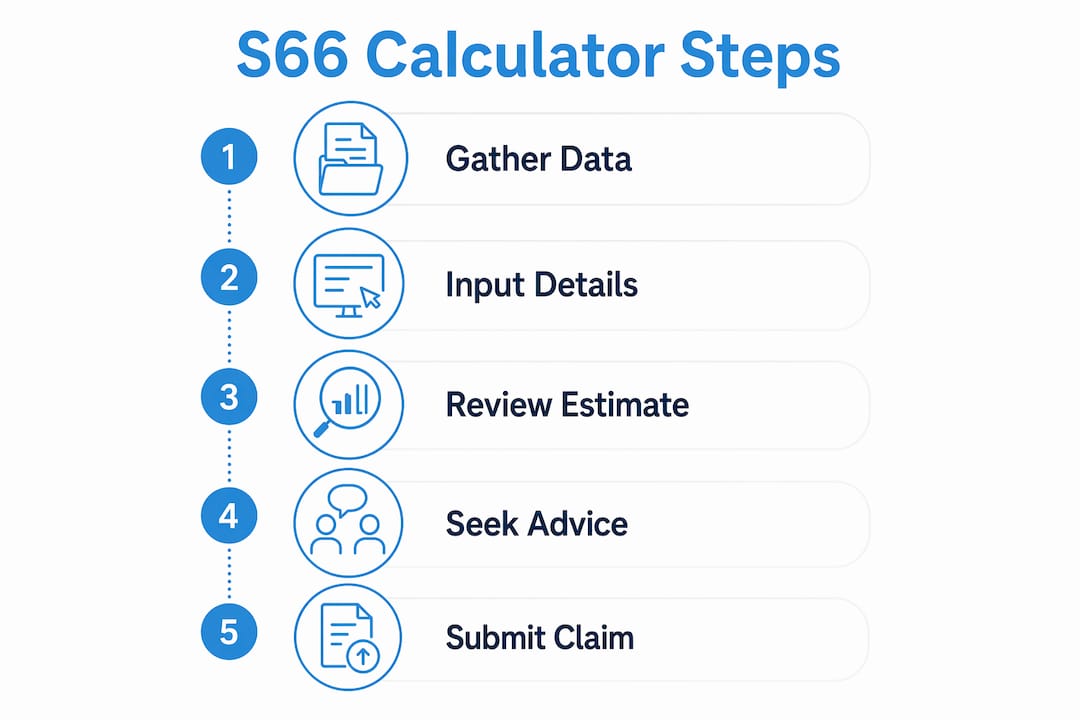
Work injury compensation claims involve interaction between impairment ratings, weekly payments, and lump sum entitlements, all governed by statutory timeframes and insurer assessments. The calculator models the financial outcome of that process. It does not replace any step in the process itself.
| Stage | Role of the calculator |
|---|---|
| Pre-claim preparation | Provides an estimate to set realistic expectations before lodging |
| Insurer assessment | Outputs can be compared against the insurer’s own figures |
| Negotiation | Gives you a documented basis for disputing a low offer |
| Medical panel review | Highlights discrepancies between your WPI and the insurer’s rating |
| Appeal or recalculation | Allows you to model revised figures if new medical evidence emerges |
The calculator output is not a legal determination. An insurer can accept, dispute, or modify any figure based on their own assessment. If the insurer’s offer is lower than your calculated estimate, you have the right to request a review or lodge a dispute through the Workers Compensation Independent Review Office (WIRO) in NSW. Recalculation may also be necessary if your medical condition changes or new evidence becomes available.
Understanding weekly workers comp benefits alongside lump sum entitlements gives you the full picture of what the claim process can deliver. The calculator covers both components, but each follows its own rules and timelines.
Key takeaways
The s66 calculator NSW estimates permanent impairment compensation using WPI ratings, PIAWE, and indexed statutory caps, but accurate inputs and legal context determine whether the output reflects your real entitlement.
| Point | Details |
|---|---|
| WPI rating is the foundation | Your Whole Person Impairment percentage must come from an approved medical specialist, not a self-assessment. |
| Caps change twice yearly | Statutory maximums are indexed each april and october, so always use the current SIRA benefits guide figures. |
| SIRA Certificate of Capacity is mandatory | Insurers can stop weekly payments if this certificate is not provided within 7 days of request. |
| Calculator output is indicative only | The figure produced is an estimate; the insurer’s assessment and medical evidence determine the final amount. |
| Section 66 has two meanings in NSW law | The compensation s66 and the Conveyancing Act s66 are entirely separate; confirm which applies to your situation. |
Why the calculator is only half the answer
I have worked with enough injured workers to know that the s66 calculator is genuinely useful, and genuinely misunderstood. Most people arrive at it expecting a definitive number. What they get is a model, and a model is only as good as the data you feed it.
The most common problem I see is not a wrong formula. It is a wrong WPI rating. Impairment assessments are not objective measurements like a blood pressure reading. Two approved medical specialists can assess the same injury and produce meaningfully different percentages. That gap directly affects the lump sum figure. If your impairment has been assessed by an insurer-appointed specialist, there is a real chance the rating is conservative.
The second problem is PIAWE. Workers with variable hours, multiple employers, or recent pay changes often have a PIAWE that is genuinely complex to calculate. A small error in that figure compounds across 260 weeks of potential payments. Getting it right matters more than most people realise.
My honest view is that the calculator is best used as a preparation tool, not a negotiation tool. Run it before you speak to anyone, understand the range of possible outcomes, and then get a lawyer to verify the inputs before you rely on the output in any formal context. The calculator tells you what the law says you might be owed. A lawyer tells you what you can actually recover.
— Daniel
Carelawyers can help you get the calculation right
Carelawyers specialises in workplace injury compensation claims across New South Wales, with a success rate of over 99% of claims won. If your s66 estimate does not match the insurer’s offer, or if you are unsure whether your WPI rating and PIAWE figures are correct, the team at Carelawyers can review your situation directly.

Carelawyers clients speak directly to their lawyers, without intermediaries or jargon. The firm operates on a no win no fee basis, so there is no financial risk in getting advice. Whether you need help interpreting a calculator result, gathering workplace injury evidence, or understanding your full entitlements, Carelawyers provides the kind of personalised attention that larger firms rarely offer. Contact Carelawyers to get a clear picture of what your workers compensation claim is actually worth.
FAQ
What does the s66 calculator NSW actually calculate?
The s66 calculator NSW estimates lump sum compensation for permanent impairment and weekly payment entitlements based on your WPI rating, pre-injury average weekly earnings, and current statutory caps under the Workers Compensation Act 1987 NSW.
Is the s66 calculator the same as the Section 66 in property law?
No. Section 66 in the Conveyancing Act 1919 NSW relates to cooling off periods in property contracts. The s66 calculator for workplace injuries operates under entirely separate workers compensation legislation administered by SIRA NSW.
How often do the statutory caps in the calculator change?
Statutory maximum weekly rates and lump sum thresholds are indexed twice yearly, in april and october, and published in the SIRA workers compensation benefits guide. Always confirm you are using the current figures before relying on any output.
What happens if my WPI rating is disputed?
If your Whole Person Impairment rating is disputed by the insurer, the matter can be referred to a medical panel for independent assessment. The panel’s determination affects the lump sum figure the calculator produces, so a legal review of the dispute is advisable.
Can I use the s66 calculator without a lawyer?
You can use the calculator independently to model potential entitlements, but the output is an estimate only. If your claim involves a disputed WPI rating, complex PIAWE, or a significant gap between your estimate and the insurer’s offer, legal advice from a workers compensation specialist is the practical next step.


