

Role of a neuropsychologist in your injury claim
A neuropsychologist is defined as a specialist psychologist who assesses how brain injuries affect thinking, memory, behaviour, and daily function. The role of neuropsychologist in an injury claim is to deliver court-compliant, independent evaluations that connect invisible cognitive damage to real-world losses. These assessments are critical when standard imaging like MRI or CT scans show nothing abnormal, yet the claimant clearly cannot work, manage finances, or parent effectively. Carelawyers works with clients across Sydney who face exactly this challenge, where the gap between what a scan shows and what a person can actually do determines the entire compensation outcome.
What does the role of a neuropsychologist in an injury claim involve?
Neuropsychological assessment is the formal process of measuring how a brain injury has changed the way a person thinks, feels, and functions. It is the primary tool courts and insurers use when cognitive impairment cannot be confirmed by imaging alone.

Neuropsychological evaluations typically require several hours to a full day of testing and provide objective evidence of cognitive impairments often invisible on standard imaging. That time commitment reflects the depth required to map both strengths and weaknesses across multiple cognitive domains.
A standard assessment covers:
- Memory: Both short-term recall and long-term retention are tested using word lists, story recall, and visual pattern tasks.
- Attention and concentration: Sustained focus, divided attention, and processing speed are measured through timed tasks.
- Executive function: Planning, problem-solving, and impulse control are evaluated using tasks that mimic real-life decision-making.
- Language and communication: Word retrieval, comprehension, and verbal fluency are assessed.
- Emotional and psychological functioning: Depression, anxiety, and post-traumatic stress are measured using validated questionnaires.
The assessment also includes a detailed review of your life history. Transparency about prior health and psychological history is vital to maintain credibility in claims. A neuropsychologist needs to know about pre-existing conditions, prior mental health treatment, and educational background to separate what existed before the injury from what the injury caused.
One feature many claimants do not expect is validity and effort testing. Validity tests identify whether the claimant is fully engaged or potentially exaggerating symptoms, directly impacting the reliability of the evidence. These tests are not accusatory. They are a standard part of every credible medico-legal assessment.
Pro Tip: Be completely honest about your full medical and psychological history before and during the assessment. Omitting past mental health treatment or prior head injuries does not protect your claim. It creates inconsistencies that defence experts will exploit.
How does a neuropsychological report influence legal decisions?
The report produced after assessment is not simply a clinical document. It functions as a bridge between neurological findings and the real-world functional losses that determine how damages are calculated in your claim.
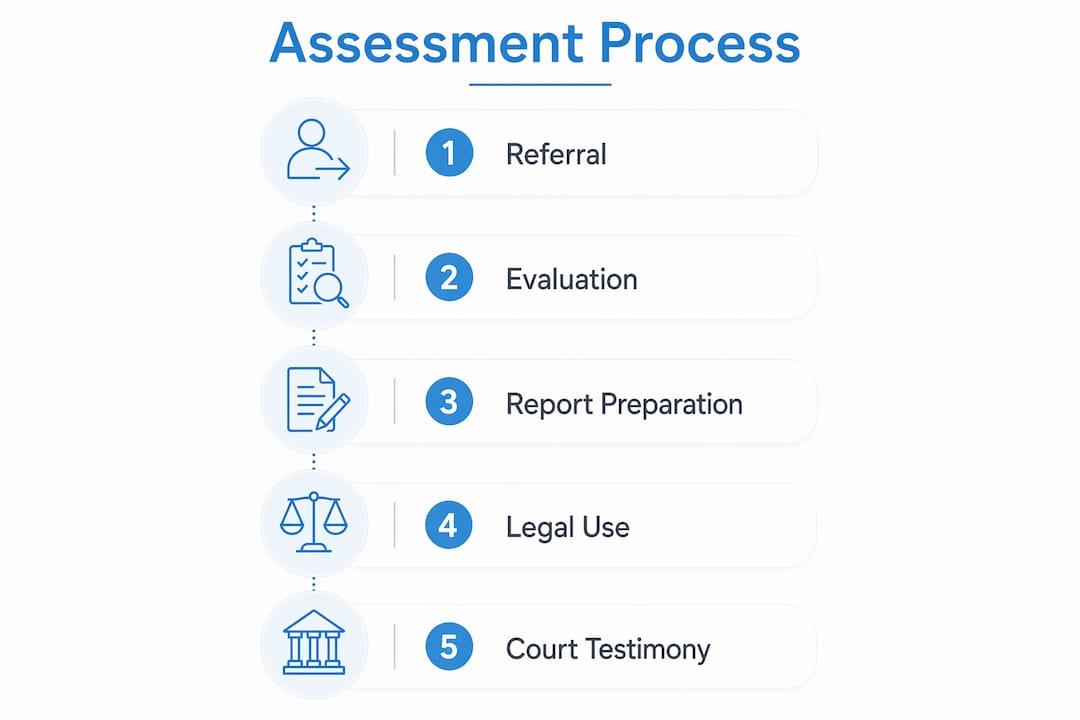
Neuropsychological reports are most persuasive when integrated with medical, vocational, and psychological evidence to demonstrate functional impairment and inform damage awards. A report that stands alone carries less weight than one that aligns with treating doctors, occupational therapists, and vocational assessors.
The report typically addresses these areas in sequence:
- Cognitive profile: A detailed account of which functions are impaired and by how much, compared to normative data for your age and education level.
- Functional impact: How those impairments affect daily activities, including employment capacity, financial management, and parenting.
- Injury causation: The probable link between the documented injury event and the measured deficits.
- Future care needs: Recommendations for ongoing treatment, rehabilitation, and support services that form the basis of future care cost calculations.
- Life care planning input: Specific data that life care planners and actuaries use to calculate long-term compensation figures.
Selecting a board-certified neuropsychologist with court testimony experience is essential to ensure credible and legally robust expert evidence. A report authored by a general psychologist without medico-legal experience is far more vulnerable to challenge in cross-examination.
Neuropsychological evidence also appears in workers compensation, disability insurance disputes, and criminal law proceedings. If you are pursuing a workplace injury claim, the same principles of cognitive assessment and functional impact apply.
Pro Tip: Ask your lawyer whether the neuropsychologist they recommend has given evidence in court before. A specialist who has been cross-examined and maintained their opinion under pressure is worth considerably more to your claim than one who has only written reports.
What is the neuropsychologist expert witness role in court?
The neuropsychologist expert witness role is distinct from that of a treating clinician. A treating psychologist works for the patient. An expert witness works for the court.
In medico-legal claims, neuropsychological assessment is evaluative, not therapeutic. The expert’s duty is to provide an independent opinion compliant with court rules, not to advocate for the person being assessed. Many claimants misunderstand this distinction and feel unsupported during the assessment. That discomfort is a sign the process is working correctly.
“Expert witnesses must provide balanced interpretations, explaining probable links between injury and cognitive deficits especially when medical imaging is inconclusive. The neuropsychologist’s role is to offer the most plausible connection rather than only symptom identification.” Mild traumatic brain injury in litigation
Key features of the expert witness function include:
- Primary duty to the court: The neuropsychologist’s obligation runs to the court, not to the lawyer who instructed them or the claimant being assessed.
- Balanced interpretation: Where evidence is ambiguous, the expert must present the most probable explanation rather than the most favourable one.
- Independence from advocacy: Any attempt by a lawyer to influence the expert’s opinion undermines the report’s credibility and can damage the entire case.
- Handling symptom discrepancies: When reported symptoms do not match test results, the expert explains the discrepancy rather than ignoring it. Courts expect this analysis.
- Effort and validity consequences: Suboptimal effort can severely damage claim credibility. A finding of poor effort does not automatically mean deception, but it requires careful explanation.
Understanding this distinction protects you. If you expect the neuropsychologist to be “on your side,” you will likely feel the assessment was unfair. The assessment is designed to be fair to the court, which ultimately produces a more reliable and defensible outcome for a genuine claim.
Practical advice for claimants navigating neuropsychological assessments
Timing is the single most overlooked factor in neuropsychology in legal cases. Without timely scheduling of neuropsychological evaluations, experts risk being excluded, potentially fatally affecting brain injury claims. Early action is not optional. It is a legal necessity.
Here is what claimants need to know before and during the process:
- Schedule early: Engage a neuropsychologist as soon as your legal team identifies cognitive symptoms. Delays can result in evidence being excluded at trial, particularly in serious injury claims with strict procedural deadlines.
- Choose credentials carefully: Look for a neuropsychologist with board certification, specific experience in your injury type, and a history of providing court testimony. General psychologists do not carry the same evidential weight.
- Prepare for a long appointment: Assessments run from a few hours to a full day. Arrive rested, bring any relevant medical records, and do not take sedating medication beforehand unless medically necessary.
- Be transparent about your history: Disclose prior mental health treatment, learning difficulties, substance use, and any previous head injuries. Concealment creates inconsistencies that defence experts will identify.
- Understand unfavourable findings: If the report does not support your claim as strongly as expected, discuss the findings with your lawyer before deciding how to proceed. A second opinion from another qualified expert may be appropriate in some circumstances.
- Align legal and expert advice: Neuropsychological evidence is most effective when your legal team understands how to present it. Lawyers experienced in no win no fee arrangements for injury claims are often more motivated to secure the right expert from the outset.
Key takeaways
Neuropsychological assessments are the most reliable method for proving cognitive impairment in injury claims where imaging is normal, and their evidential value depends entirely on the expert’s independence, credentials, and the claimant’s transparency.
| Point | Details |
|---|---|
| Assessment scope | Testing covers memory, attention, executive function, and emotional wellbeing across several hours to a full day. |
| Report integration | Reports carry the most weight when combined with medical, vocational, and psychological evidence. |
| Expert witness independence | The neuropsychologist’s duty is to the court, not the claimant; independence protects the report’s credibility. |
| Timing is critical | Delays in scheduling assessments can result in evidence being excluded at trial. |
| Transparency strengthens claims | Full disclosure of prior health history prevents inconsistencies that defence experts exploit. |
What I have seen claimants get wrong about neuropsychologists
After working closely with injury claimants over many years, the most consistent mistake I observe is treating the neuropsychological assessment like a GP appointment. Claimants arrive expecting empathy and advocacy. They leave feeling interrogated and unsupported. That reaction is understandable, but it reflects a misunderstanding of what the assessment is for.
The independence of the expert is not a flaw in the system. It is the feature that makes the evidence credible. A report from a neuropsychologist who clearly advocated for the claimant will be torn apart in cross-examination. A report from a genuinely independent expert who found impairment despite applying rigorous validity testing is almost impossible to dismiss.
The second mistake I see regularly is leaving the assessment too late. Claimants often focus on physical recovery in the months after an injury and delay addressing cognitive symptoms. By the time legal proceedings are underway, scheduling conflicts and procedural deadlines have already narrowed the options. Early involvement of a qualified neuropsychologist changes the trajectory of a claim more than almost any other single decision.
My advice is straightforward. Get the right expert early. Be completely honest during the assessment. And work with a legal team that understands how to use neuropsychological evidence to its full effect.
— Daniel
How Carelawyers can support your claim with expert evidence
Carelawyers has helped clients across Sydney secure fair compensation in complex injury claims where neuropsychological evidence was central to the outcome. The team understands how to identify the right expert, manage assessment timelines, and present cognitive impairment evidence in a way that holds up under scrutiny.

Whether your claim involves a car accident, a workplace injury, or another serious incident, Carelawyers can advise you on how damages are calculated when cognitive and functional impairments are part of the picture. With a success rate of over 99% of claims won and a commitment to direct, personal service, Carelawyers gives you access to experienced lawyers who speak plainly and act decisively. Contact Carelawyers today to discuss your claim and get the expert support your case deserves.
FAQ
What does a neuropsychologist do in an injury claim?
A neuropsychologist conducts an independent assessment of cognitive and psychological functioning to provide objective evidence of impairments caused by a brain or neurological injury. Their report connects clinical findings to real-world functional losses, which directly informs compensation calculations.
How long does a neuropsychological assessment take?
Assessments typically run from a few hours to a full day, depending on the complexity of the injury and the number of cognitive domains being tested. Claimants should arrive rested and prepared to complete multiple standardised tests in a single sitting.
Can a neuropsychologist’s report hurt my claim?
A report that identifies poor effort on validity testing or finds no significant impairment can weaken a claim. Being fully transparent about your history and engaging genuinely with all tasks gives the assessment the best chance of accurately reflecting your true condition.
Why does the neuropsychologist seem impartial rather than supportive?
The neuropsychologist’s primary duty is to the court, not to the claimant or the instructing lawyer. This independence is what makes their evidence credible and difficult to challenge, which ultimately benefits claimants with genuine impairments.
When should I arrange a neuropsychological assessment for my claim?
Schedule the assessment as early as possible after cognitive symptoms are identified. Delays risk procedural exclusion of the evidence, which can be fatal to brain injury claims with strict legal timelines.


