

Provisional liability workers comp: NSW claimants’ guide
In NSW, provisional liability lets an insurer start paying you for lost income and medical costs while it investigates your workers compensation claim. It is not a final acceptance. Think of it as a holding position: the insurer is saying “we’ll pay while we look into this,” not “we accept your claim.” Under SIRA guidance, provisional payments can run for a limited period and cover weekly income replacement (calculated on your pre-injury average weekly earnings, known as PIAWE) and cover reasonable medical treatment costs within scheme limits.
What you need to know right now:
- Provisional payments cover weekly income (PIAWE-based) and reasonable medical costs up to scheme limits
- The provisional period lasts up to 12 weeks from when payments begin
- Receiving provisional payments does not mean the insurer has accepted your claim
- You must supply ongoing medical certificates to keep payments flowing
- If the insurer delays or refuses, you have clear dispute rights through the Personal Injury Commission (PIC)
Your next 24–72 hours:
- Lodge your claim (or confirm it has been received) and request provisional payments in writing
- Get a certificate of capacity from your treating doctor and send it to the insurer
- Start a folder: save every receipt, medical certificate, email, and letter from day one
Table of Contents
- What provisional liability actually means in NSW workers comp
- What provisional payments cover and the monetary limits
- How the 12-week provisional period works in practice
- What insurers must do, and what you must do
- When insurers can delay payments using a ‘reasonable excuse’
- What to do if the insurer refuses or delays beyond permitted limits
- How to request provisional payments and what evidence to include
- What happens when provisional payments stop
- When to get legal help with provisional liability
- Key takeaways
- The part most injured workers get wrong about provisional payments
- Carelawyers: straightforward help when provisional payments get complicated
What provisional liability actually means in NSW workers comp
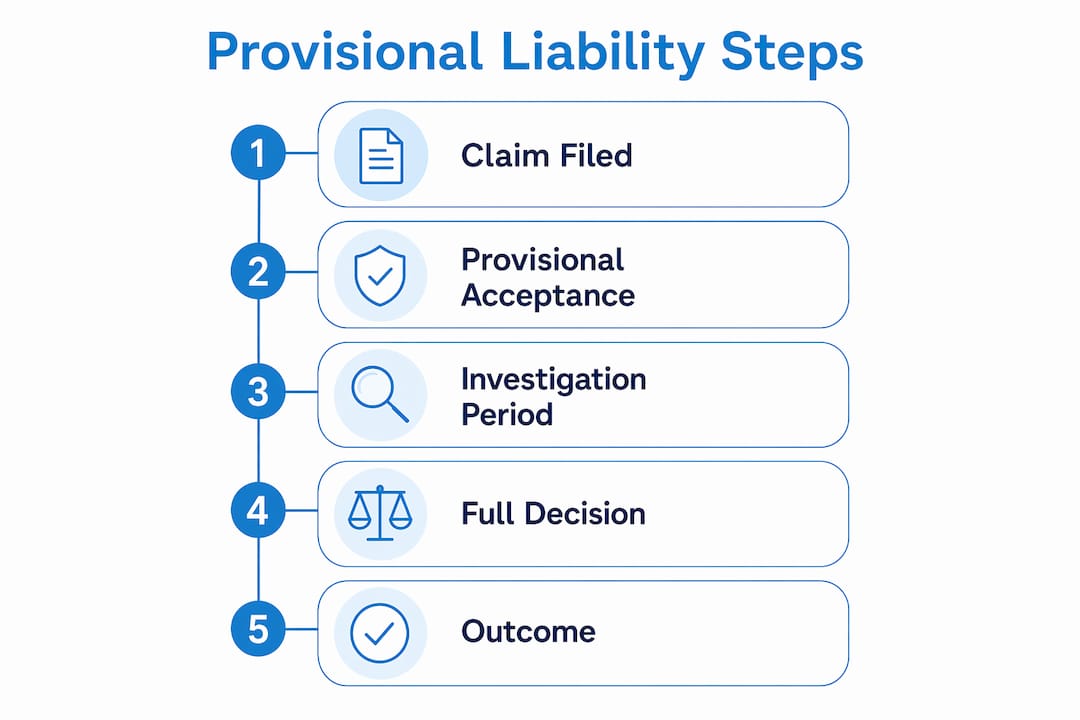
Provisional liability is an interim status, not a final decision. When an insurer accepts provisional liability, it is agreeing to pay you while it continues to investigate whether it is ultimately responsible for your claim. That investigation can run for the full 12-week provisional period.
The practical difference between provisional and full liability matters enormously. Under provisional liability, payments can stop if the insurer ultimately denies the claim. Under full liability, the insurer has accepted responsibility and your entitlements are on a firmer footing.
| Feature | Provisional liability | Full liability |
|---|---|---|
| Insurer’s position | Investigating; not yet decided | Accepted responsibility |
| Payment status | Interim payments for up to 12 weeks | Ongoing entitlements apply |
| Can insurer stop payments? | Yes, if claim is denied during the window | Only through formal dispute process |
| Worker’s certainty | Limited — outcome still open | Higher — claim accepted |
| PIAWE disclosed? | Yes, required by SIRA standards | Yes, confirmed on acceptance |
SIRA’s Standards of Practice (S3) govern how insurers must handle initial liability decisions, including provisional acceptance. Those standards set the notification content, the two-working-day notice requirement, and what information must be given to you when provisional liability is accepted.
Receiving provisional payments is not the same as the insurer accepting your claim. The insurer can continue to investigate and ultimately deny liability within the provisional window. Do not assume ongoing payments mean your claim is secure — keep gathering evidence throughout.
What provisional payments cover and the monetary limits
Provisional payments cover two categories: weekly income replacement and reasonably necessary medical and treatment costs. Both have defined limits under the NSW workers compensation scheme.
What provisional payments can cover:
- Weekly payments based on your PIAWE (pre-injury average weekly earnings) — the average of your ordinary earnings in the 52 weeks before injury, or a shorter period if you were employed for less than a year
- Medical and treatment costs up to $10,000 for reasonably necessary treatment, including GP visits, specialist consultations, physiotherapy, and prescribed medication
- Necessary aids or equipment directly related to treatment, where reasonably necessary
- Travel costs to and from treatment appointments, where applicable under the scheme
PIAWE is the figure that drives your weekly payment amount. If your earnings varied, the insurer calculates an average across the relevant period. Getting this figure right from the start is worth your attention: a miscalculation compounds over weeks, and disputing PIAWE early gives you the best chance of a correct interim calculation.
$10,000 medical cap: Under SIRA guidance, provisional payments for medical and treatment expenses are capped at $10,000 in total across the provisional period. This covers reasonably necessary treatment — not every expense automatically qualifies.
How the 12-week provisional period works in practice
Provisional payments can be made during a provisional period while the insurer investigates your claim. “Up to” is the operative phrase: the period can be shorter if the insurer accepts or denies your claim before the 12 weeks are up.

Two common outcomes during the provisional window:
1. Claim accepted early. The insurer finishes its investigation, accepts full liability, and your payments convert to ongoing weekly benefits. The provisional period ends, and your entitlements are confirmed. Any gap between what you received provisionally and what you were owed under full liability may be reconciled.
2. Claim denied during the provisional period. The insurer completes its investigation and disputes liability. Provisional payments stop. You then have the right to challenge that decision through the dispute pathways covered below.
Under SIRA’s S3 standards, the insurer must give you written notice within two working days of making a provisional liability decision. That notice must include your PIAWE, how your weekly payment was calculated, when payments will be made, and how to dispute the amount. If you do not receive that notice, ask for it in writing immediately.
The 12-week window is also when most settlement discussions and final acceptance negotiations happen. Insurers often use this period to gather information and assess exposure. Early legal advice during this window can materially affect the outcome of your claim.
What insurers must do, and what you must do
Both sides have defined obligations once provisional liability is accepted. Knowing yours keeps payments flowing; knowing the insurer’s tells you when to push back.
Insurer obligations:
- Provide written notice to you (and your employer) within two working days of the provisional liability decision
- Disclose your PIAWE and explain how your weekly payment was calculated
- State the payment timing and method
- Explain how to dispute the PIAWE calculation or payment amount
- Develop or contribute to an injury management plan to support your recovery at work
- Make a final decision (accept or deny) before the provisional period ends
Your responsibilities:
- Provide a current certificate of capacity from your treating doctor and keep it updated
- Respond promptly to reasonable information requests from the insurer
- Notify your employer and insurer of any change in your capacity for work
- Attend medical appointments and cooperate with the injury management process
- Notify the insurer if you return to work, even part-time
Pro Tip: Keep a dated log of every document you send and receive. Use email where possible so you have a timestamp. If you post anything, use registered mail. A gap in your paper trail is the first thing an insurer will point to if payments are disputed.

When insurers can delay payments using a ‘reasonable excuse’
An insurer can delay provisional weekly payments if it has a genuine ‘reasonable excuse.’ This is a defined concept under SIRA’s standards, not a blank cheque to stall indefinitely.
Common scenarios that may qualify as a reasonable excuse include:
- Critical information is missing (for example, the insurer cannot identify which employer or insurer is responsible)
- There is a genuine question about whether the worker is an employee or contractor
- The worker has not yet provided a certificate of capacity or claim form
- There is unresolved uncertainty about the identity of the correct insurer
If an insurer relies on a reasonable excuse, it must tell you in writing what the excuse is, how you can resolve it, and that you have the right to seek assistance from the Independent Review Office (IRO) or request an expedited assessment by the Personal Injury Commission. A reasonable excuse does not allow indefinite delay — once resolved, the insurer must provisionally accept within seven days or make a final decision within 21 days.
Worker’s checklist when a reasonable excuse is raised:
- Ask the insurer for written details of the excuse and exactly what information it needs
- Provide the requested information as quickly as possible and confirm receipt in writing
- Contact the Independent Review Office (IRO) for free, independent advice if you are unsure what to do
- Request an expedited assessment at the Personal Injury Commission if the delay is causing hardship
If you are in a labour hire or staffing arrangement, notify both the agency and the host employer in writing. Temporary workers compensation situations can create confusion about which insurer is responsible, and written notification to both parties protects your rights from the start.
What to do if the insurer refuses or delays beyond permitted limits
If provisional liability is refused or the insurer delays beyond the permitted windows, you have a defined escalation path. Do not wait and hope the situation resolves itself.
Ask for written reasons. Request a written explanation of the refusal or delay. The insurer is required to give you one. This document becomes your foundation for any dispute.
Request an internal review. Ask the insurer to review its decision internally. This is the first formal step and must be completed before most external pathways open. Put your request in writing and keep a copy.
Lodge a dispute at the Personal Injury Commission (PIC). The PIC is the independent body that resolves workers compensation disputes in NSW. For urgent matters, you can request an expedited assessment. The PIC can make binding decisions on provisional liability disputes, PIAWE calculations, and payment obligations.
Request an expedited assessment. Where the insurer has raised a reasonable excuse and payments have not started, the PIC can conduct an expedited assessment to determine whether provisional payments should begin. This is specifically designed for situations where delay is causing financial hardship.
Lodge a complaint with SIRA. SIRA has complaint and dispute resolution functions. A complaint to SIRA is appropriate where the insurer is not following its obligations under the standards of practice.
Contact the Independent Review Office (IRO). The IRO provides free, independent advice and assistance to injured workers navigating the scheme. It can help you understand your rights and prepare for a PIC dispute.
For serious injury claim disputes, the evidence you bring to the PIC matters. Medical certificates, written communications with the insurer, payslips, and any record of the insurer’s stated reasons for refusal all strengthen your position. Timely written follow-up is critical: if the insurer is slow to respond, document that too.
How to request provisional payments and what evidence to include
Request provisional payments in writing as soon as you have lodged your claim. Attach your core evidence from the start.
Evidence checklist:
- Current certificate of capacity from your treating doctor (this is the primary medical document the insurer needs)
- Employer incident report or written notification of the injury to your employer
- Recent payslips covering at least the last 52 weeks (for PIAWE calculation)
- Invoices and receipts for any out-of-pocket medical costs already incurred
- Contact details for your treating practitioners (GP, specialist, physiotherapist)
- Claim form (if not already lodged with the insurer)
- Written record of the date and method you notified your employer
For workers in agency or labour hire roles, also include written notification to both the agency and the host employer. If you have been told you are not covered because you are classified as a contractor, lodge the claim anyway and let the insurer and scheme investigate the arrangement. Misclassification is common and often overturned.
A short written request might read: “I am writing to request provisional payments under my workers compensation claim [claim number / date of injury]. I attach a certificate of capacity dated [date], payslips for the period [dates], and receipts for medical expenses incurred to date. Please confirm receipt and advise the expected payment date and PIAWE calculation.”
Pro Tip: Keep originals of every document and send copies only. Log the date you sent each item and the insurer’s response date. This record becomes your evidence if you need to dispute a delay or a PIAWE calculation later. See the workplace injury evidence guide for a fuller breakdown of what to collect.
What happens when provisional payments stop
At the end of the provisional window, the insurer must make a final decision: accept or deny liability. Payments either continue, stop, or are adjusted retrospectively.
| Outcome | What it means | What to do |
|---|---|---|
| Liability accepted | Payments continue as ongoing weekly benefits; any shortfall from the provisional period may be reconciled | Confirm PIAWE is correct; check retrospective top-up |
| Liability denied | Provisional payments stop; you have the right to dispute the decision | Request written reasons; lodge internal review; escalate to PIC |
| Claim settled | Payments may convert to a lump sum or settlement terms | Get legal advice before signing any settlement deed |
Retrospective payments become relevant when the insurer accepts liability after a period of underpayment or non-payment. If your PIAWE was calculated incorrectly during the provisional period, the difference between what you received and what you were owed may be payable as a back-payment. Raising a PIAWE dispute early, rather than waiting until the provisional period ends, gives you the best chance of resolving it before the gap grows.
To protect your position for retrospective payments, keep dated records of every payment received, every medical expense incurred, and every communication with the insurer. The S66 calculator can help you estimate entitlements if you are considering a lump sum. For a broader picture of what you may be owed, the work injury damages guide covers the full range of entitlements available under the NSW scheme.
When to get legal help with provisional liability
Get legal advice early if the insurer refuses provisional payments, disputes your PIAWE, or you are dealing with a serious or complex injury. The provisional period is not just a waiting room: it is often when the most important decisions about your claim are made.
A workers compensation lawyer can help you in practical ways:
- Reviewing the insurer’s PIAWE calculation and identifying errors before they compound
- Preparing evidence for a PIC dispute or expedited assessment
- Negotiating retrospective payments or a settlement during the provisional window
- Advising on time limits so you do not miss a procedural step
- Representing you at PIC proceedings if the insurer disputes liability
Carelawyers’ workers compensation services cover provisional liability disputes, PIAWE challenges, and PIC proceedings across NSW. The firm operates on a no-win-no-fee basis for eligible claims, which means you can get advice without upfront cost. Understanding how to choose a workers comp lawyer early in the process helps you avoid common pitfalls.
Pro Tip: Procedural windows in the NSW workers compensation scheme are strict. Missing a deadline for an internal review or PIC dispute can close off options that would otherwise be available. Do not wait until the provisional period ends to seek advice — by then, some pathways may already be shut.
Key takeaways
Provisional liability in NSW workers comp gives you up to 12 weeks of interim payments for lost income and medical costs while the insurer investigates, but it is not a guarantee of ongoing entitlements.
| Point | Details |
|---|---|
| Provisional liability is interim | The insurer is paying while it investigates — not accepting your claim. |
| Limited provisional window | Payments can run during a defined provisional period; the insurer must decide before this period ends. |
| $10,000 medical cap | Provisional payments for medical and treatment costs are capped at $10,000 under SIRA guidance. |
| Evidence drives outcomes | Supply medical certificates, payslips, and receipts from day one to protect your PIAWE and payment rights. |
| Carelawyers can help early | Carelawyers handles provisional liability disputes, PIAWE challenges, and PIC proceedings on a no-win-no-fee basis. |
The part most injured workers get wrong about provisional payments
Most people who contact a workers compensation lawyer after a provisional liability dispute share one thing in common: they waited too long. They assumed that because payments had started, the claim was on track. They did not check the PIAWE calculation. They did not follow up in writing when the insurer was slow. And when the insurer denied liability at week ten, they were scrambling.
The provisional period is not passive. It is the window during which the insurer is building its case, and you should be building yours. Every medical certificate you provide, every receipt you keep, every written request you send is evidence. The insurer’s obligation to disclose its PIAWE calculation is not a courtesy — it is a SIRA requirement, and if the figure is wrong, you have the right to challenge it immediately.
There is also a common misunderstanding about what provisional payments mean legally. Claimants often interpret ongoing payments as a signal that the insurer is satisfied with the claim. It is not. The insurer can, and sometimes does, deny liability at the end of the provisional window after paying for weeks. That denial is not a reversal of a previous acceptance — it is the outcome the provisional period was always designed to allow.
The practical implication: treat the provisional period as a negotiation, not a formality. Get advice early, document everything, and do not assume the insurer’s silence is agreement.
Carelawyers: straightforward help when provisional payments get complicated
When provisional payments are refused, delayed, or your PIAWE looks wrong, the gap between what you are owed and what you are receiving can grow quickly. Carelawyers works directly with injured workers across NSW on exactly these situations: provisional liability disputes, PIAWE challenges, PIC proceedings, and the full workplace injury claim process from lodgement through to resolution.

The firm’s no-win-no-fee model means eligible clients pay nothing unless their claim succeeds. You speak directly to your lawyer, not a case manager or a call centre. With a success rate of over 99% of claims won, the focus is on getting you the right outcome, not just moving your file along.
If you are unsure whether your provisional payments are correct, or the insurer has refused to accept liability, a free initial assessment is the sensible first step. Contact Carelawyers through carelawyers.com.au or call the Sydney office to speak with a lawyer about your situation.
This article is general information only and does not constitute legal advice. Workers compensation rules can vary depending on your specific circumstances. Confirm the current rules with SIRA or a qualified NSW workers compensation lawyer before acting on any information here.


