

Pedestrian accident claim rights: your 2026 guide
Pedestrian accident claim rights are the legal entitlements injured pedestrians hold to seek compensation from negligent drivers or their insurers after a collision. These rights cover the types of damages you can claim, the timeframes for filing, and how fault is assessed under Australian law. The formal legal term for this area is personal injury law, specifically tort law based on negligence. Understanding both terms helps you communicate clearly with lawyers and insurers. Your rights exist whether you were crossing at a marked crossing or mid-block, and they do not disappear simply because an insurer says otherwise.
What legal rights do pedestrians have after an accident?
Every driver owes pedestrians a duty of care. That duty requires drivers to take reasonable steps to avoid causing harm to people on or near the road. When a driver breaches that duty and you suffer injury as a result, you have the legal right to claim compensation.
Three elements must exist for a valid claim. First, the driver must have been negligent. Second, that negligence must have directly caused your injuries. Third, you must have suffered actual damage, whether physical, financial, or both. All three elements work together. A near-miss with no injury does not give rise to a claim, but a collision that causes a broken leg and lost wages does.

Limitation periods govern how long you have to act. In many jurisdictions, strict statutory deadlines apply, and missing these deadlines bars your claim entirely. In New South Wales, the standard limitation period for personal injury claims is three years from the date of the accident. Acting early protects your position.
Timely reporting also strengthens your claim. A police report creates an official record of the accident. Medical records dated close to the incident confirm the link between the collision and your injuries. Both documents carry significant weight when insurers and courts assess your case.
Key steps to take immediately after a pedestrian accident:
- Call police and request an official accident report
- Seek medical attention the same day, even for minor symptoms
- Photograph the scene, your injuries, and any relevant road markings
- Collect the driver’s name, licence plate, and insurance details
- Gather contact details from any witnesses present
What types of compensation can you claim as a pedestrian?
Pedestrian injury compensation falls into two broad categories: general damages and special damages. Understanding both helps you build a complete claim rather than leaving money on the table.
General damages cover non-financial losses. These include pain and suffering, loss of enjoyment of life, and the psychological impact of your injuries. Courts assess these by reference to the severity and permanence of the injury. A fractured wrist that heals fully attracts a lower award than a spinal injury that limits your mobility permanently.
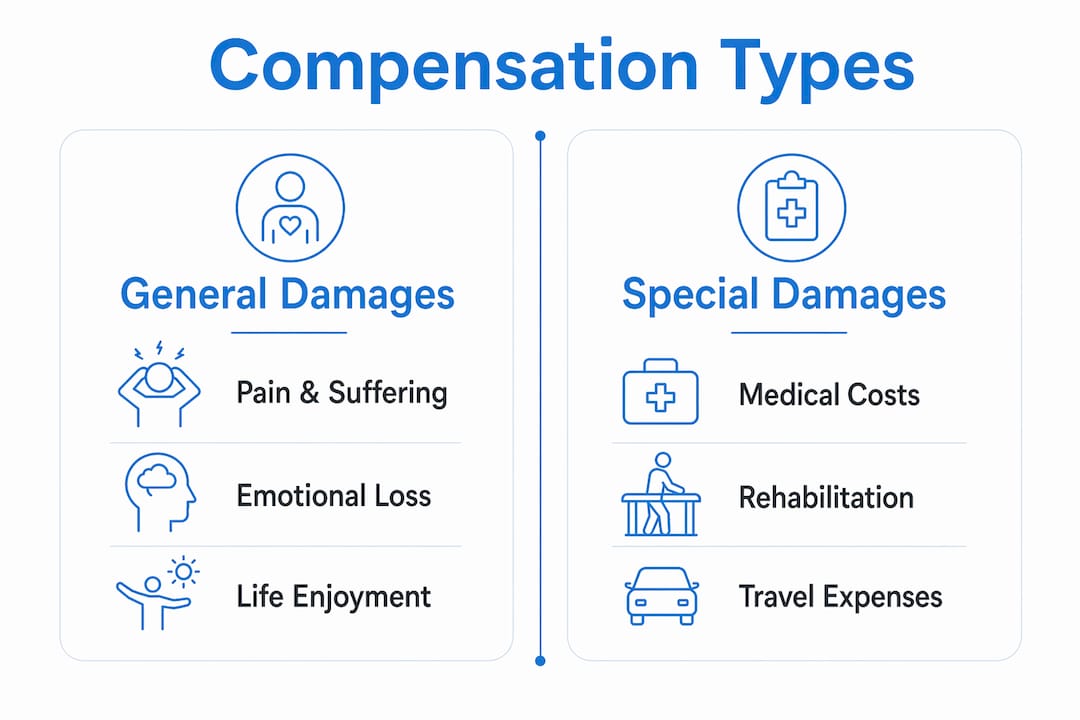
Special damages cover out-of-pocket financial losses. These include medical and hospital expenses, rehabilitation costs, lost wages during recovery, and future care needs if your injuries are long-term. Wage loss claims require payslips and employer confirmation. Future care claims require medical evidence from treating specialists. The more detailed your documentation, the stronger your claim.
Compensation aims to restore you to your pre-accident financial position. That principle means insurers scrutinise your evidence closely. They are not simply verifying that an accident occurred. They are assessing the precise monetary impact on your life.
Settlement amounts vary widely based on injury severity. Minor injuries typically settle between $10,000 and $75,000, while catastrophic injuries can exceed $1 million. That range reflects how much documentation and medical evidence matter to the final figure.
| Damage type | What it covers | Evidence needed |
|---|---|---|
| Pain and suffering | Physical pain, emotional distress | Medical reports, specialist assessments |
| Lost wages | Income lost during recovery | Payslips, employer statements |
| Medical expenses | Hospital, GP, specialist, physio costs | Invoices, receipts, referral letters |
| Rehabilitation | Ongoing therapy and aids | Treatment plans, therapist reports |
| Future care | Long-term support needs | Specialist prognosis, care assessments |
Pro Tip: Keep every receipt related to your injury, including travel costs to medical appointments. These small amounts add up and are fully claimable as special damages.
You can read more about how damages in accident claims are calculated and categorised under Australian law.
How does fault affect your pedestrian accident claim rights?
Fault is not a simple yes or no question in pedestrian accident cases. Australian law applies the principle of contributory negligence, which means your compensation can be reduced if you were partly responsible for the accident. It does not mean your claim is worthless.
Comparative negligence allows claimants to recover compensation reduced by their fault percentage. If a court finds you were 20% at fault for stepping onto the road without looking, your total compensation is reduced by 20%. You still receive 80% of the assessed amount. Partial fault rarely eliminates a claim entirely.
A common misconception is that jaywalking cancels your right to compensation. Pedestrians outside crosswalks often still hold valid claim rights because drivers maintain a primary duty of care regardless of where the crossing occurred. A driver who was speeding, distracted, or under the influence carries significant fault even if you were not at a marked crossing.
Key facts about fault and pedestrian claims:
- Fault is assessed as a percentage, not an absolute determination
- A pedestrian found partially at fault still receives a proportional payout
- Drivers carry a primary duty of care on all roads, not just near crossings
- Evidence such as CCTV footage and witness statements shapes fault assessment
- An accurate fault assessment directly affects the value of your claim
Pro Tip: Never admit fault at the scene or in early conversations with the other driver’s insurer. Fault is a legal determination made after reviewing all evidence, not a roadside conversation.
Understanding how to prove fault in a claim is one of the most practical steps you can take early in the process.
What is the typical process for filing a pedestrian accident claim?
The accident claim process follows a clear sequence, though the timeline varies depending on injury complexity and whether fault is disputed.
- Report the accident. Notify police at the scene or as soon as possible after. Obtain the accident report number for your records.
- Seek medical treatment. Attend a doctor or emergency department the same day. Your medical records from this visit become the foundation of your claim.
- Notify the relevant insurer. In New South Wales, motor accident claims are managed through the Motor Accident Injuries Act 2017 and lodged with the at-fault driver’s CTP insurer. Notify the insurer promptly to avoid complications.
- Engage a personal injury lawyer. Early legal advice protects your rights. A lawyer identifies the correct insurer, gathers evidence, and prevents you from making statements that could reduce your claim.
- Gather and preserve evidence. Collect witness statements, photographs, medical records, and wage documentation. The stronger your evidence file, the better your negotiating position.
- Negotiate a settlement. Most claims settle through negotiation between your lawyer and the insurer. A pedestrian injury claim typically takes 12 to 18 months to settle. Complex cases involving serious injuries or disputed fault take longer.
- Accept a settlement or proceed to court. If the insurer’s offer is fair and reflects your full losses, you accept. If not, your lawyer can escalate to formal legal proceedings.
First settlement offers from insurers are often low-ball attempts designed to close the claim quickly. Accepting early may forfeit your right to seek full compensation, particularly if your injuries worsen over time. Patience and professional advice at this stage are critical.
The role of the insurer in this process is worth understanding before you make any contact with them.
Key takeaways
Pedestrian accident claim rights give injured pedestrians a legal path to full compensation, but only when claims are filed promptly, supported by strong evidence, and managed with professional legal advice.
| Point | Details |
|---|---|
| Duty of care applies to all drivers | Drivers owe pedestrians a duty of care regardless of where the crossing occurred. |
| Compensation covers financial and non-financial losses | General and special damages together aim to restore your pre-accident position. |
| Partial fault reduces but does not eliminate your claim | Contributory negligence reduces your payout proportionally, not absolutely. |
| Limitation periods are strict | Missing the filing deadline bars your claim entirely, so act within three years. |
| Early legal advice protects your claim | A lawyer prevents costly mistakes with insurers and builds a stronger evidence file. |
What I have learned from pedestrian accident claims
The biggest mistake I see pedestrians make is waiting too long to get legal advice. They assume the insurer will be fair, or that their injuries are not serious enough to warrant a lawyer. By the time they realise the offer on the table is inadequate, they have already made statements that weaken their position.
Fault is the other area where people consistently underestimate their rights. A pedestrian who was crossing mid-block often assumes they have no claim. That assumption is wrong. Drivers carry a primary duty of care, and a pedestrian’s location at the time of impact is just one factor among many. I have seen claims succeed where the pedestrian was found partly at fault, because the driver’s negligence was the dominant cause of the collision.
The evidence you gather in the first 48 hours shapes everything that follows. Photographs, witness names, and a same-day medical visit create a factual record that is very difficult for an insurer to dispute. Waiting a week to see a doctor, by contrast, gives an insurer grounds to argue your injuries were not caused by the accident.
Insurers are not on your side. Professional adjusters may attempt to get claimants to admit fault or minimise their injuries in early conversations. Treat every interaction with an insurer as a formal process, not a casual chat. Your words become part of the claim record.
The pedestrians who achieve the best outcomes are those who act quickly, document thoroughly, and get legal advice before accepting anything. Understanding your rights is not just reassuring. It is the practical foundation of a successful claim.
— Daniel
Carelawyers: personal injury support for pedestrian accident victims
Pedestrian accident claims involve strict deadlines, complex fault assessments, and insurers whose interests are not aligned with yours. Carelawyers specialises in personal injury claims across Sydney, with a success rate of over 99% of claims won. The team works on a no-win, no-fee basis, so you pay nothing unless your claim succeeds.

Every client speaks directly with their lawyer. No call centres, no middlemen. If you have been injured as a pedestrian, Carelawyers can assess your claim, explain your entitlements, and manage the entire process on your behalf. Read the detailed guide on accident claim damages to understand exactly what you may be owed, then contact Carelawyers for a free consultation.
FAQ
What are pedestrian accident claim rights?
Pedestrian accident claim rights are the legal entitlements injured pedestrians hold to seek compensation from a negligent driver or their insurer. These rights cover pain and suffering, medical costs, lost wages, and future care needs.
How long do I have to file a pedestrian accident claim in Australia?
In New South Wales, the standard limitation period for personal injury claims is three years from the date of the accident. Missing this deadline bars your claim, so acting promptly is critical.
Can I still claim compensation if I was jaywalking?
Yes. Pedestrians outside crosswalks often retain valid claim rights because drivers hold a primary duty of care on all roads. Your compensation may be reduced by your fault percentage, but it is rarely eliminated entirely.
How long does a pedestrian accident claim take to settle?
A pedestrian injury claim typically takes 12 to 18 months to settle. Cases involving serious injuries or disputed fault take longer.
Should I accept the insurer’s first settlement offer?
No. First settlement offers are typically low-ball figures designed to close the claim quickly. Accepting early may forfeit your right to full compensation, particularly if your injuries worsen. Get legal advice before accepting anything.


