

Motorcycle accident CTP entitlements: your NSW guide
If you’ve been injured in a motorcycle accident in NSW, you’re entitled to statutory benefits under the Motor Accident Injuries Act 2017, regardless of who caused the crash. These benefits cover medical treatment, income support, rehabilitation, and more. The scheme is administered by the State Insurance Regulatory Authority (SIRA), and your CTP insurer (identified through the Green Slip attached to the at-fault vehicle) is responsible for paying your claim.
Here’s what your motorcycle accident CTP entitlements include at a glance:
- Medical and treatment costs: GP visits, physiotherapy, specialist consultations, and hospital expenses
- Income support payments: Weekly payments replacing lost wages while you recover
- Vocational rehabilitation: Support returning to work, including retraining programmes
- Lump sum compensation: Available for non-threshold injuries where you were not mostly at fault
- Funeral expenses: Covered by the insurer regardless of fault if a rider or passenger dies
Statutory benefits run for up to 52 weeks for all injured people. If your injuries are more serious (classified as “non-threshold”) and you were not mostly at fault, income support can continue for up to 2 years, and if you have a whole person impairment above 10% and lodge a common law claim, these benefits may extend up to 5 years.
What can you actually claim after a motorcycle accident in NSW?
All people injured in a NSW motor vehicle accident, including motorcyclists and even at-fault drivers, are entitled to statutory benefits. The scope of what you can claim is broader than most riders realise.
Treatment and care benefits include:
- GP consultations and specialist medical appointments
- Physiotherapy, chiropractic treatment, and allied health services
- Hospital and surgical costs
- Prescription medications related to your injuries
- Attendant care and domestic assistance if your injuries limit daily function
- Medical aids and equipment
Income support replaces your wages while you’re off work. For the first 13 weeks, you receive up to 95% of your pre-accident earnings. After that, payments reduce to 85% if you have no work capacity, or 80% if you have some capacity to work.
Lump sum compensation is available if you have a non-threshold injury and were not mostly at fault. This covers pain and suffering, permanent impairment, and past and future economic loss under a common law claim. The claim must be lodged within 3 years of the accident date.

Funeral expenses are covered by the insurer for anyone who dies in a motor vehicle crash on NSW roads, regardless of fault. This applies even if no formal claim was lodged before the death.
Vocational rehabilitation helps you return to work through retraining, workplace modifications, and job-seeking support. These services are part of your statutory entitlements and don’t require a separate application.
Who is eligible to claim CTP benefits after a motorcycle crash?
Eligibility under the NSW CTP scheme is deliberately wide. Anyone injured in a motor vehicle crash in NSW can apply, provided the accident occurred on or after 1 December 2017.
Eligible claimants include:
- Motorcycle riders
- Pillion passengers
- Passengers in other vehicles involved in the crash
- Pedestrians struck by a motorcycle or other vehicle
- Cyclists
Fault and statutory benefits: For the first 52 weeks of statutory benefits, fault does not matter. Even if you caused the accident, you can still claim medical treatment, rehabilitation, and income support. The no-fault design of the scheme is one of its most important features for riders.
Fault and common law claims: This is where fault becomes critical. Common law damages, including lump sum compensation for pain and suffering and economic loss, are only available to claimants who were not mostly at fault and who have non-threshold injuries.
What counts as a threshold versus non-threshold injury?
The Motor Accident Injuries Act 2017 draws a clear line between these two categories, and your classification directly affects how long your benefits last and whether you can pursue a lump sum.
Threshold injuries (minor injuries) include:
- Soft tissue injuries (sprains, strains, whiplash)
- Minor psychological injuries
Non-threshold injuries (more serious) include:
- Fractures
- Nerve damage
- Significant organ damage
- Severe psychological conditions
If your injuries are non-threshold and you were not mostly at fault, income support can continue for up to 2 years. With a whole person impairment (WPI) assessment above 10%, and a common law claim lodged, that extends to up to 5 years.
Pro Tip: Get a formal injury classification from your treating doctor as early as possible. If your injuries are borderline, a specialist assessment can make the difference between 52 weeks of support and several years of income protection.
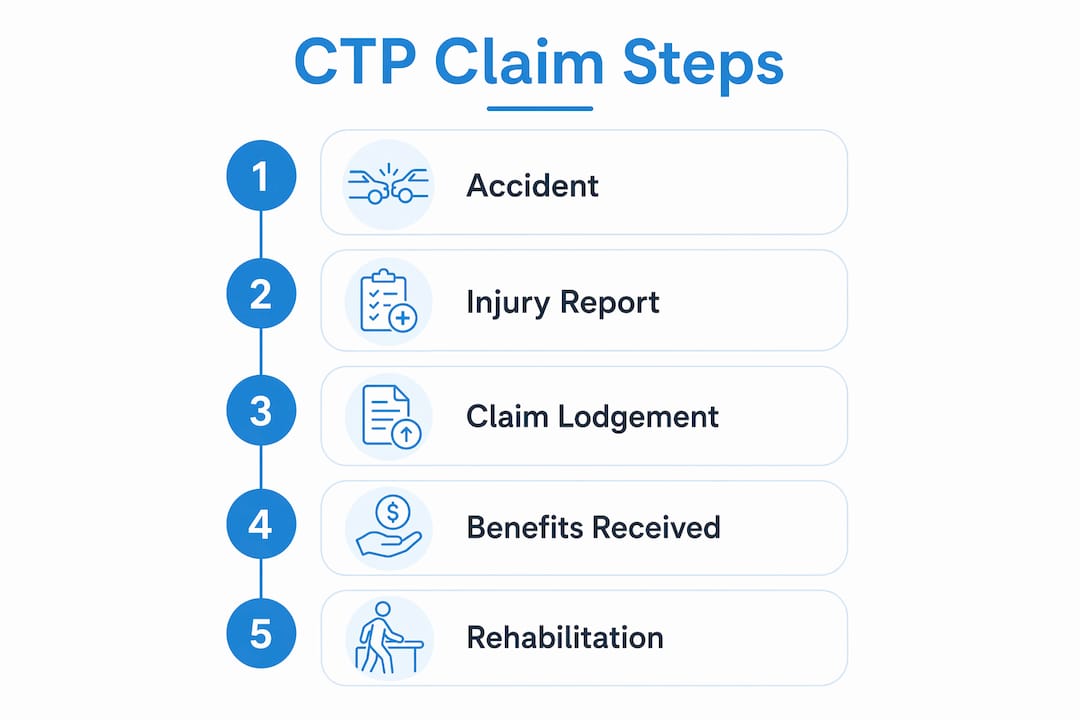
How to file a CTP claim after a motorcycle accident in NSW
Speed matters here. Lodging your claim promptly protects your right to back-pay for medical expenses and lost income incurred before you submitted. If you miss the early lodgement window, those retrospective payments are forfeited, even though you can still lodge a claim later.
What you need to gather first:
- Police event number (call the Police Assistance Line on 131 444 to report the crash and obtain this)
- Certificate of Fitness/Capacity completed by your GP
- Proof of earnings (recent payslips or tax returns if claiming income support)
- Bank account details for direct payment
- Details of all vehicles involved, including registration numbers
- Ambulance and hospital records, if applicable
- Photos of the accident scene, witness statements, or news reports if no police report exists
How to submit:
You can lodge your claim online through your MyServiceNSW Account, or complete a paper Application for Personal Injury Benefits form and send it directly to the at-fault vehicle’s CTP insurer. If you don’t have all documents ready, submit what you have. The insurer will contact you for anything outstanding.

Key deadlines to know:
| Deadline | What it affects |
|---|---|
| Within 28 days | Back-pay for medical costs and lost income before lodgement |
| Within 3 months | Latest point to lodge a statutory benefits claim |
| Within 3 years | Deadline for a common law damages claim |
One thing many riders don’t know: before your claim is formally accepted, insurers may approve one GP consultation and up to two treatment sessions (such as physiotherapy) at their discretion. This early treatment approval applies within the first 28 days of the accident. Use it. Getting treatment started early supports both your recovery and your claim.
The NSW CTP system prioritises early, evidence-based treatment to aid recovery and incentivises filing claims within 28 days to access full benefits.
How income support is calculated and what compensation amounts look like
Income support under the NSW CTP scheme is structured in stages, and the amounts shift depending on how long you’ve been off work and the severity of your injuries.
Payment stages:
- Weeks 1–13: Up to 95% of pre-accident earnings, paid weekly
- Weeks 14–52: 85% if you have no work capacity; 80% if you have some capacity
- Beyond 52 weeks: Only available for non-threshold injuries where you were not mostly at fault; continues up to 2 years
- Beyond 2 years: Requires a lodged common law claim; up to 3 years total for WPI of 10% or less; up to 5 years for WPI above 10%
For riders with catastrophic injuries, the Lifetime Care and Support scheme (a separate no-fault scheme funded through a CTP levy) provides ongoing treatment and care beyond the 5-year mark.
Funeral expense coverage applies to all deaths in motor vehicle crashes on NSW roads. The insurer covers all reasonable funeral costs regardless of whether a claim was active at the time of death.
Lump sum compensation under a common law claim covers past and future economic loss, as well as non-economic loss such as pain and suffering. The amount depends on your WPI assessment, your pre-accident income, your age, and the long-term impact of your injuries on your earning capacity. For a clear breakdown of how damages are calculated, the Carelawyers guide on types of accident damages is a practical starting point.
Expert tips for getting your NSW motorcycle CTP claim right
Getting your claim right from the start saves weeks of delays and protects the full value of your entitlements. These are the mistakes that most commonly derail motorcycle injury compensation claims in NSW.
Common errors to avoid:
- Delaying the police report or failing to get an event number before lodging
- Not obtaining a Certificate of Fitness/Capacity from your GP promptly. This single document is the most critical requirement for commencing income support payments, and its absence is the leading cause of insurer delays
- Assuming you’re ineligible because you were partly at fault. Statutory benefits apply regardless of fault for the first 52 weeks
- Waiting to see how injuries develop before lodging. Lodge first, update the claim as your condition evolves
- Missing the early lodgement window and losing back-pay for expenses already incurred
- Failing to document all injuries at the initial GP visit, which can complicate later claims for non-threshold status
What Carelawyers recommends:
Carelawyers has a success rate of over 99% of claims won, built on one consistent approach: getting the right documentation in place early and keeping clients informed at every step. Their motorcycle accident lawyers work directly with riders, not through intermediaries, so nothing gets lost in translation between you and the insurer.
Pro Tip: Keep a daily injury diary from the day of the accident. Record your pain levels, what activities you can and can’t do, and how your injuries affect your work and daily life. This contemporaneous record is powerful evidence for both statutory benefit assessments and common law claims.
Acting quickly after an accident is a principle that personal injury lawyers consistently emphasise, and NSW’s CTP scheme makes that urgency concrete through its back-pay rules.
What happens if your CTP claim is denied or disputed?
A claim denial or dispute is not the end of the road. NSW has a structured process for challenging insurer decisions, and most disputes can be resolved without going to court.
If your insurer rejects your claim or disputes the value of your benefits, your first step is to request a written explanation of the decision. Insurers are required to give reasons. From there, you can request an internal review by the insurer, which must be completed within a set timeframe.
If the internal review doesn’t resolve the dispute, you can escalate to SIRA’s dispute resolution process. SIRA oversees the scheme and has authority to review insurer decisions on benefit entitlements, injury classifications, and payment amounts. For disputes about injury thresholds or WPI assessments, an independent medical examination may be ordered.
For common law claims that can’t be settled through negotiation, the matter proceeds to the Personal Injury Commission (PIC), which handles motor accident disputes in NSW. The PIC offers mediation before any formal hearing, and most disputes settle at that stage. Legal representation at this point is strongly advisable, particularly for non-threshold injury claims where lump sum amounts are at stake.
Where to get help with your NSW CTP claim
SIRA (State Insurance Regulatory Authority)
SIRA is the government body that regulates the NSW CTP scheme. Their website at sira.nsw.gov.au has claim guides, insurer contact details, and dispute resolution information. SIRA also operates an Injury Advice Centre for people who need guidance on their rights.
Service NSW
You can lodge your CTP claim online through your MyServiceNSW Account at service.nsw.gov.au. Service NSW also provides phone support for people who need help with the application process.
Your CTP insurer
The insurer is identified through the Green Slip of the at-fault vehicle. If you don’t know which insurer is involved, SIRA can help you identify them.
Carelawyers
For riders dealing with complex claims, disputed injury classifications, or serious injuries requiring a common law claim, Carelawyers offers direct, no-jargon legal advice. Their team specialises in motorcycle accident claims across NSW, with no win, no fee arrangements so upfront costs aren’t a barrier.
How CTP claims interact with Medicare and other insurance
CTP and Medicare operate in parallel, but there are rules about which scheme pays first and whether you can claim the same expense twice.
Medicare: Medicare will cover eligible medical costs as usual, but if those costs are also covered by your CTP claim, the insurer is required to reimburse Medicare. In practice, your treating practitioners will often bill the CTP insurer directly once your claim is accepted, bypassing Medicare entirely for accident-related treatment.
Private health insurance: Similar rules apply. If your private health fund pays for treatment that your CTP claim also covers, the insurer may seek reimbursement from your fund, or your fund may require you to pursue the CTP claim first. Check your policy’s coordination of benefits clause.
Workers compensation: If your motorcycle accident happened while you were travelling for work, both CTP and workers compensation may apply. The two schemes don’t simply stack on top of each other. Generally, CTP covers treatment and income support first, with workers compensation filling gaps. Getting legal advice early is important when both schemes are potentially in play, as the interaction between them can affect your total entitlements.
Income protection insurance: Payments from a private income protection policy may be offset against your CTP income support, depending on your policy terms. Some policies have a CTP offset clause; others don’t. Review your policy documents or speak to your insurer before assuming you can receive both in full.
Key takeaways
NSW motorcycle accident CTP entitlements cover medical treatment, income support, and lump sum compensation under the Motor Accident Injuries Act 2017, with the 28-day lodgement window being the single most critical deadline for protecting your full back-pay entitlements.
| Point | Details |
|---|---|
| No-fault statutory benefits | All injured riders can claim medical and income support for up to 52 weeks, regardless of fault. |
| Income support rates | Payments start at up to 95% of pre-accident earnings for the first 13 weeks, then reduce. |
| Non-threshold injury extensions | Income support can continue for up to 2 years for non-threshold injuries if you were not mostly at fault, and up to 5 years with a common law claim and a whole person impairment above 10%. |
| Lodge within 28 days | Missing this window forfeits back-pay for medical costs and lost income incurred before lodgement. |
| Certificate of Fitness/Capacity | This GP document is the single most critical requirement for commencing income support payments. |


