

Motor accident injury assessment: what you need to know
A motor accident injury assessment is a formal medical and functional evaluation that documents the nature, extent, and impact of injuries sustained in a motor vehicle accident. It forms the foundation for personal injury claims, insurer negotiations, and rehabilitation planning. Without one, proving the link between the crash and your injuries becomes significantly harder. This article explains what the process involves, when to get assessed, and why both clinical findings and functional limitations matter equally to your claim.
What is a motor accident injury assessment?
A motor accident injury assessment is the structured process by which doctors, specialists, and allied health professionals evaluate injuries from a road accident for medical and legal purposes. The industry term used in medico-legal contexts is “independent medical examination” or IME, though the broader evaluation process includes clinical testing, functional assessments, and documented reporting. Both terms appear throughout the claims process, so understanding each helps you engage with your treating team and insurer more confidently.
The assessment serves two distinct purposes. Medically, it identifies what injuries you have, how severe they are, and what treatment you need. Legally, it creates the documented evidence base that supports your compensation claim. Insurers and courts rely on these findings to determine liability, impairment ratings, and the financial value of your claim.

The Transport Accident Commission (TAC) in Victoria operates under guidelines that allow permanent impairment assessment as early as 3 months post-accident, with a benefit threshold triggered at over 10% impairment. That threshold matters because it determines whether you qualify for additional statutory benefits beyond basic treatment costs.
What components are involved in a motor accident injury assessment?
A thorough motor vehicle injury assessment covers several distinct layers of evaluation, each targeting a different aspect of your injury.
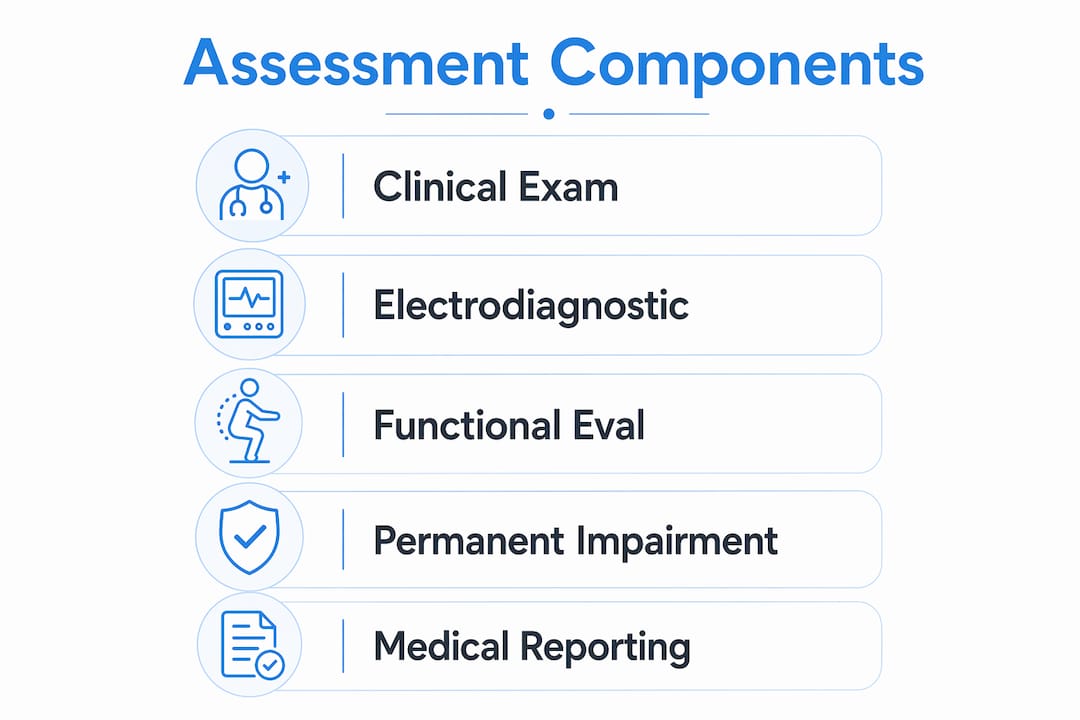
Clinical and neurological examination
The examining doctor tests your musculoskeletal and neurological function directly. This includes range of motion testing, reflex checks, and sensory assessments. Muscle strength is graded using the Medical Research Council Scale, a 0 to 5 scale where 0 means no contraction and 5 means full normal strength. The unaffected side is tested first to establish a baseline, which makes the comparison objective and defensible in legal proceedings.
Spinal nerve function testing maps which muscle groups are affected, helping doctors localise the injury to a specific spinal level. This level of precision matters when distinguishing a soft tissue strain from a disc injury or nerve root compression.
Electrodiagnostic testing
When nerve damage is suspected, nerve conduction studies (NCS) and electromyography (EMG) provide objective data that imaging often cannot. NCS and EMG identify nerve injuries that may not appear on MRI shortly after the accident. Repeated at intervals post-injury, these tests differentiate temporary nerve disruption from permanent damage, which directly affects prognosis and compensation value.
Functional impact evaluation
This is where occupational therapists (OTs) enter the process. An OT assessment goes beyond diagnosis to measure how your injuries affect real life. Standardised OT tools measure strength, endurance, and task performance, including activities like cooking, dressing, and walking. The findings quantify limitations in a way that clinical notes alone cannot.
Key components typically covered in a full car accident injury evaluation include:
- Musculoskeletal examination covering spine, limbs, and joints
- Neurological testing including reflexes, sensation, and muscle grading using the MRC Scale
- Electrodiagnostic studies (NCS/EMG) for suspected nerve injuries
- Occupational therapy assessment for daily life and work capacity
- Psychological screening where trauma or chronic pain is present
- Review of imaging results including X-rays, CT scans, and MRI reports
Pro Tip: Ask your treating doctor to document every symptom at each appointment, even minor ones. Symptoms that seem trivial early on can become significant evidence if they persist or worsen.
When should you get a motor accident injury assessment done?
Timing is one of the most consequential decisions you make after a crash. Seeking medical evaluation within 24 hours of a motor vehicle accident is strongly recommended to protect both your health and your insurance claim. Many injuries, particularly soft tissue and nerve injuries, do not produce immediate symptoms. Waiting days or weeks creates a gap that insurers will use to argue the injury was not caused by the accident.
The formal assessment timeline for legal purposes follows a different schedule:
- Within 24 hours. Attend a GP or emergency department to document the accident and any immediate symptoms. This visit creates the first entry in your clinical paper trail.
- Within the first two weeks. Follow up with your GP or a specialist if symptoms persist or worsen. Request referrals to physiotherapy or neurology as needed.
- At 3 months post-accident. Under TAC guidelines, permanent impairment can be assessed once injuries are considered stable. This is the earliest point at which an impairment rating carries legal weight.
- Within one year. Claims generally must be lodged within one year of the accident, extendable to three years with reasonable grounds. Missing this window can extinguish your right to compensation entirely.
- Up to six years post-accident. The TAC allows impairment assessments up to six years after the accident in some circumstances, but earlier assessment produces stronger evidence.
The car accident claim timeline is unforgiving. Delays in assessment do not just weaken your evidence. They can void your claim altogether.
How do doctors and therapists evaluate injury impact on daily life?
Clinical diagnosis tells you what is damaged. Functional impact assessment tells you what you can no longer do. These are different questions, and courts and insurers weigh both.
“Functional impact evidence is often the decisive factor in compensation cases, more so than clinical diagnosis alone. An OT medico-legal report quantifies how injuries affect daily tasks, supporting clear compensation claims beyond what clinical findings show.”
A doctor may confirm a lumbar disc injury. But an OT assessment reveals that the same injury prevents you from sitting for more than 20 minutes, lifting your child, or returning to your trade. That functional picture is what determines the real value of your claim.
Occupational therapy assessments use real-world task observations alongside standardised measurement tools. The OT watches you perform activities under controlled conditions, not just asks how you feel. This produces objective, reproducible data.
Functional limitations that carry significant legal weight include:
- Inability to perform paid work or reduced work capacity
- Restrictions in self-care tasks such as bathing, dressing, and grooming
- Reduced mobility affecting transport and community participation
- Cognitive or psychological limitations affecting concentration and decision-making
- Dependence on others for tasks previously performed independently
Insurers scrutinise functional evidence closely because it directly links your injuries to financial loss. A well-documented OT report can be the difference between a disputed claim and a settled one. For claims involving spinal cord injuries, functional evidence is particularly critical given the long-term care costs involved.
What role do medical reports play in injury claims?
Documented assessments are the legal backbone of any injury claim. Without a clear clinical paper trail, insurers may contest claims or delay rehabilitation funding by arguing the injury predated the accident or was not serious enough to warrant treatment.
A strong documentation trail includes:
- The initial GP or emergency department record from within 24 hours of the accident
- Specialist referral letters and consultation notes
- Imaging reports with clinical interpretation
- OT and physiotherapy assessment reports
- Electrodiagnostic test results where nerve injury is present
- Psychological assessment reports where trauma is documented
One critical gap many people miss: emergency rooms focus on life-threatening injuries, not on documenting functional limitations for legal claims. An ER discharge note confirms you attended. It rarely captures the musculoskeletal detail that insurers need to approve rehabilitation funding or that courts need to assess damages.
Pro Tip: Request copies of every report and imaging result at each appointment. Keep a personal file. Your lawyer and insurer will need these documents, and delays in obtaining them can slow your claim.
Follow-up evaluations with physiotherapists and specialists produce the detailed records that fill the gap left by emergency care. The importance of documenting injuries after an accident cannot be overstated. Each report adds another layer of evidence that connects your injuries to the accident and to your ongoing limitations.
Understanding what recovery expenses are covered after a motor accident helps you plan which assessments to prioritise and how to fund them through your insurer.
Key takeaways
A motor accident injury assessment combines clinical examination, electrodiagnostic testing, and functional evaluation to build the medical and legal evidence your compensation claim depends on.
| Point | Details |
|---|---|
| Get assessed within 24 hours | Early medical attendance creates the first record linking your injuries to the accident. |
| Clinical plus functional evidence | Courts and insurers weigh functional limitations as heavily as clinical diagnosis. |
| TAC impairment thresholds apply | Permanent impairment over 10% triggers additional TAC benefits; assessment can begin at 3 months. |
| Documentation gaps cost claims | ER records alone are insufficient; follow-up specialist and OT reports are required. |
| Claim deadlines are strict | Claims must generally be lodged within one year, with a maximum extension to three years. |
What I have learned from watching people navigate these assessments
The biggest mistake I see is treating the initial GP visit as the whole assessment. People attend once, get told to rest, and assume the process is done. It is not. The clinical examination is the starting point. The functional impact evaluation is where the real legal work happens.
The second mistake is waiting to feel “bad enough” before seeking further assessment. Soft tissue injuries and nerve damage often worsen over weeks, not days. By the time symptoms peak, the early documentation window has closed. Insurers notice that gap immediately.
What actually protects people is a layered approach: GP within 24 hours, specialist referral within two weeks, OT assessment once the acute phase settles, and a lawyer involved from the beginning to coordinate the evidence. The benefits of personalised legal advice at this stage are real. A lawyer who understands medico-legal assessments will tell you which reports to obtain and in what order, which saves time and prevents gaps that insurers exploit.
The functional impact report is the document most people underestimate. It is also the one that most often determines whether a claim settles at a fair value or gets disputed into the ground. Get the OT assessment. Do not skip it because you think your injuries are obvious. Obvious to you is not the same as documented.
— Daniel
How Carelawyers supports your motor accident claim

Carelawyers has helped clients across Sydney navigate the full motor accident claims process, from the first medical assessment through to final settlement. The team works directly with you, no intermediaries, to help you understand what assessments you need, how to obtain them, and how to use them to build the strongest possible claim.
Understanding what damages you can claim after an injury assessment is the first step toward knowing what you are owed. Carelawyers explains each component clearly and fights for the full amount. With a success rate of over 99% of claims won, the firm brings both experience and personal attention to every case. Contact Carelawyers today for a confidential conversation about your situation.
FAQ
What is a motor accident injury assessment?
A motor accident injury assessment is a formal medical and functional evaluation that documents injuries sustained in a road accident for clinical treatment and legal compensation purposes. It typically includes physical examination, imaging review, and occupational therapy assessment.
How soon should I get assessed after a car accident?
Medical evaluation within 24 hours of the accident is strongly recommended to protect your health and establish a documented link between the crash and your injuries.
What does an occupational therapist do in an injury assessment?
An OT uses standardised tools and real-world task observations to measure how your injuries limit daily activities such as work, self-care, and mobility, producing evidence that directly supports compensation claims.
When can a permanent impairment assessment be done?
Under TAC guidelines, permanent impairment can be assessed as early as 3 months post-accident if injuries are stable, and up to 6 years after the accident in some circumstances.
What happens if I delay getting an injury assessment?
Delayed assessment creates gaps in your clinical record that insurers use to dispute whether your injuries were caused by the accident. Claims must generally be lodged within one year, so early assessment protects both your health and your legal rights.


