

Lifetime care and support in NSW: 2026 guide
The Lifetime Care and Support Scheme in NSW is a no-fault government programme that pays for treatment, rehabilitation, and ongoing care for people severely injured in motor accidents. Managed by Insurance and Care NSW (icare), it removes the burden of proving fault before accessing support. For injured individuals in NSW, this scheme is often the most significant financial and practical lifeline available after a catastrophic accident. Understanding how lifetime care and support in NSW works, who qualifies, and how to apply can make a measurable difference to your recovery.
What is lifetime care and support in NSW?
The Lifetime Care and Support Scheme pays for treatment, rehabilitation, and care for people severely injured in motor accidents in NSW. The defining feature is its no-fault structure. icare funds support regardless of who caused the accident, which means injured individuals do not need to win a legal battle before receiving care.
The scheme covers a wide range of serious injuries and is designed to last for the person’s entire life if needed. That permanence matters. Many injured individuals assume support will end after initial hospital treatment, but the scheme is built for the long term. Care plans are reviewed and updated as needs change, so the support grows with the person rather than cutting off at an arbitrary point.

icare coordinates the scheme through case managers and approved health professionals. These professionals assess each person’s needs and match them to appropriate services. The scheme does not operate as a one-size-fits-all arrangement. It is structured around individual circumstances, which is why understanding your specific eligibility is the critical first step.
What eligibility criteria determine access to lifetime care and support in NSW?
Eligibility requires a severe injury from a motor vehicle accident that results in a catastrophic condition. The scheme does not cover minor or moderate injuries. Qualifying conditions include:
- Spinal cord injury
- Traumatic brain injury
- Amputations
- Serious burns
- Blindness caused by the accident
The no-fault principle means the scheme applies whether the injured person was a driver, passenger, pedestrian, or cyclist. Fault is not assessed as part of the eligibility process. This is a common misconception that stops people from applying. Many injured individuals assume they cannot access support because they believe they were partly responsible for the accident. That assumption is incorrect under this scheme.
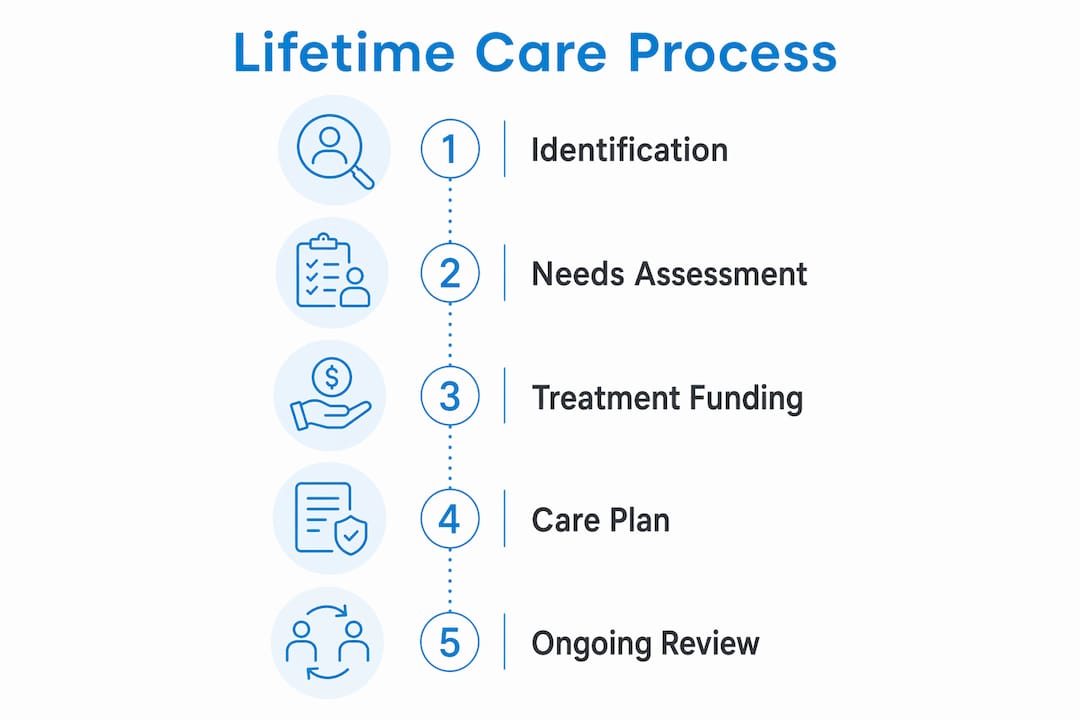
Once a potential claim is identified, icare assigns a health professional to conduct a formal needs assessment. This assessment looks at the nature of the injury, the level of functional impairment, and the care required. A case manager then coordinates the outcome of that assessment into a care plan.
icare provides up to two years of treatment funding immediately after injury. After that period, a formal lifetime care application is made. This two-stage process is critical to understand. Missing the transition from initial funding to lifetime care can create gaps in support, which is why early contact with a case manager is non-negotiable.
One common misconception is that only people who were hospitalised for extended periods qualify. The scheme assesses functional impairment, not length of hospitalisation. A person discharged quickly but left with permanent disability from a spinal cord injury qualifies just as much as someone who spent months in acute care.
What types of support does the lifetime care scheme provide?
The scheme funds a broad range of personalised services focused on helping injured persons regain independence and quality of life. Support categories include:
- Attendant care and in-home support: Personal care, hygiene assistance, and supervision at home
- Rehabilitation therapies: Physiotherapy, occupational therapy, speech pathology, and psychology
- Equipment and modifications: Wheelchairs, communication devices, and home or vehicle modifications
- Domestic assistance: Cleaning, meal preparation, and household tasks the person can no longer perform
- Community access: Transport and support to participate in social, recreational, or vocational activities
Each of these categories is funded based on assessed need, not a fixed dollar cap. That distinction matters because it means the scheme can respond to significant changes in a person’s condition without requiring them to fund the gap themselves.
Care plans are built around the individual. An injured person has the right to choose from approved providers, which gives them genuine control over who enters their home and delivers their care. Choice and control over approved providers directly improves rehabilitation outcomes and satisfaction. This is not a minor administrative detail. Research consistently shows that people who feel in control of their care recover more effectively.
Pro Tip: Ask your case manager for a written list of all approved providers in your area before committing to any service. Comparing two or three options before deciding gives you real leverage over the quality and fit of your care.
The scheme also coordinates with other health professionals, including treating specialists and general practitioners. This coordination reduces the administrative load on the injured person and their family. Rather than managing multiple referrals and invoices independently, the case manager handles much of the paperwork.
For those with complex needs, personalised care plans can include a mix of funded services delivered by different providers. A person with a spinal cord injury might receive attendant care from one provider, physiotherapy from another, and psychological support from a third, all coordinated under a single plan.
How to apply for lifetime care and support in NSW
The application process follows a clear sequence. Following it correctly avoids delays that can leave injured individuals without funded support during a critical recovery period.
- Contact icare or your insurer immediately after the accident. The sooner you make contact, the sooner the initial two-year funding period begins. Delays at this stage push back the entire timeline.
- Confirm your injury qualifies as catastrophic. Your treating doctor or specialist can provide the clinical documentation needed to support this determination.
- Undergo a formal needs assessment. icare assigns a health professional to assess your functional needs. Attend this assessment with a support person if possible, and bring all relevant medical records.
- Receive your care plan. Once approved, icare coordinates with approved providers to begin delivering services. You have input into which providers are selected.
- Transition to lifetime care. Before the two-year initial funding period ends, contact your case manager to begin the formal lifetime care application. This step is critical to avoid a funding gap.
Pro Tip: Keep a dated log of every phone call, email, and meeting with icare, your insurer, and your case manager. If a dispute arises about timelines or decisions, that log is your strongest evidence.
Documentation is the backbone of a successful application. Medical reports, specialist assessments, and functional capacity evaluations all support your claim. If your treating team has not provided written reports, request them before your needs assessment. Verbal information carries far less weight in the formal process.
After approval, expect regular reviews of your care plan. These reviews are not a threat to your support. They are the mechanism by which your plan stays current as your needs evolve. Approach them as an opportunity to request additional services rather than a checkpoint to pass.
For injured individuals who also have legal claims related to their accident, motor vehicle accident lawyers can help coordinate the legal and care processes simultaneously. This avoids situations where legal strategy inadvertently affects care entitlements.
Common challenges and best practices for managing lifetime care and support
Managing lifetime care involves more than receiving services. It requires active participation in a system that can be administratively complex.
Early engagement with case managers significantly improves the speed and quality of care coordination. The most common mistake injured individuals make is waiting until a crisis point before contacting their case manager. Proactive communication prevents gaps in service and gives you more influence over how your care is structured.
Key best practices include:
- Request a dedicated case manager early. Consistency in your case manager reduces the time spent re-explaining your situation at every contact.
- Advocate for your preferred providers. The scheme allows choice. If a provider is not working for you, you can request a change.
- Update your care plan when your needs change. The scheme reassesses and updates care plans as injury or care requirements evolve. Do not wait for a scheduled review if your needs change significantly.
- Build a support network. Family members, carers, and community organisations can supplement funded services and reduce isolation during recovery.
- Seek legal advice if disputes arise. If icare disputes your eligibility or reduces your funded services, a lawyer with experience in rehabilitation support after injury can help you challenge that decision.
Paperwork is the most common source of frustration. Keeping copies of every document submitted and received creates a clear record that protects you if information is lost or disputed. Treat your claim file the same way you would treat a financial record. Organise it, date it, and store it securely.
Key takeaways
Lifetime care and support in NSW is a no-fault scheme managed by icare that funds treatment, rehabilitation, and ongoing care for people catastrophically injured in motor accidents, with no requirement to prove fault.
| Point | Details |
|---|---|
| No-fault access | You do not need to prove fault to access the scheme; eligibility is based on injury severity. |
| Qualifying injuries | Spinal cord injury, brain injury, amputations, burns, and blindness from a motor accident all qualify. |
| Two-year initial funding | icare funds up to two years of treatment before the formal lifetime care application is made. |
| Choice of providers | Injured persons can choose from approved providers, which improves care quality and recovery outcomes. |
| Early contact is critical | Contacting icare or your insurer immediately after the accident prevents delays and funding gaps. |
What I have learned about navigating lifetime care in NSW
Working alongside injured individuals through the claims process has shown me one pattern more than any other: the people who engage early and stay engaged consistently get better outcomes. Not because the system rewards persistence as a matter of policy, but because case managers have more to work with when a person is communicating clearly and regularly.
The most damaging misconception I encounter is the belief that the scheme will automatically take care of everything once approved. It does not. Care plans require active input. Providers need to be monitored. Reviews need to be prepared for. The scheme is a resource, not a passive safety net.
The other thing I have seen repeatedly is injured individuals accepting the first care plan offered without questioning whether it fully reflects their needs. You are entitled to push back. You are entitled to request additional services if your condition warrants them. The scheme is funded to meet genuine need, and genuine need is often higher than the initial assessment captures.
Legal support is not just for compensation claims. A lawyer who understands the intersection of icare entitlements and personal injury law can help you access the full scope of what you are owed, not just the minimum the system offers by default.
— Daniel
How Carelawyers supports injured NSW individuals
Carelawyers specialises in personal injury law for people seriously injured in NSW motor accidents. The firm operates on a no win no fee basis, which means you pay nothing unless your claim succeeds.

If you are managing a lifetime care claim alongside a compensation matter, Carelawyers can coordinate both. The team works directly with clients, with no intermediaries, so you speak to your lawyer every time you call. Carelawyers has won over 99% of claims handled. For injured individuals dealing with accident claim damages or complex care entitlements, that track record matters. Contact Carelawyers for an initial consultation to understand exactly where you stand.
FAQ
What is the Lifetime Care and Support Scheme in NSW?
The Lifetime Care and Support Scheme is a no-fault government programme managed by icare that funds treatment, rehabilitation, and ongoing care for people catastrophically injured in NSW motor accidents.
Who qualifies for lifetime care and support in NSW?
People who sustain catastrophic injuries, including spinal cord injury, brain injury, amputations, serious burns, or blindness, from a motor vehicle accident in NSW qualify, regardless of who caused the accident.
How long does icare fund treatment before lifetime care begins?
icare provides up to two years of treatment funding after the accident. After that period, a formal application for lifetime care is made to continue support.
Can I choose my own care providers under the scheme?
Yes. The scheme allows injured persons to select from approved providers. Choosing your own providers improves care quality and gives you greater control over your recovery.
Do I need a lawyer to access lifetime care and support?
You do not need a lawyer to apply, but legal advice is strongly recommended if your eligibility is disputed or if you also have a compensation claim. Carelawyers can assist with both through no win no fee representation.


