

Journey claim workers compensation: your 2026 guide
What is a journey claim and who can make one?
A workers compensation journey claim covers injuries sustained while travelling to, from, or for work purposes. If you were hurt on your commute this morning, or on the way to a work-related training session, you may have grounds to claim. The key legal test across Australian jurisdictions is whether there is a real and substantial connection between your employment and the accident that caused the injury.
Under Section 10 of the Workers Compensation Act 1987 (NSW), a personal injury received during a qualifying journey is treated as an injury arising out of or in the course of employment. That framing matters because it means the same compensation entitlements apply as for a workplace injury.
Journeys that typically qualify include:
- Daily travel between your home and your place of employment
- Travel to or from an educational institution your employer requires or expects you to attend
- Travel to obtain a medical certificate or receive treatment connected to an existing workers compensation injury
- Travel between two separate jobs with different employers
- Travel to or from a work conference, meeting, or work-related event, locally, interstate, or overseas
- Travel to collect wages from your employer when that arrangement is part of your employment terms
Core eligibility conditions:
- The journey must have a real and substantial connection to your employment
- You must have started the journey without a major delay or deviation from your usual route
- The injury must not have occurred at your home before the journey began, since injuries at home before travel starts are not compensable under the Workers’ Compensation and Rehabilitation Act 2003 (QLD) or its NSW equivalent
- The injury must not result from your own serious and wilful misconduct, including being under the influence of alcohol or drugs at the time
One important exception: exempt workers such as police officers, paramedics, firefighters, and emergency services volunteers are not required to demonstrate a real and substantial connection. Their journey injuries are covered by default given the nature of their roles.
Table of Contents
- Eligibility nuances, common scenarios, and what gets claims rejected
- How to lodge a workers compensation journey claim
- Insurance nuances and legal complexities worth knowing
- Carelawyers can take the complexity off your plate
- Key takeaways
Eligibility nuances, common scenarios, and what gets claims rejected
Jurisdiction matters more than most workers realise. NSW, Queensland, and Victoria each apply the substantial connection test differently, and the practical outcomes can vary.
Compensable scenarios across Australian states:
- Commuting directly between home and your fixed workplace (subject to the substantial connection test in NSW)
- Travelling to or from a trade school or training course your employer expects you to attend
- Travelling to or from medical or rehabilitation appointments that form part of an existing WorkCover Queensland claim
- Inter-job travel between two employers on the same day
- Attending an after-hours work function or employer-directed event
- Travelling for a work conference interstate or overseas where employment is a significant contributing factor
Scenarios that typically result in rejection:
- Stopping at a shop, gym, or friend’s house on the way home without a work-related reason
- A substantial delay or deviation from the usual route, such as a lengthy personal errand
- Dangerous driving where you are at fault, or being under the influence of alcohol
- Injury occurring inside your home before you have physically left the property boundary
The Andronicos case is frequently cited in NSW journey claim disputes. It reinforced that the real and substantial connection test requires more than a loose association between travel and work. Courts look at whether the employment itself created the need for the journey, not merely whether the worker happened to be travelling at the time.
In Victoria, WorkSafe applies a similar interruption or deviation test. Whether a detour is “substantial” is a question of fact, assessed against the time taken, the route chosen, and the purpose of the side trip.

SIRA NSW clarifies that routine home-to-work commutes are assessed on a case-by-case basis rather than automatically covered. That case-by-case approach is why the facts of your specific trip matter so much when lodging a claim.
How to lodge a workers compensation journey claim
The claim lodgement process follows a clear sequence, but the evidence you gather in the hours after an injury often determines whether the claim succeeds.
Steps to take immediately after a journey injury:
- Seek medical attention and obtain a certificate of capacity from your treating doctor
- Report the injury to your employer as soon as practicable
- Document the route you were travelling, the time, and the circumstances of the accident
- Gather witness details, photographs of the scene, and any police report if a vehicle was involved
- Complete the Other Work Related Injuries Claim Form (available from SIRA NSW or your employer’s insurer) and lodge it with the insurer
Key evidence to support your claim:
- A work injury certificate from your treating practitioner
- GPS data, transport records, or a statutory declaration confirming your route
- Witness statements from anyone who saw the accident
- Police event number if the injury involved a motor vehicle collision
- Employment records confirming your work schedule and location on the day
Timeframes: In Queensland, you generally have 6 months from the date of injury to lodge a claim with WorkCover Queensland or a self-insurer. Missing that window can cost you your entitlements. NSW does not apply an identical hard cut-off, but delays weaken claims and can trigger insurer disputes.
Benefits payable for an accepted journey claim include weekly wage payments during incapacity, medical and rehabilitation expenses, lump sum compensation for permanent impairment, and paid care or assistance with daily activities.
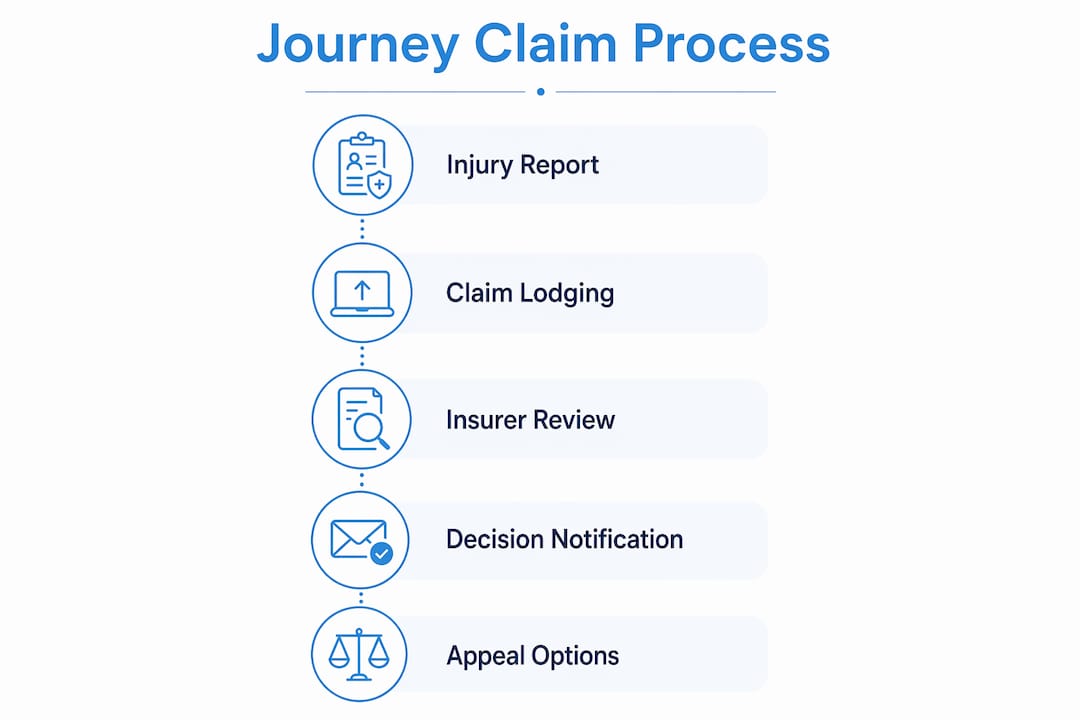
If the insurer disputes liability, you can escalate to the Workers Compensation Commission (NSW) or the Queensland Industrial Relations Commission. The NSW Independent Review Office (IRO) at iro.nsw.gov.au provides free advice and can assist with disputes. SIRA NSW and WorkSafe Queensland both publish guidance on the dispute resolution process.
Insurance nuances and legal complexities worth knowing
A motor vehicle accident during a work journey creates a dual-claim situation that catches many workers off guard. If another driver caused the accident, you may be entitled to lodge concurrent claims under both workers compensation and the state-based Compulsory Third Party (CTP) insurance scheme. Failing to lodge both claims simultaneously can cause administrative delays and potentially reduce your total recovery.
Many employers also hold separate Journey Insurance policies. This exists because standard workers compensation in NSW typically does not automatically cover routine home-to-work commutes without the substantial connection test being satisfied. Journey Insurance fills that gap for employers who want broader protection for their workers on the road.
Key legal and insurance considerations:
- Lodge CTP and workers compensation claims at the same time if a vehicle collision is involved
- Check whether your employer holds a Journey Insurance policy, as it may cover travel not captured by standard workers compensation
- Interstate and overseas work travel requires employment to be a significant contributing factor, not just incidental to the trip
- Hybrid and work-from-home arrangements create new questions about where the journey begins; SIRA NSW treats these on a case-by-case basis
- Employer-directed after-hours events and conferences extend the employer’s duty of care into travel time
Pro Tip: If you work across state borders or travel interstate regularly for work, get legal advice before lodging. Jurisdictional rules differ enough that a claim valid in Queensland may face different scrutiny in NSW, and the wrong form or insurer can delay your payments by months.
Carelawyers handles workers compensation claims across NSW with a no-win, no-fee model, so the complexity of concurrent claims or jurisdictional questions does not have to fall on you alone.
Carelawyers can take the complexity off your plate
Injured on a commute or during work travel? The legal and insurance maze around journey claims is genuinely complicated, and a misstep at the lodgement stage can cost you weeks of payments or a lump sum entitlement.

Carelawyers is a Sydney-based personal injury firm with a 99% success rate on claims won. Unlike large impersonal firms, you speak directly to your lawyer from the first call. No middlemen, no jargon. Whether your claim involves a straightforward commute injury or a concurrent CTP and workers compensation situation, the team at Carelawyers has handled it before. If you want to understand what damages you may be owed before you commit to anything, that conversation costs you nothing. Call Carelawyers today for a free, no-obligation assessment of your journey claim.
Key takeaways
A workers compensation journey claim succeeds or fails on whether your travel had a real and substantial connection to your employment, and whether you took a direct route without major deviations.
| Point | Details |
|---|---|
| Real and substantial connection | SIRA NSW and WorkSafe Queensland both require this link between employment and the accident to exist. |
| Deviations break eligibility | A substantial delay or detour for personal reasons can void an otherwise valid journey claim. |
| Lodge within 6 months (QLD) | Queensland claimants generally have 6 months from injury to lodge with WorkCover or lose entitlements. |
| Benefits available | Accepted claims can cover weekly wages, medical expenses, lump sum impairment payments, and care assistance. |
| Carelawyers | Sydney-based, no-win no-fee workers compensation lawyers with a 99% success rate on claims won. |


