

How to prove fault in a car accident claim
Proving fault in a car accident claim means demonstrating that another driver’s negligence directly caused the collision and your resulting injuries. In Australian law, this concept is formally called establishing liability, and it sits at the heart of every compensation claim. Without it, insurers have no obligation to pay. The evidence you gather in the hours and days after a crash, including police reports, witness statements, and dashcam footage, determines whether your claim succeeds or stalls. This guide walks you through every step.
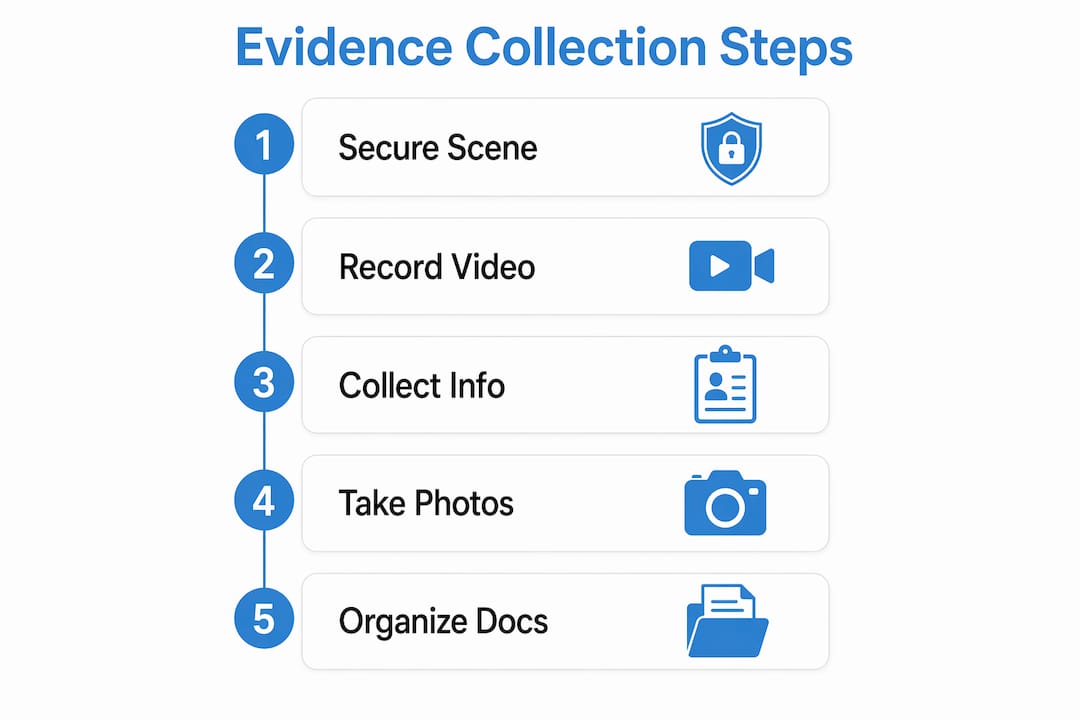
What evidence do you need to prove fault in a car accident claim?
Car accident liability evidence falls into six main categories. Each one serves a different purpose in building your case, and the strongest claims use all of them together.
- Police reports. Obtaining the official police report typically costs $5–$30 depending on your jurisdiction. These reports are valuable in early insurance negotiations, but police reports are often inadmissible as trial evidence due to hearsay rules. Request yours as soon as it is available.
- Witness statements. Witness statements secured within 72 hours carry significantly more weight because memory is still stable and insurers have less opportunity to pick apart inconsistencies. Approach bystanders at the scene and ask for their contact details immediately.
- Dashcam footage. Dashcam footage is the most persuasive evidence in fault disputes because it is objective and timestamped. It cuts through conflicting accounts in a way that no verbal testimony can.
- Traffic citations. A traffic citation strengthens a claim under the negligence per se doctrine but is not conclusive proof in civil cases. You still need to show the violation directly caused the crash.
- Medical records. Your medical records link your injuries to the accident. Seek treatment the same day if possible, because delayed medical treatment gives insurers grounds to argue your injuries were pre-existing.
- Vehicle damage reports and repair estimates. Physical damage patterns often confirm the direction and force of impact, which supports your account of how the crash occurred.
Pro Tip: Take a short video walkthrough of the entire accident scene before vehicles are moved. Capture road markings, skid marks, traffic signs, and all vehicle positions. This takes under two minutes and can be the difference between a strong claim and a disputed one.
How do you document and present evidence effectively?
Gathering evidence is only half the job. How you organise and present it to insurers and legal representatives determines how seriously your claim is taken.
- Build a chronological timeline. Write down everything that happened from the moment before impact to when emergency services arrived. Include times, locations, weather conditions, and the sequence of events. A clear timeline makes your account credible and harder to challenge.
- Collect consistent witness accounts. Insurance adjusters use a combination of physical evidence, witness accounts, traffic laws, and medical records to assign fault percentages. Any inconsistency between your statement and a witness’s account will be used against you. Review your recollection carefully before speaking to an insurer.
- Seek medical treatment immediately. Do not wait to see if pain resolves on its own. Delayed treatment is a frequent challenge in claims, and insurers exploit it to deny causation. A same-day medical record is one of the clearest links between the accident and your injury.
- Respond to initial fault decisions in writing. If an insurer assigns you partial or full fault and you disagree, do not accept it verbally. Claimants can dispute insurer fault allocations by requesting formal reviews, arbitration, or legal action. Put your objection in writing and attach supporting evidence.
- Engage a lawyer before speaking to the other driver’s insurer. The other party’s insurer is not on your side. Anything you say can be used to reduce your payout. Getting legal advice first costs you nothing if you work with a no win no fee firm.
Pro Tip: Keep a dedicated folder, physical or digital, for every document related to your claim. Label each item with the date it was created or obtained. Organised claimants are taken more seriously by adjusters and their own lawyers.
What are the most common mistakes when establishing fault?
Most claims that fail or settle for less than they should do not fail because the claimant was actually at fault. They fail because of avoidable errors in how fault was pursued.
- Treating the police report as conclusive. Police reports help with initial insurance handling but may lack legal finality at trial. Relying on them alone leaves your claim exposed if the insurer disputes the officer’s conclusions.
- Assuming a traffic violation proves everything. Traffic law violations alone don’t determine fault without proof the violation caused the crash and injury. Causation is a separate legal element you must establish.
- Waiting too long to collect evidence. Skid marks fade, witnesses forget details, and dashcam footage gets overwritten. The first 24 hours after a crash are the most critical window for evidence collection.
- Accepting the insurer’s first fault decision. Many claimants do not realise that fault decisions can be challenged through supervisor review, arbitration, or litigation. The first decision is rarely the final one.
- Underestimating shared fault rules. If you are found partially responsible for the accident, your compensation is reduced proportionally. This makes it worth fighting even a small fault allocation.
If you are unsure how to handle an accident claim without a police report, that situation is more manageable than most people expect, provided you have other evidence in place.
How do Australian fault frameworks affect your compensation?

Australia does not use a single national fault system. Each state and territory applies its own rules, and those rules directly affect how much you recover.
| Framework | How fault is assessed | Effect on compensation |
|---|---|---|
| Contributory negligence | Claimant’s fault can bar recovery entirely in some older frameworks | Full loss of compensation if found contributory |
| Comparative negligence | Fault is split by percentage between parties | Compensation reduced by your percentage of fault |
| Modified comparative negligence | Recovery barred if claimant is above a set fault threshold | Partial recovery up to the threshold percentage |
| No-fault CTP schemes | Injury compensation paid regardless of fault | Fault still matters for damages beyond basic cover |
Comparative negligence laws reduce claimant recovery by the claimant’s percentage of fault, which means even a 20% fault finding can significantly cut your payout. In New South Wales, the Compulsory Third Party scheme covers personal injury, but fault determination still governs the size of any common law damages claim. Different state fault rules including contributory and comparative negligence frameworks greatly affect claim value, which is why local legal advice matters.
For context on how contributory negligence frameworks operate in comparable common law jurisdictions, the principles around shared fault and proportional recovery follow similar logic, even if the specific rules differ.
Key takeaways
Proving fault in a car accident claim requires layered, time-sensitive evidence collected immediately after the crash, organised clearly, and presented before insurers can build a counter-narrative.
| Point | Details |
|---|---|
| Gather evidence within 24 hours | Dashcam footage, witness details, and scene photos degrade or disappear quickly after a crash. |
| Seek medical treatment the same day | Delayed treatment gives insurers grounds to argue your injuries were not caused by the accident. |
| Do not accept the first fault decision | Insurers’ initial fault allocations can be disputed through formal review, arbitration, or legal action. |
| Understand your state’s fault rules | Comparative negligence systems reduce compensation by your fault percentage, making every percentage point worth contesting. |
| Use all evidence types together | Police reports, witness statements, dashcam footage, and medical records each fill gaps the others cannot. |
What I’ve learned after years of watching fault claims succeed and fail
Most people who contact Carelawyers after a car accident are not confused about what happened. They know who ran the red light or who crossed the centre line. What catches them off guard is how quickly the evidence window closes and how aggressively insurers move to protect their own position.
The claimants who get the best outcomes share one trait: they treat the accident scene like a legal proceeding from the first minute. They photograph everything, they speak to witnesses before anyone leaves, and they go to a hospital or GP that same day. The ones who struggle are usually those who felt fine at the scene, went home to rest, and called a lawyer a week later. By then, the dashcam footage is gone, the witnesses have moved on, and the insurer has already built a file that minimises the other driver’s responsibility.
The other thing I see consistently is claimants who accept the insurer’s first fault finding as though it were a court ruling. It is not. It is an opening position. Insurers know that most people will not push back, so they start conservatively in their own favour. A well-documented counter-submission, or a letter from a lawyer, changes that calculation fast.
My honest advice: get legal advice before you speak to any insurer, including your own. A personal injury lawyer who specialises in motor vehicle claims will spot the gaps in your evidence before the insurer does, and they will know exactly which arguments to make. The cost of not doing this is almost always higher than the cost of doing it.
— Daniel
Get the right legal support for your car accident claim

Proving fault is not something you should have to figure out alone, especially when you are recovering from an injury. Carelawyers specialises in motor vehicle accident claims across Sydney and New South Wales, with a no win no fee guarantee and a success rate of over 99% of claims won. The team works directly with you, no middlemen, no jargon, just clear advice from lawyers who know how insurers think. If you are unsure where your claim stands or whether the fault decision you received is fair, contact Carelawyers for a confidential conversation. You pay nothing unless your claim succeeds.
FAQ
What does it mean to prove fault in a car accident?
Proving fault means demonstrating that the other driver was negligent, that their breach of a duty of care caused the collision and your injuries. In Australian law, this is the foundation of any compensation claim against another party.
Is a police report enough to establish fault?
A police report supports your claim in early insurer negotiations but is often inadmissible at trial due to hearsay rules. You need additional evidence such as dashcam footage, witness statements, and medical records to build a complete case.
How does shared fault affect my compensation in Australia?
Under comparative negligence rules, your compensation is reduced by the percentage of fault attributed to you. A 30% fault finding on a $100,000 claim, for example, reduces your recovery to $70,000.
How quickly should I collect evidence after a crash?
Collect evidence immediately. Witness statements secured within 72 hours are significantly more credible, and dashcam footage is often overwritten within days if not saved.
Can I challenge an insurer’s fault decision?
Yes. Fault allocations can be disputed through a formal insurer review, independent arbitration, or by commencing legal proceedings. Accepting the first decision is rarely your only option.


