

Fault vs no-fault accident claims: your 2026 guide
Fault vs no-fault accident claims determine who pays your medical expenses and whether you can sue for damages after a car accident. In a fault-based system, you claim against the driver who caused the accident. In a no-fault system, your own insurer pays your medical bills and lost wages through Personal Injury Protection (PIP) coverage, regardless of who caused the crash. Twelve US states operate true no-fault systems, including Florida, Michigan, New York, and Massachusetts. Understanding which system applies to you shapes every decision you make after an accident, from who you call first to whether you can pursue pain and suffering damages.
How do fault and no-fault accident claim systems work?
The core difference between these two systems comes down to who you claim against and how quickly you get paid.
In a no-fault state, PIP coverage activates immediately after an accident. Your own insurer pays your medical bills and a portion of lost wages without any need to prove who caused the crash. This speeds up payments for minor injuries considerably. The trade-off is that no-fault systems restrict lawsuits for pain and suffering unless your injuries cross a defined severity threshold.

In a fault state, also called a tort state, you file your injury claim against the at-fault driver’s liability insurer. That insurer investigates the accident, determines fault, and then pays out. Fault determination can delay payments significantly, since insurers conduct their own investigations before settling. The upside is that you retain full rights to sue for economic and non-economic damages without restrictive thresholds.
Property damage works differently from injury claims in both systems. No-fault PIP coverage does not cover vehicle damage. Even in no-fault states, you must claim vehicle repairs through the at-fault driver’s liability insurance or your own collision coverage, using standard fault rules.
Key steps in each system:
- No-fault states: Notify your own insurer promptly, submit a PIP claim with medical documentation, and receive payment directly from your insurer.
- Fault states: Gather evidence at the scene, report to your insurer, file a claim against the at-fault driver’s insurer, and await fault determination before payment.
- Both systems: Property damage claims follow fault rules regardless of the state’s injury system.
- Both systems: Strict filing deadlines apply. Missing them can forfeit your rights entirely.
Pro Tip: In a fault state, never admit liability at the scene. Even a casual apology can be used against you during the insurer’s fault investigation.
What are the key differences in rights and compensation?
The most significant difference between fault and no-fault claims is your right to sue for non-economic damages, specifically pain and suffering.
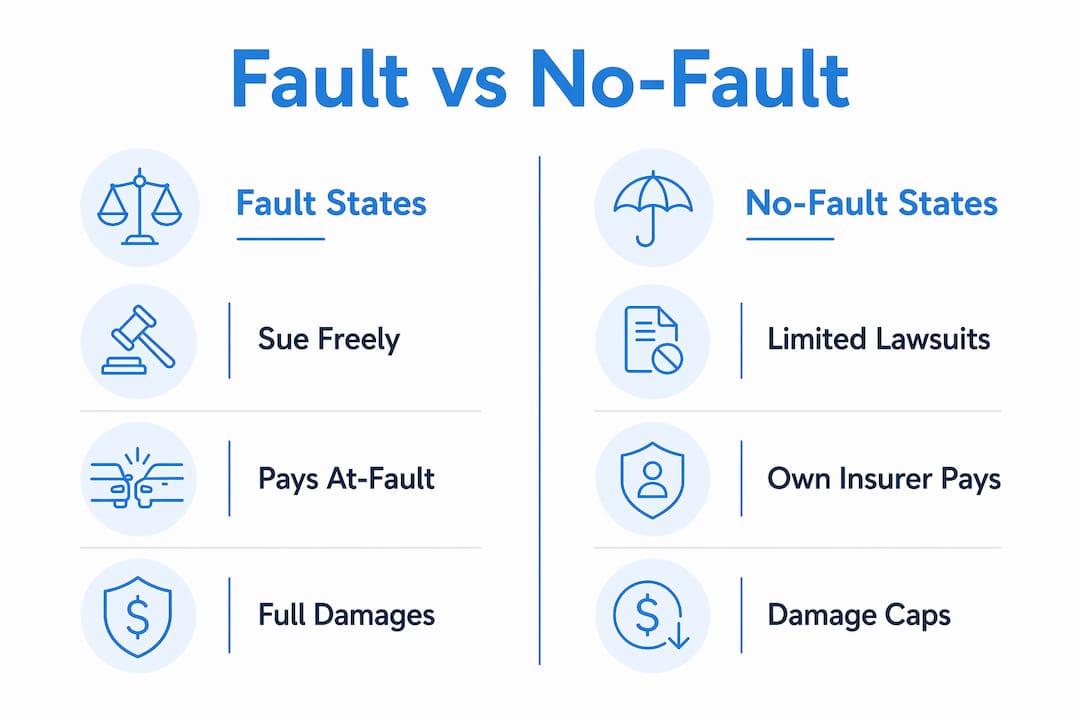
In fault states, you can pursue the full range of damages: medical expenses, lost wages, pain and suffering, and property damage. There are no statutory thresholds blocking your access to the courts. If the at-fault driver’s insurer disputes liability, you can litigate. This broader access to compensation is the primary reason tort systems offer greater recovery potential for serious injuries.
No-fault states limit your right to sue. You can only pursue pain and suffering damages once your injuries meet a statutory threshold, either a monetary amount in medical expenses or a verbal description of injury severity. Five states use verbal thresholds; seven states use monetary thresholds ranging from $1,000 to $5,000 in medical expenses. This creates a real barrier for claimants with moderate injuries who may have genuine suffering but cannot clear the threshold.
Insurance premiums also differ between the two systems. Michigan’s no-fault premiums are among the highest in the US because the state offers optional unlimited lifetime medical coverage through PIP. States with low fixed PIP caps, such as Florida, have lower premiums but leave claimants more exposed for serious injuries. Understanding what compensation you can recover under each system helps you assess whether your current coverage is adequate.
| Feature | Fault (tort) states | No-fault states |
|---|---|---|
| Who pays medical bills | At-fault driver’s insurer | Your own insurer via PIP |
| Right to sue for pain and suffering | Unrestricted | Limited by injury thresholds |
| Payment speed | Slower due to fault investigation | Faster for minor injuries |
| Property damage | Fault-based | Fault-based |
| Litigation rate | Higher | Lower |
Pro Tip: If you live in a “choice” no-fault state such as Kentucky, New Jersey, or Pennsylvania, you can elect to operate under the tort system instead. Opting out of no-fault affects both your premiums and your legal rights, so get advice before choosing.
What thresholds apply before you can sue in a no-fault state?
No-fault states do not ban lawsuits entirely. They set a bar you must clear first.
There are two types of thresholds. Monetary thresholds require you to incur a minimum amount in medical expenses before you can sue for pain and suffering. Verbal thresholds require your injury to meet a descriptive standard, such as permanent impairment, significant disfigurement, fracture, or death. States using verbal thresholds generally set a higher bar than monetary ones, since a dollar figure is easier to reach than proving permanent impairment.
Common threshold examples across no-fault states include:
- Monetary threshold: Medical expenses must exceed a set dollar amount, ranging from $1,000 to $5,000 depending on the state, before a lawsuit is permitted.
- Verbal threshold: Injuries must involve permanent loss of a body function, permanent disfigurement, fracture, or death.
- Combination states: Some states apply both tests, requiring you to satisfy either or both criteria.
- Soft tissue injuries: Sprains and strains rarely meet verbal thresholds, leaving many claimants without access to pain and suffering damages.
The practical implication is stark. A claimant with a serious fracture in New York can sue for pain and suffering. A claimant with chronic back pain from a soft tissue injury in the same state may not. This is why no-fault systems erect a substantial barrier for claimants seeking non-economic damages, even when their suffering is genuine.
Practical steps for navigating your accident claim
The steps you take in the first 24–72 hours after an accident directly affect your compensation outcome under either system.
1. Report the accident immediately. Notify your insurer and, where required, local authorities. Delays create gaps in your claim record that insurers exploit.
2. Seek medical attention the same day. Documented medical treatment is the foundation of any injury claim. Gaps in treatment give insurers grounds to argue your injuries were not serious or were caused by something else.
3. File your PIP claim within the required deadline. Michigan claimants must submit written notice within one year or forfeit all no-fault benefits. Other states have shorter windows. Missing the deadline ends your claim regardless of injury severity.
4. Gather evidence to prove fault if you are in a tort state. Photographs, witness statements, police reports, and dashcam footage all support your claim. Carelawyers has a detailed guide on proving fault in a car accident that walks through the evidence types insurers look for.
5. Respond carefully to insurer requests. Insurers in both systems may request an independent medical examination (IME). IMEs are conducted by insurer-chosen physicians and frequently result in claim denials for ongoing treatment. You have the right to challenge an IME outcome.
6. Appeal denied claims in writing. For denied PIP claims, insurers must respond to internal appeals within 30 to 60 days. Support your appeal with medical records and a letter from your treating physician. If the internal appeal fails, arbitration or litigation are the next steps.
7. Get legal advice before accepting any settlement. Insurers offer early settlements that rarely reflect full compensation. A lawyer reviews your claim against the full range of damages available in an accident claim before you sign anything.
Pro Tip: Keep a daily pain diary from the day of the accident. Courts and insurers give significant weight to contemporaneous records of how your injury affects daily life, especially in fault states where pain and suffering damages are in play.
Common misconceptions about fault and no-fault claims
Several misunderstandings cause claimants to make costly mistakes before they even speak to a lawyer.
- No-fault does not mean full coverage. PIP pays medical bills and partial lost wages. It does not cover vehicle damage, full income replacement, or pain and suffering below the threshold.
- No-fault does not mean you cannot sue. You can still pursue the at-fault driver once your injuries cross the statutory threshold. The system restricts, it does not eliminate, your right to litigate.
- Deadlines are absolute. The complex interplay between filing deadlines, IMEs, and injury thresholds traps claimants who assume they have more time. A missed deadline forfeits your claim entirely.
- IMEs are not neutral. Insurer-chosen physicians conduct IMEs with a financial relationship to the insurer. Their findings frequently conflict with your treating doctor’s assessment.
- State laws do not apply uniformly. No-fault rules vary significantly between states. What applies in Florida does not apply in New York. Even in choice no-fault states, opting out alters your legal rights substantially, a decision many claimants make without understanding the consequences.
Key takeaways
The most important fact about fault vs no-fault accident claims is this: the system your state uses determines who pays your medical bills, how fast you get paid, and whether you can sue for pain and suffering.
| Point | Details |
|---|---|
| System determines your rights | Fault states allow unrestricted lawsuits; no-fault states limit them to injuries meeting statutory thresholds. |
| PIP covers injuries, not vehicles | No-fault PIP pays medical bills and lost wages but never vehicle damage, which remains fault-based. |
| Deadlines are non-negotiable | Missing filing deadlines forfeits your claim entirely, regardless of how serious your injuries are. |
| IMEs carry real risk | Insurer-chosen physicians frequently deny ongoing treatment; challenge IME outcomes with your own medical evidence. |
| Legal advice changes outcomes | A lawyer assesses your full compensation entitlement before you accept any settlement offer from an insurer. |
What I have seen go wrong with these claims
After working with accident victims across both fault and no-fault systems, the pattern I see most often is this: people assume the insurer is on their side. They are not. The insurer’s job is to pay as little as possible, and the procedural rules in both systems give them plenty of tools to do exactly that.
The claimants who come off worst are the ones who accept the first PIP payment and assume the matter is closed. They do not realise they may still have a right to sue once their injuries are properly assessed. By the time they understand the threshold rules, months have passed and evidence has gone cold.
The claimants who do best document everything from day one. They keep medical records, photograph injuries over time, and do not give recorded statements to insurers without legal advice. They also understand the claim timeline from the outset, so they are not caught off guard by deadlines.
My honest advice: get a lawyer involved early, not after the insurer has already shaped the narrative. The difference in compensation outcomes between claimants who seek advice early and those who do not is substantial. Carelawyers handles exactly this kind of claim, and the initial conversation costs you nothing.
— Daniel
Carelawyers: getting your accident claim right from the start
Fault and no-fault rules are complex, and insurers rely on claimants not knowing them. Carelawyers specialises in personal injury and car accident claims across Sydney, with a success rate of over 99% of claims won.

Whether your claim involves a fault-based liability dispute or a denied PIP benefit, Carelawyers provides direct access to a lawyer, not a case manager or a call centre. The team explains your rights in plain language, assesses the full damages available in your accident claim, and represents you through every stage of the process. If you are unsure which system applies to your situation or whether your injuries meet a lawsuit threshold, contact Carelawyers for a no-obligation consultation. You speak directly to a lawyer from the first call.
FAQ
What is the main difference between fault and no-fault claims?
In a fault claim, you pursue compensation from the driver who caused the accident. In a no-fault claim, your own insurer pays your medical bills and lost wages through PIP coverage, regardless of who caused the crash.
Can you still sue in a no-fault state?
Yes. You can sue the at-fault driver once your injuries meet the state’s statutory threshold, either a minimum dollar amount in medical expenses or a defined level of injury severity such as a fracture or permanent impairment.
Does no-fault insurance cover vehicle damage?
No. PIP covers medical bills and partial lost wages only. Vehicle repairs are always handled through fault-based claims, either against the at-fault driver’s liability insurance or your own collision coverage.
What happens if you miss a PIP filing deadline?
Missing the deadline forfeits your no-fault benefits entirely. Michigan, for example, requires written notice within one year of the accident. Other states set shorter windows, so report your claim to your insurer as soon as possible after the accident.
When should you get a lawyer for an accident claim?
Get legal advice before giving a recorded statement to any insurer and before accepting any settlement. A lawyer assesses whether your injuries meet lawsuit thresholds, identifies the full range of damages you can pursue, and prevents insurers from using procedural rules to reduce your payout.


