

Dispute resolution workers comp explained for injured workers
Workers’ compensation disputes in NSW are resolved through a structured process: insurer internal review first, then the Personal Injury Commission if the matter remains unresolved, with many disputes settling at the very first preliminary conference. The Commission runs two main pathways: the legal disputes pathway (preliminary conference, conciliation, arbitration) and the expedited assessment pathway for simpler weekly payment or medical expense matters, where the preliminary conference is scheduled 14 days from lodgement and decisions are often issued within 14 days if not resolved at conference. Before you do anything else, confirm your insurer claim is lodged, check your eligibility for ILARS funding through the Independent Review Office, and start assembling your evidence bundle for the Commission’s Pathway platform.
Key immediate steps:
- Lodge your workers’ compensation claim with your employer and insurer before approaching the Commission.
- Request an insurer internal review if you disagree with a decision — this is a required step before Commission lodgement in most cases.
- Check ILARS eligibility early; funding can cover legal representation at no upfront cost to you.
- Prepare an indexed, paginated evidence bundle before you lodge on Pathway — adding documents later is often restricted.
Table of Contents
- How does dispute resolution in workers comp actually work?
- What is the step-by-step timeline from lodgement to resolution?
- What documents do you need for Pathway lodgement?
- How do costs and legal funding work, including ILARS?
- What are the possible outcomes and what do they mean?
- What happens at conciliation and how should you prepare?
- Why do workers comp disputes arise and how can you avoid them?
- How do you access and use the NSW Pathway system?
- What are your rights and obligations during the dispute process?
- What are the potential outcomes for workers and employers?
- How do you initiate a dispute? Step-by-step
- Key takeaways
- The part most guides skip
- Carelawyers can help you through every stage of your dispute
How does dispute resolution in workers comp actually work?
The workers compensation dispute process in NSW moves through distinct forums depending on the type of issue. Here is what each one does and who decides.
| Forum | Dispute type | Who decides | Typical outcome |
|---|---|---|---|
| Insurer internal review | All disputes | Senior review officer | Affirm, vary or reverse decision |
| Preliminary conference | All Commission matters | Commission member | Settlement or referral to conciliation |
| Conciliation | Legal disputes | Commission member | Agreement or referral to arbitration |
| Arbitration hearing | Unresolved legal disputes | Commission member | Binding determination |
| Expedited assessment | Weekly payments, medical expenses | Commission member | Decision within 14 days if not resolved at preliminary conference |
| AMS/medical panel | Permanent impairment | Approved Medical Specialist | Conclusive impairment assessment |
Insurer internal review is the first port of call. A senior review officer examines the decision afresh, and you should always request this before lodging with the Commission — it costs nothing and sometimes resolves the matter entirely.
The legal disputes pathway at the Personal Injury Commission starts with a preliminary conference. Many disputes resolve at this stage; if not, the matter moves to conciliation and, if still unresolved, to an arbitration hearing that can be scheduled the same day as conciliation.
The Commission’s legal disputes pathway is designed so that informal resolution is attempted before any formal hearing. A substantial number of matters never reach arbitration because parties reach agreement at the preliminary conference or conciliation stage.
The expedited assessment pathway suits simpler disputes about weekly payments or medical expenses. The preliminary conference is scheduled 14 days from lodgement, and if the matter is not resolved at that conference, decisions are often issued within 14 days.
For permanent impairment disputes, an Approved Medical Specialist (AMS) conducts the assessment. That assessment carries strong evidentiary weight, and appeal routes are limited to defined grounds.
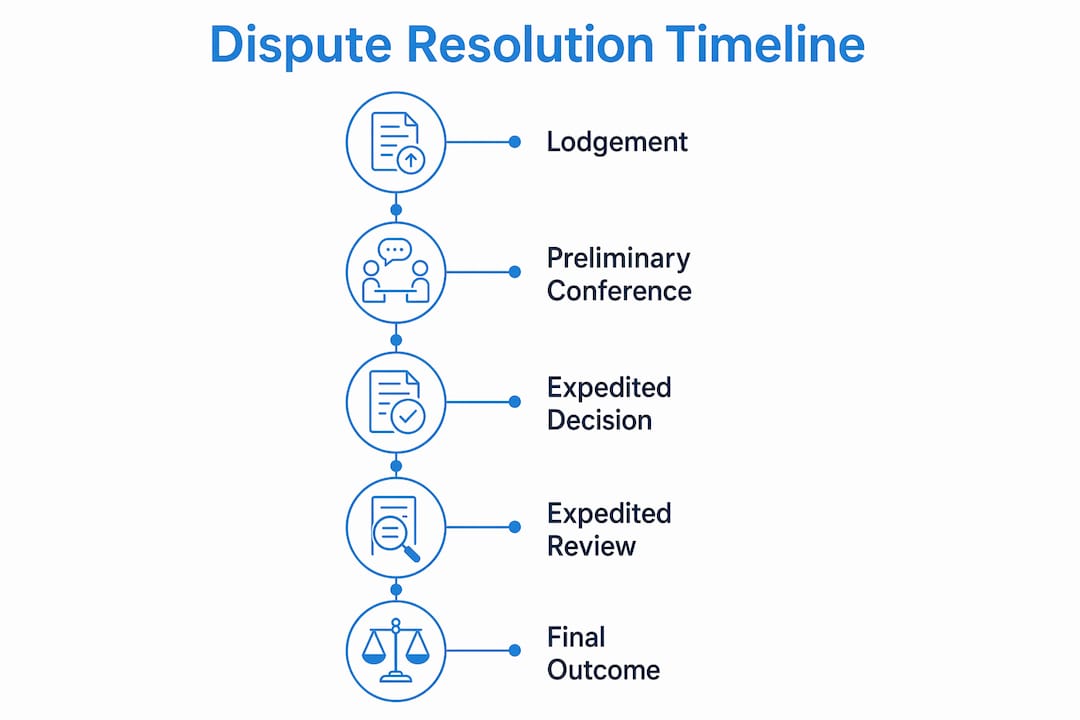
What is the step-by-step timeline from lodgement to resolution?
Understanding the workers comp claims dispute timeline helps you plan and avoid surprises.
- Lodge your claim with your employer and insurer. Collect all exchange documents: insurer decision letters, medical certificates, payslips.
- Request insurer internal review if dissatisfied with the decision.
- Prepare your Pathway bundle — indexed, paginated, complete — before you lodge with the Commission.
- Lodge on Pathway using Form 2 (legal disputes) or Form 1 (expedited assessment). Check your calendar: for expedited matters, your preliminary conference is set 14 days from lodgement and dates are rarely changed.
- Attend the preliminary conference. Many matters settle here. Come prepared to discuss all issues.
- Conciliation if unresolved. A Commission member facilitates discussion. If agreement is reached, consent orders are prepared.
- Arbitration hearing if conciliation fails. This can be scheduled the same day as conciliation. The member issues a written decision, commonly within 21 days.
| Stage | Typical timeframe |
|---|---|
| Expedited preliminary conference | 14 days from lodgement |
| Expedited decision (if not resolved at conference) | Within 14 days |
| Damages mediation conference | Within 4–8 weeks of lodgement |
| Arbitration written decision | Commonly within 21 days of hearing |
Pro Tip: For expedited applications, check your availability for the two weeks after lodgement before you submit. The Commission will not usually reschedule that preliminary conference, so lodging when you cannot attend wastes your slot.
What documents do you need for Pathway lodgement?
The quality of your evidence bundle is frequently decisive. Incomplete or disorganised bundles cause avoidable delays because the Pathway platform expects an indexed, paginated package on lodgement — and adding materials after the fact is often restricted.
Assemble these before you lodge:
- Completed Form 2 or Form 1 (as appropriate to your pathway)
- Insurer decision letter and any internal review outcome
- Medical records, certificates and specialist reports
- Worker’s written statement of the injury and its impact
- Employer incident report and any investigation findings
- Payslips covering the relevant period
- Rehabilitation and return-to-work records
- All relevant correspondence with the insurer
Your index should list each document by tab number, description, and page range. A sample index might read: Tab 1 — Insurer decision letter (pp. 1–3); Tab 2 — GP medical certificates (pp. 4–12); Tab 3 — Worker statement (pp. 13–18).
Pro Tip: Use a free PDF tool like Adobe Acrobat or Smallpdf to merge, paginate, and bookmark your bundle in one pass. A well-structured PDF takes an hour to prepare and can save weeks of delay.
How do costs and legal funding work, including ILARS?
Cost is the first concern for most injured workers, and the options are better than many people expect.
- ILARS (Independent Legal Assistance and Review Service): Administered by the Independent Review Office, ILARS funding can cover legal representation for eligible workers at no upfront cost. Check eligibility early — funding can extend to appeals.
- No-win-no-fee arrangements: Many workers’ compensation lawyers, including Carelawyers, operate on a no-win-no-fee basis, meaning you pay nothing unless your matter succeeds.
- Fixed-fee options: Some firms offer fixed fees for defined tasks such as Pathway bundle preparation or representation at a single conference.
When does legal help make a material difference? Complex liability disputes, permanent impairment claims, employer resistance, and matters requiring formal medical assessment all benefit significantly from representation. Engaging a lawyer early reduces preparation errors and eases the procedural burden — particularly given Pathway’s strict lodgement requirements.
Engaging legal representation early, often funded through ILARS, reduces the risk of preparation errors and improves readiness at every stage of the Commission process.
What are the possible outcomes and what do they mean?
The workers compensation dispute process can end in several ways, each with different practical consequences.
Settlement by agreement and consent orders are the most common resolution. When parties agree at a preliminary conference or conciliation, the Commission member prepares a Certificate of Determination — Consent Orders, which finalises the dispute and is legally binding once endorsed.
Member determination (award): If arbitration proceeds, the member issues a written decision. Written reasons are commonly provided within 21 days of the hearing. The determination is binding and enforceable.
Interim payment directions can be made pending a final decision, directing the insurer to continue or commence weekly payments or medical expense payments while the dispute is resolved. These are practically significant for workers who need income support during the process.
A consent order or Certificate of Determination finalises the dispute. Once endorsed by the Commission, it is binding on both parties and cannot be revisited except on very limited appeal grounds.
Appeals are available on limited grounds: error of law, error of fact, or error of discretion. Presidential members or panels hear appeals. For AMS permanent impairment assessments, the appeal routes are defined and narrow.
Once a work injury damages claim is settled or a court award is made, entitlement to ongoing workers’ compensation payments ceases, and amounts already paid may need to be repaid. Workers should get legal advice before finalising any settlement.
What happens at conciliation and how should you prepare?
Conciliation is an informal, facilitated discussion between you, the insurer, and a Commission member. The member’s role is to help parties identify the real issues and reach agreement — not to make a binding decision at that point. Think of it as a structured negotiation with a neutral chair.
To prepare well: know your key facts cold (injury date, medical evidence, what the insurer decided and why you disagree), bring your indexed bundle, and be ready to make or respond to offers. If you have a lawyer, they will speak for you. If you are self-represented, keep your statements factual and focused on the documents. For a deeper look at what to expect, the work injury conciliation guide covers the process in detail.

If conciliation does not resolve the matter, arbitration can follow on the same day. That means you should walk into conciliation prepared to go all the way.
Why do workers comp disputes arise and how can you avoid them?
Most disputes stem from a handful of recurring issues: the insurer disputes that the injury is work-related, disagrees with the degree of permanent impairment, disputes the need for a particular medical treatment, or reduces or stops weekly payments. Delays in reporting the injury or gaps in medical evidence are common triggers.
Early, clear communication between the worker, employer, and insurer prevents many formal disputes. Report your injury promptly, keep all medical appointments, and respond to insurer correspondence in writing. When an insurer requests information, provide it quickly and keep a copy. A workers compensation claim explained resource can help you understand your obligations at the claim stage before any dispute arises.
How do you access and use the NSW Pathway system?
Pathway is the Commission’s digital lodgement platform. You access it at the Personal Injury Commission website and create an account as either a party or a legal representative. Once logged in, you select the relevant application type (Form 2 for legal disputes, Form 1 for expedited assessments, Form 11C for work injury damages mediation), complete the required fields, and attach your document bundle as a single indexed, paginated PDF.
The platform guides you through each section, flags missing mandatory fields, and confirms lodgement by email. The Commission’s lodgement guidance and fact sheets are available on the Commission website and walk through each form in detail. If you are unsure whether your bundle meets the indexing requirements, a lawyer can review it before submission — a much cheaper fix than a rejected application.
What are your rights and obligations during the dispute process?
Workers have the right to lodge a dispute, access legal representation (including ILARS-funded representation), attend all conferences, and receive written reasons for decisions. You also have the right to appeal on defined grounds.
Your obligations include responding to Commission correspondence within specified timeframes, attending scheduled conferences (or notifying the Commission promptly if you cannot), and providing accurate and complete information. Providing false or misleading information can affect your claim.
Employers and insurers must respond to applications within 21 days of registration, attend conferences, and comply with any interim directions or consent orders. An insurer that fails to respond does not stop the process — the Commission proceeds regardless.
What are the potential outcomes for workers and employers?
For workers, a favourable determination or settlement can restore weekly payments, cover medical expenses, or deliver a lump sum for permanent impairment. An unfavourable outcome means the insurer’s decision stands, though appeal options remain. Settling a work injury damages claim ends ongoing compensation entitlements, so the timing and amount of any settlement matters enormously.
For employers and insurers, outcomes affect premium calculations and ongoing liability. A consent order or determination creates a binding obligation to pay. Employers should be aware that workplace rights after serious injury extend beyond the dispute itself — dismissing a worker because they lodged a claim carries separate legal consequences.
How do you initiate a dispute? Step-by-step
- Identify the decision you are disputing — insurer liability decision, weekly payment reduction, medical expense refusal, or impairment assessment.
- Request an insurer internal review in writing. State the decision, why you disagree, and attach supporting documents.
- If unresolved, lodge with the Commission via Pathway. Select Form 2 (legal disputes) or Form 1 (expedited). Attach your complete indexed bundle.
- Serve the sealed application on the insurer within seven days of registration (for damages matters).
- The insurer has 21 days to respond after registration. The Commission proceeds even without a response.
- Attend your preliminary conference — prepared, with all documents, and ideally with legal representation.
Contact the Personal Injury Commission directly via its website for procedural questions, or contact Carelawyers for a no-obligation eligibility check and help preparing your application.
Key takeaways
The fastest path through a workers’ compensation dispute in NSW is a complete, indexed Pathway bundle lodged early, ILARS funding secured before the first conference, and legal representation from the preliminary conference onwards.
| Point | Details |
|---|---|
| Lodge insurer claim first | You must exhaust the insurer review process before the Commission will accept most applications. |
| Indexed Pathway bundle is critical | Evidence added after lodgement is often restricted; compile everything before you submit. |
| Check ILARS eligibility early | ILARS-funded legal representation is available to eligible workers at no upfront cost. |
| Many disputes settle at preliminary conference | Prepare as if you will need to prove everything, even though early resolution is common. |
| Carelawyers for NSW disputes | Carelawyers offers direct lawyer access, no-win-no-fee representation, and Pathway bundle preparation for injured workers across NSW. |
The part most guides skip
Workers’ compensation dispute guides spend a lot of time on procedure and almost none on the preparation gap — the space between knowing the steps and actually being ready for them. The preliminary conference catches more people off guard than any other stage, not because it is complicated, but because workers arrive having lodged their application without a complete bundle, without a clear account of their injury’s impact, and without having thought through what they would accept as a resolution.
The insurer’s representative will have done all of that preparation. That asymmetry is the real problem, and it is why early legal engagement matters far more than most guides admit. ILARS funding exists precisely to close that gap. If you are eligible, there is no financial reason to face the preliminary conference alone.
The other thing worth saying plainly: a consent order at the preliminary conference is not a failure. It is often the best outcome available. The question is whether the terms reflect what you are genuinely entitled to — and that is where having a lawyer in the room, rather than finding out afterwards, makes the difference.
Carelawyers can help you through every stage of your dispute
Facing a workers’ compensation dispute without knowing the process is genuinely difficult. Carelawyers gives injured workers in NSW something most larger firms do not: direct access to your lawyer from the first call, no middlemen, and no jargon.

The firm handles the full dispute pathway: Pathway bundle preparation, lodgement, representation at preliminary conferences, conciliation, arbitration, and appeals. Fee arrangements are no-win-no-fee or fixed fee, and the team can assist with ILARS funding applications so representation costs you nothing upfront if you are eligible. With a stated success rate of over 99% of claims, Carelawyers brings the kind of preparation discipline that the Pathway process demands. For a clear picture of what your workers’ compensation claim involves and whether you qualify for funded legal help, contact Carelawyers for a no-obligation review today.
Useful resources for further reading
- Steps in the dispute resolution process — Personal Injury Commission fact sheet: the Commission’s own step-by-step guide covering lodgement, pathways, conferences and medical assessments.
- Legal disputes pathway — Personal Injury Commission: procedural detail on preliminary conferences, conciliation, arbitration and consent orders.
- Expedited assessments pathway — Personal Injury Commission: Form 1 lodgement guidance and the 14-day conference rule.
- Form 2 — Application to Resolve a Dispute: the primary lodgement form for legal disputes, with document requirements and reply timeframes.
- Table 3.7: Dispute resolution process — Safe Work Australia: cross-jurisdictional comparison of dispute forums, including ILARS funding administered by the Independent Review Office.


