

Burden of proof in an insurance claim: what policyholders must know
In any Australian insurance claim, the policyholder initially bears the burden of proof. You must establish a prima facie case on the balance of probabilities, meaning you show it is more likely than not that a valid policy existed, a loss occurred, and that loss happened during the policy period. Once you do that, the burden shifts to the insurer to prove a specific exclusion applies. According to LegalClarity, this three-step framework governs most coverage disputes: insured proves coverage, insurer proves exclusion, insured proves any exception they rely on.
Start documenting immediately. The practical steps below show you exactly what to collect, how to organise it, and what to do if your insurer still says no.
Table of Contents
- What “burden of proof” actually means in an insurance dispute
- How burdens shift depending on your policy type
- How to collect and organise evidence that actually holds up
- Common mistakes that weaken claims and how to avoid them
- How burden of proof works differently in liability claims
- What to do if your claim is denied
- Key takeaways
- Why early legal advice changes the outcome of an insurance dispute
- Carelawyers helps NSW policyholders fight insurance denials
- Useful Australian resources for insurance disputes
What “burden of proof” actually means in an insurance dispute
The phrase “burden of proof” describes who is responsible for producing enough evidence to win a legal argument. In Australian civil and insurance coverage disputes, the applicable standard is the balance of probabilities, sometimes called the preponderance of evidence. This means you do not need to prove your case beyond reasonable doubt (that is the criminal standard). You need to show that your version of events is more probable than not, a threshold often described as greater than 50%.
A prima facie case in insurance terms means satisfying three threshold questions:
- Did a valid contract (your policy) exist at the time of the loss?
- Did a loss actually occur?
- Did that loss happen during the policy period?
If you clear those three hurdles, the insurer cannot simply deny your claim. They must point to specific policy wording and prove it applies to your facts.
Beyond the threshold questions, you will typically need to produce evidence across four categories, as Claims Authority Network outlines:
- Causation: what caused the loss and how
- Valuation: what the damaged or lost items were worth
- Ownership/insurable interest: that you owned or had an interest in what was lost
- Proof of loss: a formal statement of what you are claiming and for how much
Treat your claim as a deliberate proof exercise. Go Insurance’s practitioner commentary puts it plainly: insurers expect evidentiary links between causation, valuation and ownership. Loose photos and disorganised receipts weaken claims even when the underlying loss is genuine.
How burdens shift depending on your policy type
The three-step evidentiary sequence is not static. Policy type, exclusion wording, and the doctrine of efficient proximate cause all affect who must prove what at each stage.
The three-step sequence
LegalClarity’s coverage dispute analysis describes the sequence this way: the insured proves coverage, the insurer proves an exclusion applies, and if the insured wants to rely on an exception to that exclusion, the insured proves the exception. Each step is a separate evidentiary obligation.
All-risk versus named-peril policies
| Policy type | Insured’s initial burden | Insurer’s burden | Practical effect |
|---|---|---|---|
| All-risk / open perils | Show the loss occurred during the policy period | Prove a specific exclusion applies | Lighter initial burden for the insured |
| Named-peril | Show the loss was caused by a listed peril | Prove exclusion if coverage is triggered | Heavier initial burden; insured must tie loss to a named event |
Property Insurance Coverage Law Blog notes that under all-risk policies, courts have consistently described the insured’s initial burden as relatively light, with the heavy lifting falling on the insurer to negate coverage through exclusions. Named-peril policies reverse that dynamic: if your policy only covers fire, storm and theft, and your loss was caused by something else, you carry the burden of connecting the cause to a listed event.
Efficient proximate cause
When a loss has more than one contributing cause, Australian courts apply the efficient proximate cause doctrine. The question becomes: what was the dominant, effective cause of the loss? If the dominant cause is a covered peril, coverage generally applies even if an excluded peril also contributed. If the dominant cause is excluded, the claim may fail even if a covered peril played a role. This matters most in storm and flood claims, where wind (often covered) and flood (often excluded) interact.
Exclusions must be specific
An insurer cannot simply gesture at a general exclusion clause. They must connect the specific exclusion wording to the specific facts of your loss. Vague assertions that “the loss is excluded” are not enough. If their denial letter does not quote the exact clause and explain how it applies to your circumstances, that is a gap worth pressing.
How to collect and organise evidence that actually holds up
The most critical evidence often disappears within the first 24 hours. Property Claim Checklist’s evidence guidance calls this the “Golden Hour” principle: photograph and index damage before any cleaning, disposal or temporary repair work begins.

The evidence checklist
Work through each room or area systematically. For each damaged or lost item, collect:
- Proof of ownership — title documents, registration papers, or older photos showing the item in your possession
- Witness statements — names, contact details and a brief written account from anyone who saw the loss or its immediate aftermath; guidance on preparing witness statements explains how to structure these effectively
Williamson Carson’s evidence guide confirms that photos, witness statements, invoices, repair estimates, police reports and medical records are the core categories insurers expect across claim types.
Building a photo index
Create a spreadsheet with columns: Item #, Description, Location, Photo File Name(s), Receipt File Name, Notes. Use a consistent file-naming convention: YYYY-MM-DD_Room_Item_Detail (for example, 2026-03-15_Kitchen_Oven_BurntElement). Each row in your spreadsheet maps directly to one inventory item, and each photo and receipt links back to that row. Adjusters work faster when the file is self-explanatory; a clear index reduces back-and-forth and speeds settlement.
Drafting your proof of loss
A proof of loss is a formal, signed statement of what you are claiming. Claims Authority Network notes that many policies set a deadline for submitting a signed proof of loss after the insurer requests one, and missing that deadline can stall or jeopardise recovery. Include: the date and cause of loss, a complete itemised list of what was lost or damaged, your valuation for each item, and the total amount claimed. Where you are uncertain of a value, state it as a provisional estimate and note that clearly. Overstating values creates fraud risk; understating them locks in a lower recovery.
Pro Tip: Keep a single “evidence locker” folder, never edit original files, and export copies for sharing. One clean, indexed folder with named subfolders (Photos, Receipts, Reports, Correspondence) is far more persuasive than a zip file of 200 unnamed images.
Common mistakes that weaken claims and how to avoid them
Destroying primary evidence
Cleaning up, disposing of damaged items or starting repairs before photographing and documenting is the single most damaging mistake. Adjusters cannot assess what no longer exists. If safety requires immediate action, photograph everything first, note what you are doing and why, and keep any removed materials until the adjuster has inspected.
Missing the proof of loss deadline
Your policy may require a signed proof of loss within a set period after the insurer requests one. Missing that window can give the insurer grounds to deny or delay. Check your policy wording the day you lodge your claim and calendar any deadlines immediately.
Overstating or understating values
Inflated values invite fraud allegations and can void your entire policy. Understated values lock in a lower payout. Use purchase receipts, current market values or replacement quotes, and mark any estimate as provisional when you are not certain.
Sending originals instead of copies
Send certified copies or high-resolution scans. Keep every original. If an insurer loses your documentation, you need to be able to reproduce it.
Disorganised file sharing
A folder of 300 unnamed photos sent by email is not evidence — it is a problem for the adjuster to solve. An indexed spreadsheet that maps Item # to Photo # to Receipt # reduces friction and signals that your claim is credible and well-prepared.
Pro Tip: Note every mitigation step you took (emergency drying, temporary boarding, tarpaulin hire) and keep the receipts. Failure to mitigate is a common insurer argument for reducing a payout, and your records rebut it directly.
For serious injury claims, Carelawyers’ documentation guide covers evidence collection in detail, including medical records and expert reports.
How burden of proof works differently in liability claims
Liability insurance adds a layer of complexity because it involves two distinct obligations: the duty to defend and the duty to indemnify.
The duty to defend is triggered by the allegations in the claim or proceedings against you. If those allegations, taken at face value, could potentially fall within the policy, the insurer generally must defend. The evidentiary burden here is relatively low: the insured points to the allegations and the policy wording, and the insurer must show the claim is clearly outside coverage to avoid defending.
The duty to indemnify is different. It is determined by the proven facts after the matter resolves. An insurer who defended throughout may still disclaim indemnity if the final facts establish that an exclusion applies. At that stage, the insurer bears the burden of proving the exclusion on the balance of probabilities.
For policyholders, the practical implication is this: keep every piece of correspondence with your insurer, note their stated positions in writing, and preserve your legal file throughout the dispute. If an insurer defends under a reservation of rights (meaning they reserve the right to later disclaim indemnity), get legal advice early. Understanding why insurers deny serious injury claims can help you anticipate and counter the arguments before they crystallise.
What to do if your claim is denied
A denial is not the end. In Australia, you have several escalation options, each with different costs, timeframes and outcomes.
Request written reasons immediately. Ask for the denial in writing, including the specific policy clause relied on and the factual basis for the decision. You are entitled to this.
Request your claim file and file notes. Under the Insurance Contracts Act 1984 (Cth) and the General Insurance Code of Practice, you can request access to the information the insurer used to make its decision.
Check your policy wording against the denial. Compare the exclusion clause cited to the actual facts of your loss. If the insurer has mischaracterised the cause or applied the wrong clause, document that discrepancy in writing.
Supply missing evidence promptly. If the denial cites insufficient evidence, gather and submit what is missing. Do this in writing and keep a record of what you sent and when.
Lodge an internal dispute resolution (IDR) request. All Australian general insurers are required to have an IDR process. Submit a written request citing the specific grounds for your dispute. The insurer must respond within the timeframes set by the General Insurance Code of Practice.
Escalate to the Australian Financial Complaints Authority (AFCA). If IDR fails or the insurer does not respond within required timeframes, lodge a complaint with AFCA. AFCA is free for consumers, covers most general insurance disputes, and can award binding decisions. Time limits apply: generally, you must lodge within two years of receiving the insurer’s final decision, though AFCA has discretion in some circumstances.
Consider legal advice or court action. For complex denials, fraud allegations, or high-value claims, legal representation is often the most effective route. Be aware of statutory limitation periods under the Limitation Act 1969 (NSW) and any policy-specific deadlines. Some limitation rules also restrict how long after a multi-year period an insurer can question a claim, though exceptions exist for proven fraud and the applicable rules vary by jurisdiction and policy type — always verify the specific limits with a lawyer.
For a clear overview of your dispute options as an injured claimant, Carelawyers has a dedicated guide covering AFCA and litigation pathways in NSW.
What to include in an internal review request: your full name and policy number, the date of the original decision, the specific grounds for your dispute (quote the policy clause and explain why it does not apply to your facts), a list of attached supporting documents, and a clear statement of the outcome you are seeking.
Key takeaways
The insured bears the initial burden of proof in any Australian insurance claim, and meeting it on the balance of probabilities requires organised, contemporaneous evidence collected from the first hour after a loss.
| Point | Details |
|---|---|
| Who bears the initial burden | The insured must establish a prima facie case: valid policy, loss occurred, loss within the policy period. |
| When the burden shifts | Once coverage is established, the insurer must prove a specific exclusion applies on the balance of probabilities. |
| Policy type matters | All-risk policies give the insured a lighter initial burden; named-peril policies require the insured to tie the loss to a listed event. |
| First three actions after a loss | Photograph and video everything immediately, create an indexed inventory, and lodge your claim in writing. |
| Dispute escalation path | Internal review first, then AFCA (free, binding), then legal advice or court action if needed. |
| Carelawyers can help | Carelawyers handles insurance disputes in NSW, including evidence preparation, AFCA complaints, and litigation, with direct lawyer access and no-win-no-fee options. |
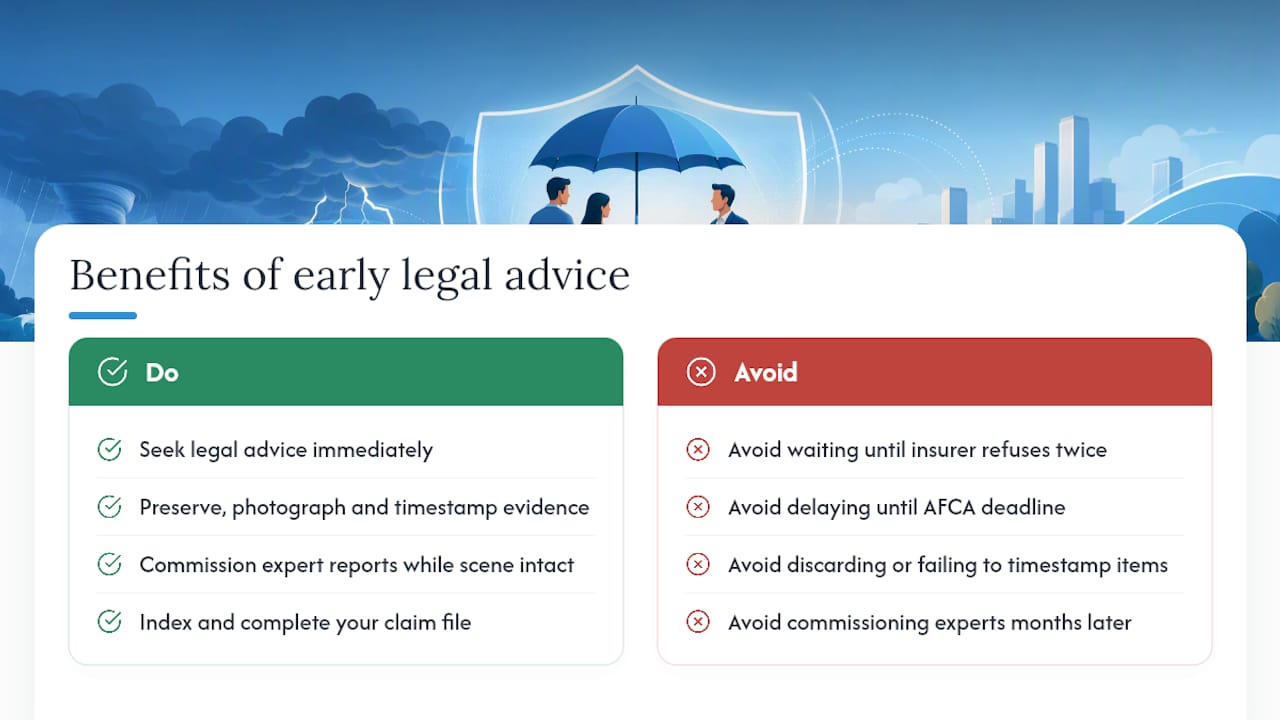
Why early legal advice changes the outcome of an insurance dispute
Most policyholders treat legal advice as a last resort, something to consider after the insurer has said no twice and the AFCA deadline is approaching. That instinct is understandable, but it is usually the wrong call.
The decisions that most affect a claim’s outcome are made in the first days: what gets photographed, what gets discarded, what gets said to the adjuster, and how the proof of loss is framed. A lawyer who is involved early can preserve evidence that would otherwise disappear, commission an expert report while the scene is still intact, and structure the proof of loss in a way that closes off the exclusion arguments before the insurer raises them.
Fraud allegations are a particular area where early legal involvement matters. If an insurer raises fraud, the evidentiary dynamic shifts significantly. The insurer bears the burden of proving fraud, but the standard is higher than the ordinary balance of probabilities given the seriousness of the allegation. A claimant who has organised, timestamped, indexed evidence is in a far stronger position to rebut those allegations than one who cannot account for gaps in their documentation.
Expert reports are another area where timing is decisive. A contractor’s report commissioned six months after the loss, after the insurer has already inspected and formed a view, can look self-serving unless it clearly documents what evidence was preserved, when the inspection occurred, and what methodology was used. A report commissioned in the first week, while the damage is fresh, carries far more weight.
The cases that settle quickly and favourably are almost always the ones where the claimant’s file is complete, indexed and impossible to dismiss. That does not happen by accident.
Carelawyers helps NSW policyholders fight insurance denials
When an insurer denies your claim or disputes the value of your loss, the difference between recovering what you are owed and walking away with nothing often comes down to how your evidence is organised and how your case is argued.

Carelawyers works with injured individuals and policyholders across NSW on insurance disputes, including evidence preparation, proof of loss drafting, AFCA complaints, and litigation when needed. You speak directly to your lawyer, not a case manager or paralegal. For eligible claims, no-win-no-fee arrangements mean you can get experienced legal help without upfront cost. Fixed-fee document reviews are also available for policyholders who want a lawyer to assess their denial letter and evidence file before deciding on next steps.
If your claim has been denied or you are unsure whether your evidence is strong enough, contact Carelawyers for a case assessment and find out where you stand before any deadlines pass.
Useful Australian resources for insurance disputes
Australian Financial Complaints Authority (AFCA): The free, independent dispute resolution service for insurance complaints in Australia. Lodge a complaint online after completing internal dispute resolution with your insurer. Decisions are binding on insurers up to the applicable monetary limits.
Australian Securities and Investments Commission (ASIC) MoneySmart: Plain-language guidance on insurance rights, how to complain, and what to expect from the claims process.
General Insurance Code of Practice: Sets the minimum standards insurers must meet for claims handling, timeframes and communication. Knowing these standards helps you identify when an insurer is not complying.
Carelawyers: why consult a lawyer in an insurance dispute: Explains when and why legal advice makes a material difference to claim outcomes in NSW.
Carelawyers: serious injury claim documentation guide: Detailed evidence-collection guidance for personal injury and serious injury claims, including medical records and expert reports.
Carelawyers: dispute options for injured claimants: Covers the full escalation path from internal review through AFCA to litigation for NSW claimants.
This article provides general information about insurance claim processes in Australia. It is not legal advice. For guidance specific to your circumstances, consult a qualified Australian lawyer or contact AFCA.


