

At-fault driver claim explained: your clear guide
An at-fault driver claim is the legal process by which the driver responsible for causing a car accident compensates others for their injuries, vehicle damage, and financial losses. Under Australian law, liability rests with the negligent party, and their compulsory third party (CTP) insurance or comprehensive policy covers those costs. Understanding how at-fault claims work is not optional when you are involved in a crash. The decisions you make in the first 48 hours directly shape your compensation outcome. This guide breaks down fault determination, the claim process, shared negligence rules, and your rights as a claimant.
How is fault determined in car accidents?
Fault determination is the foundation of every at-fault driver claim. Insurers and courts assign liability by matching the available evidence against the applicable traffic laws. Minor details at the accident scene can decisively shift liability from one driver to another. Getting this step right matters more than any other part of the process.
Types of evidence that carry weight
Insurers evaluate several categories of evidence when assigning fault:
- Police reports: These document the attending officer’s observations and any traffic infringements issued. They carry authority but are not the final word.
- Witness statements: Independent eyewitness accounts are highly persuasive because they come from parties with no financial stake in the outcome.
- Dashcam footage: Video evidence is the most objective form of proof available. Courts and insurers treat clear dashcam footage as near-conclusive.
- Photographs: Images of vehicle positions, skid marks, road conditions, and damage patterns help reconstruct the sequence of events.
- Traffic law analysis: Investigators check whether either driver ran a red light, failed to give way, or exceeded the speed limit.
Insurers conduct independent investigations that rely heavily on photographic and witness evidence, separate from any police inquiry. This means you cannot simply wait for a police report doing the work for you.
Negligence and its role in fault

Negligence is the legal standard used to measure fault. A driver is negligent when they fail to take the care that a reasonable person would take in the same situation. Running a stop sign, tailgating, or using a mobile phone while driving are all clear examples of negligent conduct. Proving negligence requires showing that the other driver owed you a duty of care, breached that duty, and caused your loss as a direct result.
Pro Tip: Collect your own evidence at the scene before vehicles are moved. Photograph all four sides of every vehicle involved, the road layout, traffic signs, and any visible injuries. Your insurer’s investigator will not be there in person, and the scene changes quickly.
What does the at-fault driver claim process involve?
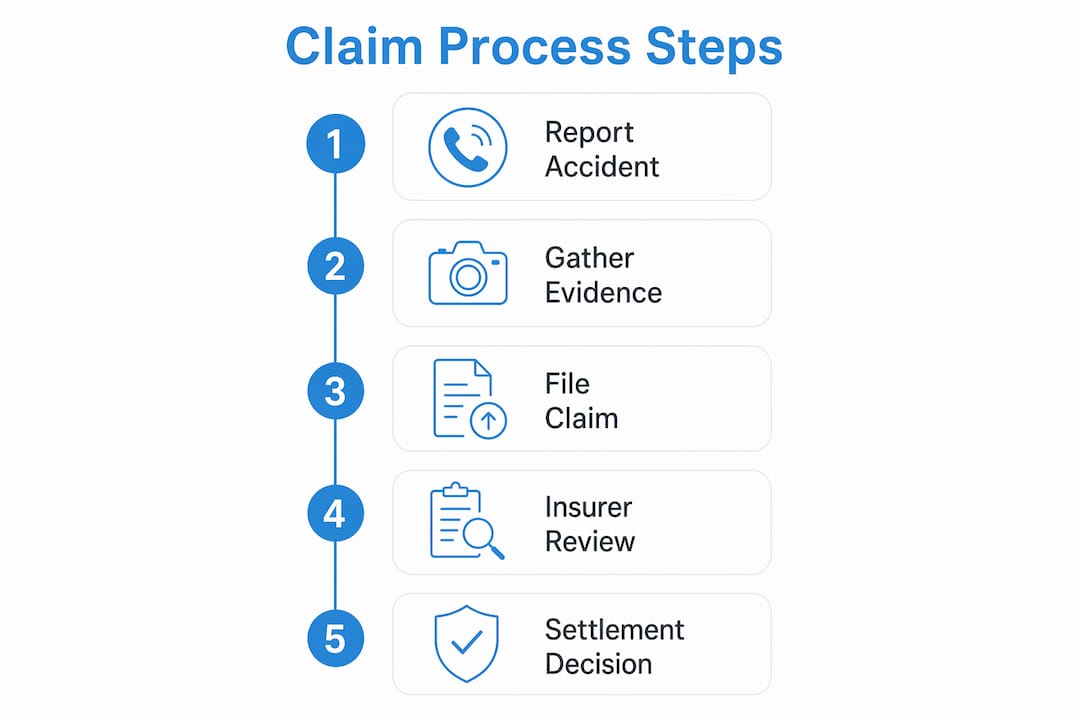
Filing a claim against the at-fault driver follows a defined sequence of steps. Skipping any step, or completing them out of order, creates delays and can reduce your payout.
- Report the accident to police. In New South Wales and most other Australian states, you must report any crash involving injury or significant property damage. A police event number supports your claim from the outset.
- Notify your own insurer promptly. Claimants must notify their insurer within 24 hours even when the other driver is at fault. Late reporting can cause delays or outright denial of cover.
- Obtain the at-fault driver’s details. Record their name, licence number, registration plate, and insurer. Without this information, filing a third-party liability claim becomes significantly harder.
- Lodge a CTP or third-party liability claim. In Australia, CTP insurance covers personal injury claims. Property damage claims go through the at-fault driver’s comprehensive policy or directly against them if they are uninsured.
- Cooperate with the insurer’s investigation. Both insurers will conduct their own liability assessment. Fault investigations typically take between 30 and 90 days when fault is contested. During this period, you may need to cover some costs out of pocket.
- Negotiate a settlement or proceed to litigation. Most claims resolve through negotiation. If the at-fault driver’s insurer disputes liability or offers an inadequate amount, litigation through a court or tribunal becomes the next option.
- Receive compensation. Approved claims cover medical expenses, lost income, vehicle repair or replacement, and pain and suffering where applicable.
Understanding what damages you can claim before you enter negotiations gives you a clear benchmark. Claimants who know their entitlements are far less likely to accept a low first offer.
One practical reality: if the at-fault driver carries insufficient insurance or none at all, recovering the full amount becomes complicated. In New South Wales, the Nominal Defendant scheme covers personal injury claims against uninsured or unidentified drivers, but property damage claims in that situation are harder to resolve.
How can shared fault and negligence rules affect your claim?
Fault is rarely black and white. Australian courts apply comparative negligence principles, which means your compensation reduces in proportion to your share of the blame.
How shared fault works in practice
If a court finds you were 30% responsible for a crash and the other driver was 70% responsible, your compensation reduces by 30%. A $100,000 award becomes $70,000. Comparative negligence rules reduce compensation proportionally based on each party’s contribution to the accident. This is not a technicality. It is a calculation that directly affects the money you receive.
State-by-state variations
Each Australian state and territory has its own legislation governing negligence and personal injury claims. New South Wales operates under the Civil Liability Act 2002, which applies contributory negligence principles. Queensland, Victoria, and South Australia have equivalent frameworks with minor procedural differences. The core principle is consistent: your degree of fault reduces your recovery.
| Fault scenario | Compensation impact |
|---|---|
| 0% claimant fault | Full compensation awarded |
| 30% claimant fault | Compensation reduced by 30% |
| 50% claimant fault | Compensation reduced by 50% |
| Over 50% claimant fault | Claim may be significantly limited or barred |
Insurance adjusters actively look for comparative negligence in every claim, even straightforward ones. A single careless comment at the scene can hand them grounds to reduce your payout.
Pro Tip: Never say “sorry” or “I didn’t see you” at the accident scene. These phrases are routinely used as admissions of fault. Stick to exchanging details and wait for the formal investigation to determine liability.
What are the rights and responsibilities of claimants in at-fault claims?
At-fault claims offer broader rights to recover damages but place a heavier burden on you to prove the other driver’s fault. Knowing your rights and responsibilities protects your claim at every stage.
Key responsibilities you must meet
- Notify your insurer without delay. Report the accident within 24 hours. Even if you are not at fault, your policy requires prompt notification.
- Preserve all evidence. Keep every photograph, medical receipt, repair quote, and written communication related to the accident. Gaps in documentation give insurers room to dispute your losses.
- Attend all medical appointments. Gaps in your treatment record suggest your injuries are not as serious as claimed. Consistent medical attendance supports your compensation for pain and suffering.
- Limit what you say to the other insurer. The at-fault driver’s insurer is not on your side. Provide factual information only and avoid volunteering opinions about how the accident happened.
- Handle medical release forms carefully. Medical release forms often request overly broad access to your health records. Sign only a release limited to the injuries caused by the accident. Broad releases allow insurers to use unrelated medical history to undervalue your claim.
When to seek legal advice
Police reports alone rarely guarantee a smooth claim. Other evidence plays a critical role, and disputes over liability are common. If the other driver contests fault, if your injuries are serious, or if the insurer’s offer seems low, consult a personal injury lawyer before accepting any settlement. Learning how to prove fault in a car accident is a skill that legal professionals apply every day. Getting that expertise on your side early changes the outcome.
You also have the right to claim without a police report in some circumstances. An accident claim without a police report is possible when alternative evidence is strong, though the process requires more careful preparation.
Key takeaways
Filing an at-fault driver claim requires prompt action, thorough evidence collection, and a clear understanding of how negligence rules affect your final compensation.
| Point | Details |
|---|---|
| Notify your insurer within 24 hours | Late reporting can delay or void your claim, even when you are not at fault. |
| Collect your own evidence at the scene | Dashcam footage, photographs, and witness details are more reliable than waiting for a police report. |
| Shared fault reduces your payout | A 30% finding of contributory negligence cuts your compensation by 30% under Australian law. |
| Limit medical release forms | Sign releases covering only accident-related injuries to prevent insurers from using unrelated health history against you. |
| Seek legal advice early | Professional guidance is most valuable before you accept any settlement offer, not after. |
What I have learned from watching claimants get this wrong
After years of working through personal injury cases, the pattern I see most often is not dramatic. It is quiet. A claimant says something casual at the scene, signs a broad medical release without reading it, or waits two weeks to call their insurer. Each of those decisions costs them money.
The biggest misconception I encounter is that the police report settles the matter. It does not. Insurers run their own investigations, and they are looking for any reason to reduce what they pay. A police report that names the other driver as responsible does not stop an adjuster from arguing you were also partly to blame.
What actually protects a claim is evidence gathered in the first hour after the crash. Photographs, witness names and phone numbers, dashcam footage saved before it overwrites. Most people are shaken after an accident and understandably do not think clearly. That is why I always tell people to treat the scene like it is the only chance they will get to build their case. Because it usually is.
The other thing I have seen derail otherwise strong claims is communication with the opposing insurer. People want to be cooperative and reasonable. That instinct is good in most situations. In a fault dispute, it can be costly. Provide facts. Do not speculate. Do not apologise. And if the insurer asks for a recorded statement, speak to a lawyer first.
— Daniel
How Carelawyers can support your at-fault claim
Navigating a fault dispute while recovering from an accident is genuinely difficult. Carelawyers specialises in car accident claims in Sydney and has won over 99% of the cases it has taken on. The team works directly with clients, with no middlemen and no legal jargon, so you always know where your claim stands.

From gathering evidence and managing insurer communications to negotiating settlements and, where needed, pursuing litigation, Carelawyers handles every stage of the process. The firm operates on a no-win, no-fee basis, which means you pay nothing unless your claim succeeds. If your accident involved serious injuries, understanding your claim timeline and entitlements early gives you the best chance of a full recovery. Contact Carelawyers for a confidential consultation.
FAQ
What is an at-fault driver claim?
An at-fault driver claim is a legal process where the driver responsible for a car accident compensates others for their injuries, property damage, and financial losses through their insurance or directly.
How long does an at-fault claim investigation take?
Fault investigations typically take 30–90 days when liability is contested, meaning claimants may need to cover some costs temporarily while the process runs.
Does shared fault affect how much compensation I receive?
Yes. Under Australian comparative negligence law, your compensation reduces by the percentage of fault assigned to you. A 30% finding of contributory negligence reduces a $100,000 award to $70,000.
Can I file a claim without a police report?
Yes, a claim can proceed without a police report when alternative evidence such as photographs, witness statements, and dashcam footage is available, though the process requires stronger documentation.
Should I speak to a lawyer before accepting a settlement?
Consulting a personal injury lawyer before accepting any offer is strongly advisable, particularly when injuries are serious or fault is disputed. Settlements accepted without legal advice are often lower than what claimants are entitled to receive.


