

Accident claim without police report: 2026 guide
Filing an accident claim without a police report is legally possible in Australia, provided you gather sufficient alternative evidence and notify your insurer promptly. The formal term insurers use is a “no-report claim,” and understanding how it works gives you a real advantage. No state or territory law mandates a police report before you can file a claim or pursue compensation. What matters is the quality of your evidence, the speed of your notification, and your willingness to follow the insurer’s process. This guide walks you through every step.
What evidence do you need for an accident claim without a police report?

The absence of a police report shifts the burden of proof entirely onto you. Insurance adjusters require a comprehensive evidence package when no official report exists. That means photos, witness details, medical records, and a written account of events. Each item fills a gap the police report would otherwise cover.
Here is what to collect at the scene and in the days that follow:
- Time-stamped photos and video. Photograph every angle of the damage, tyre marks, road conditions, traffic signs, and any visible injuries. Video is even stronger. Timestamps prove the evidence was captured immediately after the incident, not days later.
- Witness contact details and statements. Ask bystanders for their name, phone number, and a brief written account of what they saw. A signed witness statement carries significant weight when liability is disputed.
- Medical reports and bills. See a doctor on the same day if you have any pain, even minor discomfort. A same-day medical record directly links your injuries to the accident. Delayed treatment gives insurers grounds to argue the injuries were unrelated.
- A dated written account. Write down exactly what happened within hours of the accident. Include the time, location, weather, road conditions, the sequence of events, and what the other driver said. Courts and adjusters treat contemporaneous notes as credible evidence.
- Repair estimates and invoices. Obtain at least two written repair quotes. These establish the financial value of your property damage claim.
- Documenting your injuries thoroughly from the outset, including photos of bruising and swelling, strengthens your position considerably. The Oaks Law Firm’s injury documentation checklist is a practical reference for this step.
Pro Tip: Drivers typically have 24–72 hours after an accident to file their own crash report with the relevant authority. Doing so creates an official record even when police did not attend the scene. In New South Wales, you can report a crash online through Transport for NSW.
How do you file an accident claim without a police report?
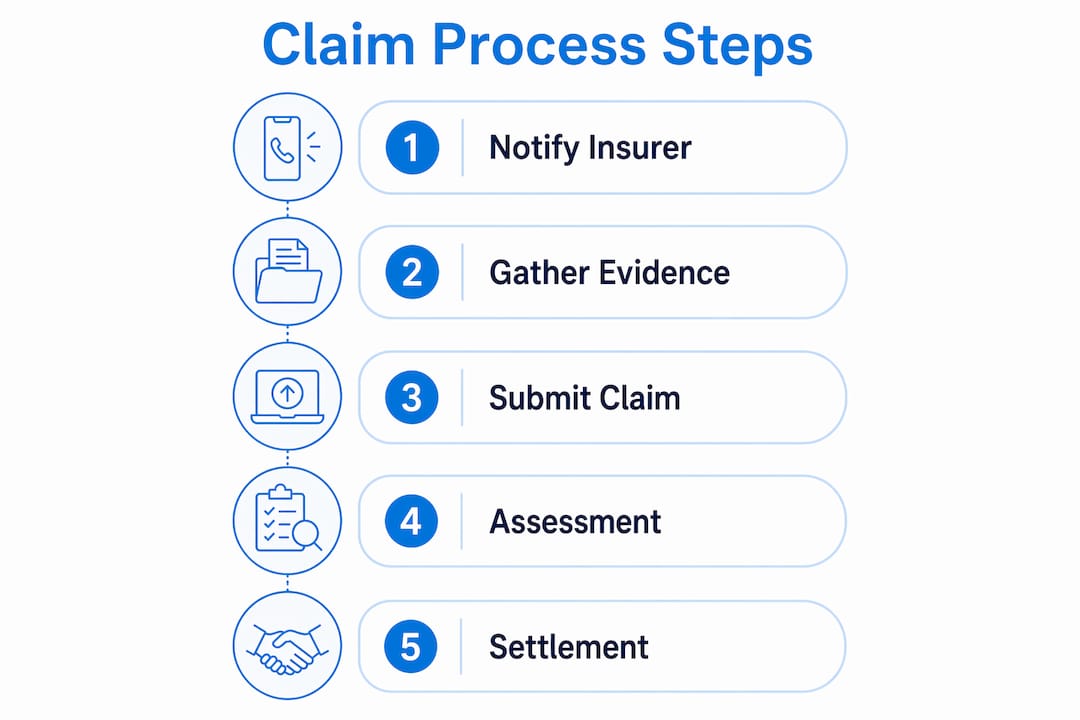
The claim process follows a clear sequence. Deviating from it, especially on timing, gives insurers a reason to reduce or deny your payout.
- Notify your insurer within 24 hours. Policyholders must report incidents promptly, whether or not they intend to file a claim. Reporting and claiming are two separate obligations. Failing to report on time can void your policy entitlements entirely.
- Submit your evidence package. Compile every item from the list above into a single, organised submission. Label each document clearly. Insurers process claims faster when the evidence is easy to review.
- Complete a sworn proof of loss. Many policies require a sworn proof of loss within a specific deadline. This is a formal written statement confirming the details of your claim. Missing this deadline can forfeit your right to compensation.
- Cooperate with the adjuster’s investigation. The adjuster will contact you for a recorded statement. Stick to the facts. Do not speculate about fault or minimise your injuries.
- Review the settlement offer carefully. Do not accept the first figure. Insurers routinely open negotiations 30%–70% below actual claim value. Multiple rounds of negotiation are standard practice, not a sign that your claim is failing.
The table below shows what to expect at each stage:
| Stage | Typical Timeframe | Key Action |
|---|---|---|
| Initial notification | Within 24 hours | Call insurer and log the incident |
| Evidence submission | Within 3–5 days | Submit photos, medical records, written account |
| Adjuster investigation | 2–6 weeks | Cooperate with interviews and inspections |
| Settlement negotiation | 1–3 months | Counter low offers with documented evidence |
| Resolution | 3–6 months (simple claims) | Accept fair offer or escalate to legal support |
Simple claims without a police report typically resolve in 3–6 months. Complex disputed claims average 11.4 months. That gap underscores why strong evidence from day one is worth the effort.
What challenges arise when filing without a police report?
Filing without an official report is legally permissible, but it creates real vulnerabilities. Knowing them in advance lets you prepare rather than react.
- Insurers may delay or dispute your claim. Adjusters use the absence of a police report to question liability and slow the process. This is a documented tactic, not an accident. Counter it by submitting a thorough evidence package upfront so there is nothing easy to challenge.
- The other driver may change their story. Without a police record locking in the other party’s account, they can revise what they told you at the scene. Witness statements and your own dated written account become your primary defence against this.
- Never admit fault at the scene. Even a casual “sorry” can be used against you. Stick to exchanging details and gathering evidence. Fault is determined by insurers and, if necessary, courts.
- Low-ball settlement offers are standard. Knowing insurer negotiation patterns is your best tool for a fair outcome. Respond to low offers in writing, citing your specific evidence and the documented cost of your injuries and repairs.
- Self-representation carries real risk. About 50% of self-represented claimants without police reports receive no settlement at all. That figure reflects how much an insurer’s process favours those who know the rules.
Pro Tip: If the at-fault driver disputes liability, your claim becomes heavily dependent on non-police evidence such as witness testimony and medical records. This is exactly when speaking to a personal injury lawyer before accepting any offer makes a measurable difference to your outcome.
Understanding how adjusters operate is also worth your time. The WreckMatch guide on dealing with insurance adjusters explains the specific pressure tactics used after crashes and how to respond without undermining your claim.
Claims with vs. without police reports: key differences
The presence or absence of a police report changes the claim process in concrete ways. The comparison below shows where the differences matter most.
| Factor | With Police Report | Without Police Report |
|---|---|---|
| Liability determination | Adjuster uses report as primary reference | Adjuster relies entirely on your evidence |
| Claim processing speed | Generally faster | Slower; more investigation required |
| Dispute risk | Lower; official record limits disputes | Higher; other party can revise their account |
| Evidence burden | Shared with police record | Falls entirely on the claimant |
| Mandatory in Australia | Required for crashes above $3,000 damage (NSW) | Permissible for minor incidents below threshold |
| Post-accident report option | Not applicable | Available within 24–72 hours via transport authority |
In New South Wales, you are legally required to report a crash to police when someone is injured, when a vehicle cannot be driven away, or when property damage exceeds the prescribed threshold. For minor incidents below that threshold, a police report is not required. Filing your own crash report with Transport for NSW remains an option and creates a useful official record even when police attendance was not required.
Key takeaways
Filing an accident claim without a police report succeeds when you replace the missing official record with thorough, dated, and well-organised alternative evidence submitted promptly to your insurer.
| Point | Details |
|---|---|
| Police report not mandatory | You can file a claim without one in most minor accident scenarios across Australia. |
| Evidence quality is decisive | Time-stamped photos, witness statements, and same-day medical records carry the most weight. |
| Notify insurer within 24 hours | Prompt reporting preserves your policy rights regardless of whether you file a claim. |
| Expect low initial offers | Insurers routinely open 30%–70% below claim value; always negotiate with documented evidence. |
| Legal support improves outcomes | Self-represented claimants without police reports have a significantly higher rate of receiving no settlement. |
What i have learned from claims without police reports
I have worked with clients across Sydney who assumed their claim was dead the moment they realised police had not attended the scene. That assumption costs people real money. The absence of a police report is a disadvantage, not a disqualification.
What I have found consistently is that the claimants who fare worst are not those without a report. They are those who waited too long to see a doctor, took no photos at the scene, or accepted the first settlement offer because they felt they had no leverage. Each of those decisions is avoidable.
The single most underrated step is writing down exactly what happened within the first few hours. People underestimate how much their memory shifts over days and weeks. A detailed, dated written account written close to the event reads as credible and specific. Vague recollections written weeks later do not.
I also want to be direct about one thing: if the other driver is disputing fault, do not try to resolve it yourself. The insurer’s process is designed to favour the party with better documentation and better knowledge of the rules. A car accident lawyer who knows how insurers operate can often recover significantly more than a self-represented claimant, even after legal fees. The no win, no fee model means there is no financial barrier to getting that advice early.
Patience matters too. A three-to-six month resolution feels long when you are dealing with a damaged vehicle and ongoing medical treatment. But rushing to accept a low offer to end the process is one of the most common and costly mistakes I see.
— Daniel
How Carelawyers can help with your claim
Dealing with an insurer after an accident is stressful enough. Doing it without a police report adds another layer of complexity that most people are not prepared for.

Carelawyers specialises in car accident claims across Sydney and NSW, including cases where no police report was filed. The team helps clients build a strong evidence package, handles insurer negotiations, and pushes back against low-ball offers. With a success rate of over 99% of claims won and a no win, no fee guarantee, you can access expert legal support without upfront cost. If you have been in an accident and are unsure where to stand, speak directly with a personal injury lawyer at Carelawyers for a free initial consultation.
FAQ
Can i file an insurance claim without a police report in australia?
Yes. Filing an insurance claim without a police report is legally permissible for minor accidents in Australia. Your insurer will assess the claim based on the alternative evidence you provide, including photos, witness statements, and medical records.
How long does a claim take without a police report?
Simple claims without a police report typically resolve in 3–6 months. Disputed or complex claims can take significantly longer, averaging 11.4 months, which is why strong evidence from the outset matters.
What happens if the other driver disputes fault and there is no police report?
If fault is disputed, your claim becomes entirely dependent on non-police evidence such as witness testimony, photos, and medical records. This is the scenario where legal representation provides the clearest benefit.
Can i file a crash report after the fact if police did not attend?
Yes. Drivers generally have 24–72 hours to file their own crash report with the relevant transport authority. In NSW, this can be done online through Transport for NSW and creates an official record to support your claim.
Should i accept the first settlement offer from my insurer?
No. Insurers typically open with offers 30%–70% below actual claim value. Always respond in writing with your documented evidence and, if the offer remains unfair, seek legal advice before signing anything.


